Search the SPREP Catalogue

Refine Search Results

Tags / Keywords

Available Online

Tags / Keywords

Available Online

46022 result(s) found.

Sort by

Global warming and the future of Pacific Island Countries
Climate Change Resilience
Available Online

Tisdell Clem

2007
This article briefly outlines the cause of global warming, its trends and consequences as indicated by the International Panel on Climate Change. Sea-level rise is one consequence of particular concern to Pacific island states. It also reviews the views of economists about connections between economic growth and global warming. Whereas the majority of economists did not foresee a conflict between economic growth and global warming, the possibility of such a conflict is now more widely recognized following the Stem Report. International efforts, such as through the Kyoto Protocol, to reduce greenhouse gas emissions and their atmospheric concentration are discussed and prospects for post-Kyoto policies are considered. It is predicted that a significant reduction in global greenhouse gas emissions is unlikely to be achieved in the foreseeable future due to conflicting national interest (a prisoners' dilemma problem) and because is will take time to develop new technologies which will reduce greenhouse gas emissions. However, payment for greenhouse gas emissions (for example, via tradable permits) will accelerate desirable technological advance. Both international political action and efforts to develop and use technologies that lower greenhouse gas emissions need to be pursued. Given current and likely increases in greenhouse gas emissions, continuing global warming in this century appears to be inevitable and consequently Pacific island states will be adversely affected by sea-level rise and climate change. How they will be affected and to what extent is discussed together with their ability to cope with the emerging problem Ways are also examined of addressing the consequences for Pacific island states of global warming.
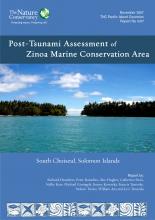
Post-Tsunami assessment of Zinoa marine conservation area, South Choiseul, Solomon Islands
Biodiversity Conservation
Available Online

Hamilton Richard, Ramohia Peter, Hughes Alec, Siota Catherine, etc

2007
The waters surrounding Choiseul contain some of the highest diversities of coral and reef fish in the world, with the 2004 Solomon Island Marine Assessment showing that the Solomon Islands are part of the global centre for marine diversity known as the Coral Triangle. Other countries that make up the Coral Triangle are Indonesia, Philippines, parts of Malaysia, East Timor and Papua New Guinea. Since 2004 The Nature Conservancy (TNC), the Lauru Land Conference of Tribal Community (LLCTC) and Choiseul provincial fisheries have assisted five local communities around Choiseul in their efforts to establish Marine Conservation Areas (MCA) on their traditional reefs. The first MCA to be established was the Zinoa MCA. Zinoa is located on the south-west side of Choiseul in the Solomon Islands. The Zinoa MCA was established by traditional leaders in November 2004, covering 150 hectares and consisting of two islands and associated reefs that occur approximately one kilometre offshore from Voza village on the Choiseul mainland. The reefs around Zinoa Islands are representative of this region of the South coast of Choiseul. In early 2005 sea cucumbers, trochus and giant clams around Zinoa Islands were reported by traditional reef owners to be only a tiny fraction of their former abundance and food fish populations were also reported to be in decline.