Search the SPREP Catalogue

Refine Search Results

Tags / Keywords

Available Online

Tags / Keywords

Available Online

46022 result(s) found.

Sort by

Regional assessment of the Commercial viability for Marine Ornamental aquaculture within the Pacific Islands (Giant clam, hard & soft coral, Finfish, Live rocks & Marine shrimp)
Biodiversity Conservation
Available Online

Ledua, E.

,

Lindsay, S.R.

,

Stanley, J.

2004
The completion of this report would not have been possible without the assistance of a large number of organizations and individuals. We would like to convey our sincere thanks and gratitude to all those who provided information, guidance and advice. Special thanks are extended to the following individuals whose assistance was instrumental in providing information for this report. Mr. Francis Itimai for the Federated States of Micronesia. Mr. Theo Isamu, Mr. Obichang Orak, Mr. Roman Yano, Mr. Larry Goddard, Mr. Francis Matsutaro, Mr. Yimnang Golbuu, Ms. Elisabeth Mathews and Mr. and Mrs. Yano in Palau. Mr. Danny Wase, Ms. Florence Edwards, Mr. Terry Keju, Dr. Manoj Nair and Mr. Rod Bourke in the Marshall Islands. Dr. Dan Sua, Ms. Malwine Lober, Mr. Lui Bell and Mr. Masanami Izumi in Samoa. Ms. Michelle Lam, Mr. Walt and Mrs. Debra Smith, Mr. Tim McLeod, Mr. Hugh Govan in Fiji. Mr. Poasi Fale, Mr. Dickson, Joe Viock and Ms. Mandi Johnson in Tonga. Mr. Moses Amos, Mr. William Naviti, Mr. Larry Sharron and Mr. Quentin Segrest in Vanuatu. In addition, we would like to extend our thanks to a number of individuals; Mr. David Hesaie, Mr. Ian Bertram, Mr. Georges Remoissenet, Dr. Mike Rimmer, Mr. Flinn Curren, Mr. John Gourley, Ms Cathy Hair, Ms. Marine-Ange Hnaujie Mr. Paul Holthus, Mr. Nelson Kile, Mr. Idris Lane, Mr. Ben Ponia and for their help, information and guidance.
Extreme weather: does nature keep up?: observed responses of species and ecosystems to changes in climate and extreme weather events: many more reasons for concern
Climate Change Resilience
Available Online

Leemans, Rik

,

van Vilet Arnold

2004
Plants, birds, insects, mammals, amphibians and fishes are rapidly responding to the observed changes in climate everywhere on the planet. Extreme high temperatures immediately result in hefty responses. The responses, however, significantly differ from species to species and from year to year, which complicates a clear attribution of causes. The ecological impacts are nowadays visible everywhere through changes in the timing of life cycle events and the geographic distributions of species. Plants have advanced flowering by up to 30 days and are now doing so at dates never documented in the last two centuries. Some species show a dramatic increase in range area, disrupting ecosystems like, for example, the rapid spread over millions of hectares of the Mountain Pine Beetle in North America and the northward expansion of the Oak Processionary caterpillar in The Netherlands. Also fires have increased catastrophically in tropical wet forests during the severe droughts of the El Niño years in the nineties. Other species show a dramatic decrease in distribution or population sizes, illustrated by bleaching corals and disappearing amphibians worldwide. Warm winters, hot summers, excessive precipitation and extended droughts are weather events that trigger these responses
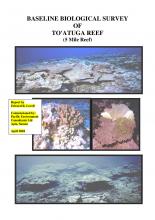
Baseline biological survey of To'atuga reef : Samoa
Available Online

Lovell, Edward R.

2004
To’atuga Reef is located between 6.5-7.4 km (3.5-4.0 nautical miles) north or seaward of Apia Harbour (middle) on the north coast of Upolo Island, Samoa. It is an elongate ridge of reef extending in a NW–SE axis, with a broad reef top which ranges between 15-22m descending on a slope of 300 450 with vertical sections to a sand and rubble bottom at 35-40m. The reef top is characterised by a low topographic relief with the undulating contours of small ridges and depressions. This report provides a baseline description of the major habitat types and dominant fauna present on the reef. A basic inventory and description of the To’atuga marine environment is undertaken. Transects were used to detail the occurrence primarily of fish, coral, algae, mobile invertebrates and physical substrate types. Preliminary species inventories were compiled for hard coral and fish, with records of other benthos. General features of the habitat such as the surge environment, current, depth, bathymetric profile, community type and dynamics are described. Bathymetric assessment was aided by the profiling of the reef by South Pacific Applied Geoscience Commission (SOPAC) which provided a framework for site position and general reef assessment. Impacts of storms, coral bleaching, disease and the human impacts of recreational diving, fishing and anchoring are discussed and management recommendations made.