Search the SPREP Catalogue

Refine Search Results

Tags / Keywords

Available Online

Tags / Keywords

Available Online

46022 result(s) found.

Sort by

Impact of anthropogenic disturbances on a diverse riverine fish assemblage in Fiji predicted by functional traits
Available Online

Brown, Christopher J.

,

Jenkins, Aaron P.

,

Jupiter, Stacy D.

,

Lin, Hsien-Yung

2017
1. Anthropogenic disturbances particularly affect biodiversity in sensitive freshwater ecosystems by causing species loss. Thus, measuring the response of species to multiple disturbances is a key issue for conservation and environmental management. 2. As it is not practical to assess the response of every species in a community, we compared the performance of trait and taxonomic-based groupings of species for their abilities to predict species loss in a threatened freshwater fish assemblage. Specifically, we examined responses of a Fijian freshwater fish assemblage to deforestation, placement of anthropogenic barriers (overhanging culverts) and the presence of introduced cichlids. 3. Species grouped by traits showed more consistent responses to disturbances than taxonomic groups. In particular, species belonging to trait groups that were estuary associated favoured medium-to-hard substrate, while feeding specialists were highly likely to be absent in catchments with high deforestation and overhanging culverts. The presence of introduced cichlids (Oreochromis mossambicus and O. niloticus) had a smaller effect than deforestation and barriers, but was negatively associated with species richness of diadromous species with climbing ability and positively associated with presences of some piscivores. The trait groups also revealed that detritivores, species favouring soft substrate, and those with a broad dietary range were less sensitive to anthropogenic disturbances. 4. Our study indicates that using traits to predict species loss from disturbed environments can aid in detecting the responses of rare species to disturbance. In addition, we provided a method to estimate the consistency of species’ responses to disturbance. This study may ultimately help managers identify the most effective actions for conserving sensitive species that are seldom recorded in surveys.
Habitat change mediates the response of coral fish populations to terrestrial run-off
Available Online

Albert, Simon

,

Brown, Christopher J.

,

Jupiter, Stacy D.

,

Klein, Carissa

,

Lin, Hsien-Yung

,

Maina, Joseph M.

,

Mumby, Peter J.

,

Tullock, Vivitskaia J. D.

,

Wenger, Amelia S.

2017
ABSTRACT: Coastal fish populations are typically threatened by multiple human activities, including fishing pressure and run-off of terrestrial pollution. Linking multiple threats to their impacts on fish populations is challenging because the threats may influence a species directly, or indirectly, via its habitats and its interactions with other species. Here we examine spatial variation in abundance of coral reef fish across gradients of fishing pressure and turbidity in Fiji. We explicitly account for multiple pathways of influence to test the alternative hypotheses that (1) habitat moderates predation by providing shelter, so habitat loss only affects prey fish populations if there are abundant predators, (2) habitat change co-drives biomass of both prey and predator functional groups. We examined responses of 7 fish functional groups and found that habitat change co-drives both predator and prey responses to turbidity. Abundances of all functional groups were associated with changes in habitat cover; however, the responses of their habitats to turbidity were mixed. Planktivore and piscivore abundance were lower in areas of high turbidity, because cover of their preferred habitats was lower. Invertivore, browser and grazer abundance did not change strongly over the turbidity gradient, because different components of their habitats exhibited both increases and decreases with turbidity. The effects of turbidity on fish populations were minor in areas where fish populations were already depleted by fishing. These findings suggest that terrestrial run-off modifies the composition of reef fish communities indirectly by affecting the benthic habitats that reef fish use.
A database for traditional knowledge of weather and climate in the Pacific
Climate Change Resilience
Available Online

Chambers, Lynda E.

,

Dossis, Tom

,

Hiriasia, David H.

,

Malsale, Philip

,

Martin, David J.

,

Mitiepo, Rossy

,

Plotz, Roan D.

,

Tahera, Khadiza

,

Tofaeono, Tile I.

2017
Growinginterestintraditionalknowledge(TK),particularlyinrelationtothepredictionofweatherorclimate extremes, raises issues concerning the appropriate storage and management of the information collected. The Traditional Knowledge Database (TK Database) for the storage and use of TK associated with weather and climate prediction in the Paci c was designed with the following principles in mind: (1) preservation of the knowledge, maintaining cultural context wherever possible; (2) respect for intellectual property and cultural sensitivities around data sharing and use; (3) appropriate system design, accounting for ongoing costs of system maintenance and often intermittent Internet access; and (4) moving beyond data preservation to ensure continued use and growth of the TK. The TK Database was successfully deployed to four countries in the south Paci c and is regularly used by their national meteorological services, and partner organizations, both to preserve TK related to weather and climate and as a tool to assist in monitoring the TK indicators. As the rst database of its kind, the TK Database lls a critical gap in the appropriate storage and application of TK and provides an important foundation for future developments.
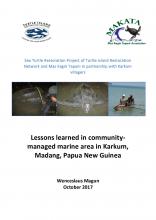
Sea Turtle Restoration Project of Turtle Island Restoration Network and Mas Kagin Tapani in partnership with Karkum villagers - Lessons learned in community-managed marine area in Karkum, Madang, Papua New Guinea
Available Online

Magun, Wenceslaus

2017
This paper was informed by literature review, review of project activities and interviews with key leaders from Karkum, and other local communities the Sea Turtle Restoration Project (STRP) team has worked with in Madang, Papua New Guinea. Local communities and other stakeholders were informed about the critical status of the Pacific leatherback sea turtle (Dermochelys coriacea) which is being pushed to the verge of extinction. The paper further showed the seven resource management planning steps used that enabled Karkums to establish their Community-managed Marine Area using Conservation Deed (CMMA-CD) on 17th November 2008. The Karkum STRP experience points out that some of the root causes of environmental destruction, often begins with lack of community control over resources and the inequitable distribution of money and power. These conflicts are further inflamed by misconceived “cargo cult” demands. To overcome some of these challenges, the paper indicated that Mas Kagin Tapani (MAKATA) needs long-term funding to carry out further turtle awareness, and conduct problem tree analysis workshop(s) to review the Karkum-Mirap conservation Map, and the Karkum CMMA-CD. Funds will also be used to carry out sea turtles tagging and beach monitoring exercises, conduct a training needs analysis study, and meet the recommendations identified in the training needs analysis study. If funded MAKATA will continue to develop and distribute educational awareness materials to local communities and other stakeholders. The paper revealed further that additional funds are needed by MAKATA to build its infrastructure, recruit staff, and meet its management and governance issues.
The Best of Both Worlds: A decision-making framework for combining traditional and contemporary forecast systems
Climate Change Resilience
Available Online

Chambers, Lynda D.

,

Finn, Charlotte K.

,

Plotz, Roan D.

2017
In most countries, national meteorological services either generate or have access to seasonal climate forecasts.However,inanumberofregions,theuptakeoftheseforecastsbylocalcommunitiescanbelimited, with the locals instead relying on traditional knowledgeto make their climate forecasts.Both approachesto seasonal climate forecasting have bene ts, and the incorporation of traditional forecast methods into contemporaryforecastsystemscanleadtoforecaststhatarelocallyrelevantandbettertrustedbytheusers.This in turn could signi cantly improve the communication and application of climate information, especially to remote communities. A number of different methodologies have been proposed for combining these forecasts. Through considering the bene ts and limitations of each approach, practical recommendations are providedonselectingamethod,intheformofadecisionframework,thattakesintoconsiderationbothuser and provider needs. The framework comprises four main decision points: 1) consideration of the level of involvement of traditional-knowledge experts or the community that is required, 2) existing levels of traditional knowledge of climate forecasting and its level of cultural sensitivity, 3) the availability of long-term data—both traditional-knowledge and contemporary-forecast components, and 4) the level of resourcing available.Noonemethodissuitableforeveryoneandeverysituation;however,thedecisionframeworkhelps to select the most appropriate method for a given situation.