Search the SPREP Catalogue

Refine Search Results

Tags / Keywords

Available Online

Tags / Keywords

Available Online

45905 result(s) found.

Sort by

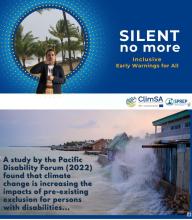
Silent no More Inclusive Sign Language for EWS & DRR
SPREP Publications, Climate Science and Information
Available Online
2024
A study by the Pacific Disability Forum (2022) found that climate change is increasing the impacts of pre-existing exclusion for persons with disabilities and creating new risks and negative impacts for persons with disabilities. The report also highlights that early warning information is not always designed or delivered in a way that reaches individuals with disabilities, and particularly those who are deaf, blind or have vision impairment, or intellectual or psychological disability. The Sendai Framework for Disaster Risk Reduction (2015–2030) mandates stronger inclusion of persons with disability in DRR. Yet pathways to achieving new targets for disability-inclusive disaster risk reduction (DiDRR) and their feasibility remain unclear and are under-researched.Early Warning Systems (EWS) may give people valuable seconds to take protective action. In order for individuals to take protective action, they need to receive the alert, understand the alert message, and have enough contextual knowledge to take appropriate protective action.Supported by the European Union-funded Intra-ACP Climate Services and Related Applications Programme (ClimSA), SPREP in partnership with the Pacific Disability Forum have developed a glossary of commonly used meteorological terms which have been translated into Oceania Sign as a series of videos.At COP29, ClimSA Pacific hosted a well-attended side event to launch Oceania Sign of common meteorological terms that will be used as resources in the Pacific region to enhance the ability of deaf people to prepare and respond better to hazards.1 Silent No More Inclusive Sign Language for EWS & DRR
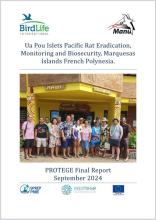
Ua Pou Islets Pacific Rat Eradication - PROTEGE Final Monitoring and Biosecurity Report
SPREP Publications, Biodiversity Conservation, BRB
Available Online

Cranwell, S. (Birdlife International)

,

Withers, T. (SOP Manu)

2024
The Ua Pou islets Pacific rat eradication operation was undertaken in August-September 2023. It attempted a global first of aerially broadcasting rodent bait by drone from a small ship in open sea across the islets of Motu Tākaè, Motu Oa, and Motu Mokohe, at Ua Pou in the Marquesas Islands. The aerial bait application resulted in only two of the three islands having bait successfully applied across their entirety, nonetheless, monitoring 12 months later has confirmed Motu Oa and Motu Tākaè are rat free as is the partially isolated section of Motu Mokohe that was also baited. The eradication success is supported by the establishment of biosecurity knowledge and practices throughout the Ua Pou communities. The results of the seabird and other environmental monitoring will help sustain a commitment over time, as well as benefiting the wider conservation community. The operation demonstrated that drones could be operated off a boat for rodent eradication purposes but was constrained by the consistently strong winds and swell conditions. A larger vessel with a deeper draught is recommended for similar operations in the future and would likely increase the number of flyable days and improve the ease with which take-offs and landings are undertaken by the drone pilots.