Search the SPREP Catalogue

Refine Search Results

Publication Year

Available Online

Publication Year

Available Online

8 result(s) found.

Sort by

You searched for

Dispositif de suivi de l'abondance et de l'impact du cerf - Fiche finale de capitalisation - PROTEGE
SPREP Publications, Biodiversity Conservation, BRB
Available Online

PROE / SPREP

2025
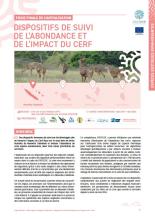
Des dispositifs innovants de suivi ont été développés afin de mesurer l’impact du Cerf Rusa sur le sous-bois de forêts humides de Nouvelle Calédonie et évaluer l’abondance de cette espèce envahissante, dans trois zones prioritaires du territoire. L’élaboration de ces dispositifs poursuit des objectifs complémentaires aux actions de régulation professionnelle mises en œuvre dans le cadre de PROTEGE. Le suivi vise notamment à réaliser un état initial et à évaluer les bénéfices des opérations de régulation, grâce à des outils adaptés à des zones d’intervention difficiles d’accès et caractérisées par une biodiversité exceptionnelle, plus de 80% des espèces végétales des forêts humides d’altitude étant endémiques à la Nouvelle-Calédonie. Un travail initial de sectorisation a permis mieux de caractériser les enjeux, les pressions sur l’environnement ainsi que le contexte socio-économique afin de délimiter les zones d’intervention prioritaires. Pour la première fois en Nouvelle-Calédonie, un protocole standardisé de mesure de l’impact des cerfs a été élaboré. Il s’appuie sur plusieurs indicateurs et prend en compte les spécificités des espèces végétales concernées et des contraintes associées à sa mise en œuvre. En complément, PROTEGE a permis d’élaborer une méthodeinnovante d’évaluation de l’abondance des cerfs, reposant sur l’utilisation d’un drone équipé de capteur thermique pour l’enregistrement de vidéos nocturnes. Un algorithme développé spécifiquement a par ailleurs vocation à réaliser automatiquement les détections à partir de ces vidéos, facilitant considérablement le traitement des données. La mise en œuvre de ce protocole pour la prospection de 4 700 hectares a révélé des densités de populations et des concentrations de hardes localement très élevées, atteignant par endroits des niveaux parmi les plus élevés enregistrés à l’échelle mondiale. Ces résultats fournissent des informations précieuses pour le ciblage de futures interventions et le suivi de leurs bénéfices. FICHE FINALE DE CAPITALISATION DU PROJET PROTEGE, financé par l'Union Européenne.
Maximising conservation impact by prioritising islands for biosecurity
Available Online

Bambini, L.

,

Dawson, J.

,

Havery, S.

,

John, L.

,

Oppel, S.

,

Radford, E.

,

Varnham, K.

2019
Invasive alien species are one of the primary threats to native biodiversity on islands worldwide, and their expansion continues due to global trade and travel. Preventing the arrival and establishment of highly successful invasive species through rigorous biosecurity is known to be more economic than the removal of these species once they have established. However, many islands around the world lack biosecurity regulations or practical measures and establishing biosecurity will require social and financial investments. Guiding these investments towards islands where native biodiversity is at highest risk from potential invasions is of strategic importance to maximise conservation benefit with limited resources. Here we implement an established prioritisation approach, previously used to identify which islands will have the greatest conservation gains from the eradication of invasive species, to identify which islands would benefit the most from establishing or improving biosecurity. We demonstrate this approach for 318 islands in the Caribbean UK Overseas Territories and Bermuda where we considered all threatened native terrestrial vertebrates that are vulnerable to the most harmful invasive vertebrates (black and brown rats, cats, small Indian mongoose, green iguana). The approach calculates the increase in conservation threat score resulting from anticipated negative effects of potential invaders on native biodiversity, and highlighted Sombrero (Anguilla) and Cayman Brac (Cayman Islands) as important islands where threatened reptile species would likely be eliminated if rats, feral cats or mongoose invaded. Feasibility and cost implications should now be investigated more closely on the highlighted islands. The prioritisation presented here can be expanded to more islands and more invasive/native taxa (herbivores, plants and invertebrates), but requires a classification of the severity of potential impacts between invasive and native species for which currently little information exists. Besides highlighting opportunities for biosecurity, this approach also highlights where knowledge gaps about population sizes of and threats to reptiles with restricted ranges exist.
Scaling down (cliffs) to meet the challenge: the Shiants’ black rat eradication
Biodiversity Conservation, BRB
Available Online

Bambini, L.

,

Bell, E.

,

Campbell, G.

,

Churchyard, T.

,

Douse, A.

,

Floyd, K.

,

Ibbotson, J.

,

Main, C.E.

,

Nicolson, T.

,

Reid, R.

,

Taylor, P.R.

,

Tayton, J.

,

Varnham, K.

,

Whittington, W.

2019
A successful ground-based eradication of black rats (Rattus rattus) was undertaken on the remote, uninhabited Shiant Isles of north-west Scotland over winter (14 October–28 March) 2015–16. The rat eradication was carried out as part of the Shiants Seabird Recovery Project, which aims to secure long-term breeding habitat for protected seabirds and to attract European storm petrels and Manx shearwaters to nest on the Shiants. Throughout the eradication operation, teams were stationed on two of the three main Shiant islands (Eilean an Tighe, Eilean Mhuire), with access to the third (Garbh Eilean) via a boulder causeway from Eilean an Tighe. Bait (Contrac® blocks containing the anticoagulant bromadiolone 0.005% w/w), was deployed in a grid of 1,183 bait stations covering all areas of the islands and sea stacks. Bait stations were set 50 m apart, with intervals reduced to 25 m in coastal areas of predicted high rat density. Difficult areas were accessed by boat and cliff s of ~120 m in height were accessed by abseiling down ropes made safe using either bolted anchors or ground stakes. The team of staff and volunteers worked through difficult conditions, deploying bait and monitoring intensively for any surviving rats using a combination of tools. The islands were declared rat free in March 2018. This ambitious and challenging project has greatly enhanced UK capacity in rodent eradications for the purposes of conservation.
Long term rodent control in Rdum tal-Madonna yelkouan shearwater colony
Biodiversity Conservation, BRB
Available Online

Cabello, J.S. Santiago

,

Lago, P.

,

Varnham, K.

2019
Rodent predation on eggs and chicks is one of the main threats to procellariiform species in the Mediterranean, where the black rat (Rattus rattus) and brown rat (R. norvegicus) have been present on many islands for centuries. The yelkouan shearwater (Puffinus yelkouan) is an endemic Mediterranean seabird species classified as vulnerable. Malta holds up to 10% of the global population; the largest colony, Rdum tal-Madonna (RM), protected as a Natura 2000 site, hosts around 500 breeding pairs. This colony has been monitored since its discovery in 1969. A very low reproductive success due to rat predation was noticed in the late 1990s to early 2000s. In 2007 a seasonal rodent control programme was established during the breeding season of yelkouan shearwater to reduce rat predation on eggs and chicks. Rodent control took place between 2007 and 2010 and was reviewed and continued from 2012 to 2017. Breeding success since 2007 has been higher than 80%. In two other colonies with rat presence and where rodent control did not take place, the breeding success in 2016 and 2017 was substantially lower than in the colony with the rodent control programme. The European storm-petrel (Hydrobates pelagicus melitensis) only breeds in rat-free areas like remote sea caves or islets around the Maltese islands. In 2014, the first breeding attempt by European storm-petrel was recorded on the Maltese mainland at RM with a chick fledging successfully for the first time in 2016. The ongoing LIFE Arcipelagu Garnija project is assessing rat predation in all Maltese yelkouan shearwater colonies in order to establish predator control in the most important yelkouan shearwater breeding sites in 2018.
The eradication of black rats (Rattus rattus) from Dog Island, Anguilla, using ground-based techniques
Biodiversity Conservation, BRB
Available Online

Bell, E.

,

Connor, R.

,

Daltry, J.

,

Mukhida, F.

,

Varnham, K.

2019
Rat eradication techniques developed in New Zealand are a proven method for removing invasive rodents from islands worldwide. This technology moved rapidly from ground-based bait station operations to aerial application of rodenticides. Rat eradications on tropical islands using similar methods, have not always been as successful as those in temperate regions. As most previous eradications in the Caribbean have been on islands smaller than 50 ha, the eradication of black rats (Rattus rattus) from 207 ha Dog Island was a significant increase in size. Reptile and seabird populations on Dog Island had been in decline for a number of years and black rats were identified as the most likely factor. Following the feasibility study in 2007, the Dog Island Recovery Project was launched in 2011. This was a multiple-year project incorporating a ground-based eradication with establishment of biosecurity procedures to prevent reinvasion, alongside long-term monitoring of native species. Bait stations with cereal-based wax blocks containing brodifacoum at 0.005% w/w were established on a 30–50 m grid over the island. Interference with bait stations by non-target invertebrates, particularly crabs, was high and bait stations required moving or elevating to avoid this. However, there was no evidence of any non-target animals being killed or injured by the bait. Eradication success was confirmed in 2014.