Search the SPREP Catalogue

Refine Search Results

Tags / Keywords

Available Online

Tags / Keywords

Available Online

6 result(s) found.

Sort by

You searched for

Dispositif de suivi de l'abondance et de l'impact du cerf - Fiche finale de capitalisation - PROTEGE
SPREP Publications, Biodiversity Conservation, BRB
Available Online

PROE / SPREP

2025
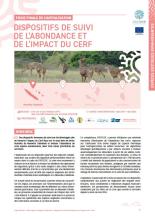
Des dispositifs innovants de suivi ont été développés afin de mesurer l’impact du Cerf Rusa sur le sous-bois de forêts humides de Nouvelle Calédonie et évaluer l’abondance de cette espèce envahissante, dans trois zones prioritaires du territoire. L’élaboration de ces dispositifs poursuit des objectifs complémentaires aux actions de régulation professionnelle mises en œuvre dans le cadre de PROTEGE. Le suivi vise notamment à réaliser un état initial et à évaluer les bénéfices des opérations de régulation, grâce à des outils adaptés à des zones d’intervention difficiles d’accès et caractérisées par une biodiversité exceptionnelle, plus de 80% des espèces végétales des forêts humides d’altitude étant endémiques à la Nouvelle-Calédonie. Un travail initial de sectorisation a permis mieux de caractériser les enjeux, les pressions sur l’environnement ainsi que le contexte socio-économique afin de délimiter les zones d’intervention prioritaires. Pour la première fois en Nouvelle-Calédonie, un protocole standardisé de mesure de l’impact des cerfs a été élaboré. Il s’appuie sur plusieurs indicateurs et prend en compte les spécificités des espèces végétales concernées et des contraintes associées à sa mise en œuvre. En complément, PROTEGE a permis d’élaborer une méthodeinnovante d’évaluation de l’abondance des cerfs, reposant sur l’utilisation d’un drone équipé de capteur thermique pour l’enregistrement de vidéos nocturnes. Un algorithme développé spécifiquement a par ailleurs vocation à réaliser automatiquement les détections à partir de ces vidéos, facilitant considérablement le traitement des données. La mise en œuvre de ce protocole pour la prospection de 4 700 hectares a révélé des densités de populations et des concentrations de hardes localement très élevées, atteignant par endroits des niveaux parmi les plus élevés enregistrés à l’échelle mondiale. Ces résultats fournissent des informations précieuses pour le ciblage de futures interventions et le suivi de leurs bénéfices. FICHE FINALE DE CAPITALISATION DU PROJET PROTEGE, financé par l'Union Européenne.
Invasive alien species on islands: impacts, distribution, interactions and management

BRB
Available Online

Holmes, Nick D

,

Meyer, Jean-Yves

,

Pagad, Shyama

,

Russell, James C.

2017
Invasive alien species (IASs) on islands have broad impacts across biodiversity, agriculture, economy, health and culture, which tend to be stronger than on continents. Across small-island developing states (SIDSs), although only a small number of IASs are widely distributed, many more, including those with greatest impact, are found on only a small number of islands. Patterns of island invasion are not consistent across SIDS geographic regions, with differences attributable to correlated patterns in island biogeography and human development. We identify 15 of the most globally prevalent IASs on islands. IAS impacts on islands are exacerbated through interactions with a number of other global change threats, including over-exploitation, agricultural intensification, urban development and climate change. Biosecurity is critical in preventing IAS invasion of islands. Eradication of IASs on islands is possible at early stages of invasion, but otherwise is largely restricted to invasive mammals, or otherwise control is the only option. Future directions in IAS management and research on islands must consider IASs within a broader portfolio of threats to species, ecosystems and people’s livelihoods on islands. We advocate for stronger collaborations among island countries and territories faced with the same IASs in similar socio-ecological environments.
Les EEE de Nouvelle-Calédonie dans les bases de données mondiales GRIIS et GISD
BRB
Available Online

Barrièrek, Patrick

,

Pagad, Shyama

,

Wong, Lian Jenna

The Global Register of Introduced and Invasive Species (GRIIS) presents validated and verified checklists (inventories) of introduced (alien) and invasive alien species at the country, territory, and associated island level. Phase 1 of the project focused on developing validated and verified checklists of countries that are Party to the Convention on Biological Diversity (CBD). Phase 2 which is on-going, aims to achieve global coverage including non-party countries and all overseas territories of countries e.g. Netherlands, France and United Kingdom. Species belonging to all Kingdoms are covered as well as occurring in all Environment/systems. Country/ Territory/ Island checklists are reviewed and verified by networks of country or species experts. Verified checklists/ species records as well as those under review are presented on the online GRIIS website (www.griis.org). Individual species records are flagged with a ‘yes’ for verification. Only verified checklists/ species records are presented on the GBIF Portal. This annotated checklist is of introduced (alien) and invasive alien species known to occur in New Caledonia, an Overseas Territory of France. Purpose: The resource will be a support to countries to make progress to achieve Aichi Biodiversity Target 9 -in the development of their National Biodiversity Strategy and Action Plans, their National Invasive Alien Species Strategy and Action Plan, target setting and monitoring.