Search the SPREP Catalogue

Refine Search Results

Available Online

Available Online

6 result(s) found.

Sort by

You searched for

Dispositif de suivi de l'abondance et de l'impact du cerf - Fiche finale de capitalisation - PROTEGE
SPREP Publications, Biodiversity Conservation, BRB
Available Online

PROE / SPREP

2025
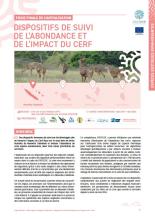
Des dispositifs innovants de suivi ont été développés afin de mesurer l’impact du Cerf Rusa sur le sous-bois de forêts humides de Nouvelle Calédonie et évaluer l’abondance de cette espèce envahissante, dans trois zones prioritaires du territoire. L’élaboration de ces dispositifs poursuit des objectifs complémentaires aux actions de régulation professionnelle mises en œuvre dans le cadre de PROTEGE. Le suivi vise notamment à réaliser un état initial et à évaluer les bénéfices des opérations de régulation, grâce à des outils adaptés à des zones d’intervention difficiles d’accès et caractérisées par une biodiversité exceptionnelle, plus de 80% des espèces végétales des forêts humides d’altitude étant endémiques à la Nouvelle-Calédonie. Un travail initial de sectorisation a permis mieux de caractériser les enjeux, les pressions sur l’environnement ainsi que le contexte socio-économique afin de délimiter les zones d’intervention prioritaires. Pour la première fois en Nouvelle-Calédonie, un protocole standardisé de mesure de l’impact des cerfs a été élaboré. Il s’appuie sur plusieurs indicateurs et prend en compte les spécificités des espèces végétales concernées et des contraintes associées à sa mise en œuvre. En complément, PROTEGE a permis d’élaborer une méthodeinnovante d’évaluation de l’abondance des cerfs, reposant sur l’utilisation d’un drone équipé de capteur thermique pour l’enregistrement de vidéos nocturnes. Un algorithme développé spécifiquement a par ailleurs vocation à réaliser automatiquement les détections à partir de ces vidéos, facilitant considérablement le traitement des données. La mise en œuvre de ce protocole pour la prospection de 4 700 hectares a révélé des densités de populations et des concentrations de hardes localement très élevées, atteignant par endroits des niveaux parmi les plus élevés enregistrés à l’échelle mondiale. Ces résultats fournissent des informations précieuses pour le ciblage de futures interventions et le suivi de leurs bénéfices. FICHE FINALE DE CAPITALISATION DU PROJET PROTEGE, financé par l'Union Européenne.
Strategies and on the ground options for climate change adaptation and disaster risk management in the Pacific
Climate Change Resilience
Available Online

Faletau, Taniela

,

Leavai, Peniamina

,

McFadzien, Diane

,

Ronneberg, Espen

2012
Small Island developing states (SIDS) have ongoing projects and projects in the pipeline which are targeted at implementing adaptation measures. In the Pacific alone there have been a range of such initiatives starting with the PICCAP project in the late 90s to the ongoing PACC project, the latter building on the lessons learnt from its predecessors to help increase resilience to the impacts of climate change. On a global, regional and national level these projects have stringently involved strengthening of institutions, policy and regulations, but more importantly evolved to implement on the ground-level tasks, many of which follow on from, or are acting in synergy with other projects for the mainstreaming of climate change adaptation (CCA) and disaster risk reduction (DRR) initiatives in communities. A key challenge in this context for decision makers, policy makers, and development partners is to understand and adopt strategies that are effective in mobilizing people and resources in response to CCA and DRR. All efforts in this context must be made to learn from past lessons and concerted action taken to refine, augment and deploy these initiatives appropriately and urgently.
Pacific Island States capacity development needs for climate change adaptation and disaster risk reduction
Climate Change Resilience, Biodiversity Conservation
Available Online

Faletau, Taniela

,

Leavai, Peniamina

,

McFadzien, Diane

,

Ronneberg, Espen

2012
This paper provides a brief examination of capacity development needs for climate change adaptation (CCA) and disaster risk reduction (DRR) in small island developing states (SIDS). It is noted that this is a critical time for SIDS which must contend with ongoing developmental pressures in addition to growing pressures from risks associated with global environmental change and economic liberalisation that threaten their physical and economic security. Much depends in this context on the orientation of SIDS in global economic and political systems. Getting the policies right is proving to be very difficult as SIDS continue to be deficient in a critical mass of intellectual capital, policy coherence, financial resources and qualified personnel that are needed to develop and implement sustainable development policies and projects. In turn, this critically hampers the emergence of adequate systemic capacity. SIDS however have a history of changes at the global and regional levels which not only created constraints but can be seen as a source of new opportunities for building resilience to natural disasters. How effective this process transpires in the end will depend on how well lessons learnt from preceding years are taken on board and effectively acted upon.