Search the SPREP Catalogue

Refine Search Results

Publication Year

Available Online

Publication Year

Available Online

4 result(s) found.

Sort by

You searched for

Dispositif de suivi de l'abondance et de l'impact du cerf - Fiche finale de capitalisation - PROTEGE
SPREP Publications, Biodiversity Conservation, BRB
Available Online

PROE / SPREP

2025
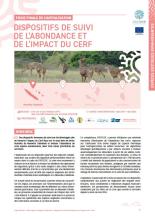
Des dispositifs innovants de suivi ont été développés afin de mesurer l’impact du Cerf Rusa sur le sous-bois de forêts humides de Nouvelle Calédonie et évaluer l’abondance de cette espèce envahissante, dans trois zones prioritaires du territoire. L’élaboration de ces dispositifs poursuit des objectifs complémentaires aux actions de régulation professionnelle mises en œuvre dans le cadre de PROTEGE. Le suivi vise notamment à réaliser un état initial et à évaluer les bénéfices des opérations de régulation, grâce à des outils adaptés à des zones d’intervention difficiles d’accès et caractérisées par une biodiversité exceptionnelle, plus de 80% des espèces végétales des forêts humides d’altitude étant endémiques à la Nouvelle-Calédonie. Un travail initial de sectorisation a permis mieux de caractériser les enjeux, les pressions sur l’environnement ainsi que le contexte socio-économique afin de délimiter les zones d’intervention prioritaires. Pour la première fois en Nouvelle-Calédonie, un protocole standardisé de mesure de l’impact des cerfs a été élaboré. Il s’appuie sur plusieurs indicateurs et prend en compte les spécificités des espèces végétales concernées et des contraintes associées à sa mise en œuvre. En complément, PROTEGE a permis d’élaborer une méthodeinnovante d’évaluation de l’abondance des cerfs, reposant sur l’utilisation d’un drone équipé de capteur thermique pour l’enregistrement de vidéos nocturnes. Un algorithme développé spécifiquement a par ailleurs vocation à réaliser automatiquement les détections à partir de ces vidéos, facilitant considérablement le traitement des données. La mise en œuvre de ce protocole pour la prospection de 4 700 hectares a révélé des densités de populations et des concentrations de hardes localement très élevées, atteignant par endroits des niveaux parmi les plus élevés enregistrés à l’échelle mondiale. Ces résultats fournissent des informations précieuses pour le ciblage de futures interventions et le suivi de leurs bénéfices. FICHE FINALE DE CAPITALISATION DU PROJET PROTEGE, financé par l'Union Européenne.
Archipelago-wide island restoration in the Galapagos Islands: Reducing costs of invaisve mammal eradication programs and reinvasion risk

BRB
Available Online

Campbell, Karl J.

,

Carrion, Victor

,

Cruz, Felipe

,

Donian, C. Josh

,

Lavoie, Christian

2011
Invasive alien mammals are the major driver of biodiversity loss and ecosystem degradation on islands. Over the past three decades, invasive mammal eradication from islands has become one of society's most powerful tools for preventing extinction of insular endemics and restoring insular ecosystems. As practitioners tackle larger islands for restoration, three factors will heavily influence success and outcomes: the degree of local support, the ability to mitigate for non-target impacts, and the ability to eradicate non-native species more cost-effectively. Investments in removing invasive species, however, must be weighed against the risk of reintroduction. One way to reduce reintroduction risks is to eradicate the target invasive species from an entire archipelago, and thus eliminate readily available sources. We illustrate the costs and benefits of this approach with the efforts to remove invasive goats from the Galápagos Islands. Project Isabela, the world's largest island restoration effort to date, removed > 140,000 goats from > 500,000 ha for a cost of US$10.5 million. Leveraging the capacity built during Project Isabela, and given that goat reintroductions have been common over the past decade, we implemented an archipelago-wide goat eradication strategy. Feral goats remain on three islands in the archipelago, and removal efforts are underway. Efforts on the Galápagos Islands demonstrate that for some species, island size is no longer the limiting factor with respect to eradication. Rather, bureaucratic processes, financing, political will, and stakeholder approval appear to be the new challenges. Eradication efforts have delivered a suite of biodiversity benefits that are in the process of revealing themselves. The costs of rectifying intentional reintroductions are high in terms of financial and human resources. Reducing the archipelago-wide goat density to low levels is a technical approach to reducing reintroduction risk in the short-term, and is being complemented with a longer-term social approach focused on education and governance.