Search the SPREP Catalogue

Refine Search Results

Publication Year

Available Online

Publication Year

Available Online

4 result(s) found.

Sort by

You searched for

Dispositif de suivi de l'abondance et de l'impact du cerf - Fiche finale de capitalisation - PROTEGE
SPREP Publications, Biodiversity Conservation, BRB
Available Online

PROE / SPREP

2025
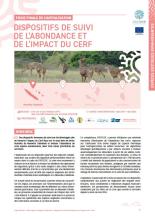
Des dispositifs innovants de suivi ont été développés afin de mesurer l’impact du Cerf Rusa sur le sous-bois de forêts humides de Nouvelle Calédonie et évaluer l’abondance de cette espèce envahissante, dans trois zones prioritaires du territoire. L’élaboration de ces dispositifs poursuit des objectifs complémentaires aux actions de régulation professionnelle mises en œuvre dans le cadre de PROTEGE. Le suivi vise notamment à réaliser un état initial et à évaluer les bénéfices des opérations de régulation, grâce à des outils adaptés à des zones d’intervention difficiles d’accès et caractérisées par une biodiversité exceptionnelle, plus de 80% des espèces végétales des forêts humides d’altitude étant endémiques à la Nouvelle-Calédonie. Un travail initial de sectorisation a permis mieux de caractériser les enjeux, les pressions sur l’environnement ainsi que le contexte socio-économique afin de délimiter les zones d’intervention prioritaires. Pour la première fois en Nouvelle-Calédonie, un protocole standardisé de mesure de l’impact des cerfs a été élaboré. Il s’appuie sur plusieurs indicateurs et prend en compte les spécificités des espèces végétales concernées et des contraintes associées à sa mise en œuvre. En complément, PROTEGE a permis d’élaborer une méthodeinnovante d’évaluation de l’abondance des cerfs, reposant sur l’utilisation d’un drone équipé de capteur thermique pour l’enregistrement de vidéos nocturnes. Un algorithme développé spécifiquement a par ailleurs vocation à réaliser automatiquement les détections à partir de ces vidéos, facilitant considérablement le traitement des données. La mise en œuvre de ce protocole pour la prospection de 4 700 hectares a révélé des densités de populations et des concentrations de hardes localement très élevées, atteignant par endroits des niveaux parmi les plus élevés enregistrés à l’échelle mondiale. Ces résultats fournissent des informations précieuses pour le ciblage de futures interventions et le suivi de leurs bénéfices. FICHE FINALE DE CAPITALISATION DU PROJET PROTEGE, financé par l'Union Européenne.
Valuing the impact of selected invasive species in the Polynesia-Micronesia hotspot, final report

BRB
Available Online

Aalbersberg, Bill

,

Boudjelas, Souad

,

Brown, Pike

,

Daigneault, Adam

,

Greenhalgh, Suzie

,

Mather, John

,

Nagle, William

2013
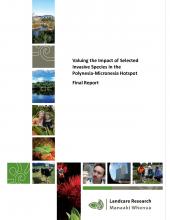
Invasive species pose an enormous threat in the Pacific: not only do they strongly affect biodiversity, but they also potentially affect the economic, social, and cultural wellbeing of Pacific peoples. Invasive species can potentially be managed and that their impacts can potentially be avoided, eliminated, or reduced. However, neither the costs nor the numerous benefits of management are well understood in the Pacific. Thus, the goals of this project were: A) to account for both the costs and benefits of managing invasive species; B) to prepare empirically grounded advocacy materials to help increase investment in the management of invasive species; C) to help governments prioritise investment in managing these species; and D) to build capability for undertaking economic assessments in the future. To accomplish these goals, we undertook cost-benefit analyses (CBAs) of managing five species that are well established on Viti Levu, Fiji: spathodea campanulata (African tulip tree), herpestus javanicus (small Asian mongoose), papuana uninodis (taro beetle), pycnonotus cafer (red-vented bulbul), and merremia peltata (merremia vine). Next, we conducted a comprehensive training programme on the CBA for invasive species management for professionals from the Pacific. Third, we collaborated with Pacific organisations to develop a uniform guide to conducting CBAs with numerous examples from the region. We also designed a flexible Microsoft Excel-based tool for conducting CBAs, enabling professionals who did not attend the training course to nevertheless undertake rigorous CBAs on invasive spsecies management. Finally, we developed advocacy material and publicised findings from this project to promote investment in invasive species management. This report details these activities in turn. It also includes numerous appendices that include the tools, guidance documents, and advocacy materials developed under this project.