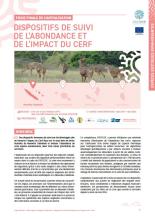
Dispositif de suivi de l'abondance et de l'impact du cerf - Fiche finale de capitalisation - PROTEGE
Des dispositifs innovants de suivi ont été développés afin de mesurer l’impact du Cerf Rusa sur le sous-bois de forêts humides de Nouvelle Calédonie et évaluer l’abondance de cette espèce envahissante, dans trois zones prioritaires du territoire. L’élaboration de ces dispositifs poursuit des objectifs complémentaires aux actions de régulation professionnelle mises en œuvre dans le cadre de PROTEGE. Le suivi vise notamment à réaliser un état initial et à évaluer les bénéfices des opérations de régulation, grâce à des outils adaptés à des zones d’intervention difficiles d’accès et caractérisées par une biodiversité exceptionnelle, plus de 80% des espèces végétales des forêts humides d’altitude étant endémiques à la Nouvelle-Calédonie. Un travail initial de sectorisation a permis mieux de caractériser les enjeux, les pressions sur l’environnement ainsi que le contexte socio-économique afin de délimiter les zones d’intervention prioritaires. Pour la première fois en Nouvelle-Calédonie, un protocole standardisé de mesure de l’impact des cerfs a été élaboré. Il s’appuie sur plusieurs indicateurs et prend en compte les spécificités des espèces végétales concernées et des contraintes associées à sa mise en œuvre. En complément, PROTEGE a permis d’élaborer une méthodeinnovante d’évaluation de l’abondance des cerfs, reposant sur l’utilisation d’un drone équipé de capteur thermique pour l’enregistrement de vidéos nocturnes. Un algorithme développé spécifiquement a par ailleurs vocation à réaliser automatiquement les détections à partir de ces vidéos, facilitant considérablement le traitement des données. La mise en œuvre de ce protocole pour la prospection de 4 700 hectares a révélé des densités de populations et des concentrations de hardes localement très élevées, atteignant par endroits des niveaux parmi les plus élevés enregistrés à l’échelle mondiale. Ces résultats fournissent des informations précieuses pour le ciblage de futures interventions et le suivi de leurs bénéfices. FICHE FINALE DE CAPITALISATION DU PROJET PROTEGE, financé par l'Union Européenne.