Search the SPREP Catalogue

Refine Search Results

Language

Available Online

Available Online

87 result(s) found.

Sort by

You searched for

  • Author Asian Development Bank
    X
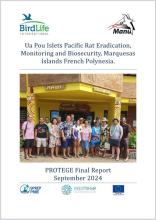
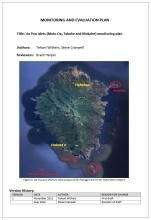
Ua Pou Islets Pacific Rat Eradication - PROTEGE Final Monitoring and Biosecurity Report
SPREP Publications, Biodiversity Conservation, BRB
Available Online

Cranwell, S. (Birdlife International)

,

Withers, T. (SOP Manu)

2024
The Ua Pou islets Pacific rat eradication operation was undertaken in August-September 2023. It attempted a global first of aerially broadcasting rodent bait by drone from a small ship in open sea across the islets of Motu Tākaè, Motu Oa, and Motu Mokohe, at Ua Pou in the Marquesas Islands. The aerial bait application resulted in only two of the three islands having bait successfully applied across their entirety, nonetheless, monitoring 12 months later has confirmed Motu Oa and Motu Tākaè are rat free as is the partially isolated section of Motu Mokohe that was also baited. The eradication success is supported by the establishment of biosecurity knowledge and practices throughout the Ua Pou communities. The results of the seabird and other environmental monitoring will help sustain a commitment over time, as well as benefiting the wider conservation community. The operation demonstrated that drones could be operated off a boat for rodent eradication purposes but was constrained by the consistently strong winds and swell conditions. A larger vessel with a deeper draught is recommended for similar operations in the future and would likely increase the number of flyable days and improve the ease with which take-offs and landings are undertaken by the drone pilots.
A region at risk - The human dimensions of climate change in Asia and the Pacific
Climate Change Resilience, Biodiversity Conservation
Available Online

Asian Development Bank

2017
The Asia and Pacific region is extremely vulnerable to the impacts of climate change. Unabated warming could significantly undo previous achievements of economic development and improvements of living standards. At the same time, the region has both the economic capacity and weight of influence to change the present fossil-fuel based development pathway and curb global emissions. This report sheds light on the regional implications of the latest projections of changes in climate conditions over Asia and the Pacific. The assessment concludes that, even under the Paris consensus scenario in which global warming is limited to 1.5°C to 2°C above preindustrial levels, some of the land area, ecosystems, and socioeconomic sectors will be significantly affected by climate change impacts, to which policy makers and the investment community need to adapt to. However, under a Business-As-Usual (BAU) scenario, which will cause a global mean temperature rise of over 4°C by the end of this century, the possibilities for adaptation are drastically reduced. Among others, climate change impacts such as the deterioration of the Asian “water towers”, prolonged heat waves, coastal sea-level rise and changes in rainfall patterns could disrupt ecosystem services and lead to severe effects on livelihoods which in turn would affect human health, migration dynamics and the potential for conflicts. This assessment also underlines that, for many areas vital to the region’s economy, research on the effects of climate change is still lacking.