Search the SPREP Catalogue

Refine Search Results

Available Online

Available Online

7 result(s) found.

Sort by

You searched for

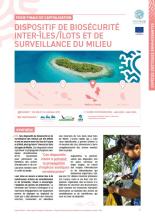
Dispositif de suivi de l'abondance et de l'impact du cerf - Fiche finale de capitalisation - PROTEGE
SPREP Publications, Biodiversity Conservation, BRB
Available Online

PROE / SPREP

2025
Des dispositifs innovants de suivi ont été développés afin de mesurer l’impact du Cerf Rusa sur le sous-bois de forêts humides de Nouvelle Calédonie et évaluer l’abondance de cette espèce envahissante, dans trois zones prioritaires du territoire. L’élaboration de ces dispositifs poursuit des objectifs complémentaires aux actions de régulation professionnelle mises en œuvre dans le cadre de PROTEGE. Le suivi vise notamment à réaliser un état initial et à évaluer les bénéfices des opérations de régulation, grâce à des outils adaptés à des zones d’intervention difficiles d’accès et caractérisées par une biodiversité exceptionnelle, plus de 80% des espèces végétales des forêts humides d’altitude étant endémiques à la Nouvelle-Calédonie. Un travail initial de sectorisation a permis mieux de caractériser les enjeux, les pressions sur l’environnement ainsi que le contexte socio-économique afin de délimiter les zones d’intervention prioritaires. Pour la première fois en Nouvelle-Calédonie, un protocole standardisé de mesure de l’impact des cerfs a été élaboré. Il s’appuie sur plusieurs indicateurs et prend en compte les spécificités des espèces végétales concernées et des contraintes associées à sa mise en œuvre. En complément, PROTEGE a permis d’élaborer une méthodeinnovante d’évaluation de l’abondance des cerfs, reposant sur l’utilisation d’un drone équipé de capteur thermique pour l’enregistrement de vidéos nocturnes. Un algorithme développé spécifiquement a par ailleurs vocation à réaliser automatiquement les détections à partir de ces vidéos, facilitant considérablement le traitement des données. La mise en œuvre de ce protocole pour la prospection de 4 700 hectares a révélé des densités de populations et des concentrations de hardes localement très élevées, atteignant par endroits des niveaux parmi les plus élevés enregistrés à l’échelle mondiale. Ces résultats fournissent des informations précieuses pour le ciblage de futures interventions et le suivi de leurs bénéfices. FICHE FINALE DE CAPITALISATION DU PROJET PROTEGE, financé par l'Union Européenne.
Habitat change mediates the response of coral fish populations to terrestrial run-off
Available Online

Albert, Simon

,

Brown, Christopher J.

,

Jupiter, Stacy D.

,

Klein, Carissa

,

Lin, Hsien-Yung

,

Maina, Joseph M.

,

Mumby, Peter J.

,

Tullock, Vivitskaia J. D.

,

Wenger, Amelia S.

2017
ABSTRACT: Coastal fish populations are typically threatened by multiple human activities, including fishing pressure and run-off of terrestrial pollution. Linking multiple threats to their impacts on fish populations is challenging because the threats may influence a species directly, or indirectly, via its habitats and its interactions with other species. Here we examine spatial variation in abundance of coral reef fish across gradients of fishing pressure and turbidity in Fiji. We explicitly account for multiple pathways of influence to test the alternative hypotheses that (1) habitat moderates predation by providing shelter, so habitat loss only affects prey fish populations if there are abundant predators, (2) habitat change co-drives biomass of both prey and predator functional groups. We examined responses of 7 fish functional groups and found that habitat change co-drives both predator and prey responses to turbidity. Abundances of all functional groups were associated with changes in habitat cover; however, the responses of their habitats to turbidity were mixed. Planktivore and piscivore abundance were lower in areas of high turbidity, because cover of their preferred habitats was lower. Invertivore, browser and grazer abundance did not change strongly over the turbidity gradient, because different components of their habitats exhibited both increases and decreases with turbidity. The effects of turbidity on fish populations were minor in areas where fish populations were already depleted by fishing. These findings suggest that terrestrial run-off modifies the composition of reef fish communities indirectly by affecting the benthic habitats that reef fish use.
Opportunities and constraints for implementing integrated land-sea management on islands
Biodiversity Conservation

Albert, Simon

,

Jupiter, Stacy

,

Klein, Carissa J.

,

Mangubhai, Sangeeta

,

Nelson, Joanna

,

Teneva, Lida

,

Tulloch, Vivitskaia J.

,

Watson, James E.M.

,

Wenger, Amelia

,

White, Alan T.

2017
Despite a growing body of literature on integrated land–sea management (ILSM), very little critical assessment has been conducted in order to evaluate ILSM in practice on island systems. Here we develop indicators for assessing 10 integrated island management principles and evaluate the performance of planning and implementation in four island ILSM projects from the tropical Pacific across different governance structures. We find that where customary governance is still strongly respected and enabled through national legislation, ILSM in practice can be very effective at restricting access and use according to fluctuations in resource availability. However, decision-making under customary governance systems may be vulnerable to mismanagement. Governmentled ILSM processes have the potential to design management actions that address the spatial scale of ecosystem processes and threats within the context of national policy and legislation, but may not fully capture broad stakeholder interests, and implementation may be poorly coordinated across highly dispersed island archipelagos. Private sector partnerships offer unique opportunities for resourcing island ILSM, although these are highly likely to be geared towards private sector interests that may change in the future and no longer align with community and/or national objectives. We identify consistent challenges that arise during island ILSM planning and implementation and offer recommendations for improvement.
Interactions between sea-level rise and wave exposure on reef island dynamics in the Solomon Islands
Biodiversity Conservation
Available Online

Albert, Simon

,

Church, John A.

,

Gibbes, Badin R.

,

Grinham, Alistair R.

,

Leon, Javier X.

,

Woodroffe, Colin D.

2016
Low-lying reef islands in the Solomon Islands provide a valuable window into the future impacts of global sea-level rise. Sea-level rise has been predicted to cause widespread erosion and inundation of low-lying atolls in the central Pacific. However, the limited research on reef islands in the western Pacific indicates the majority of shoreline changes and inundation to date result from extreme events, seawalls and inappropriate development rather than sea-level rise alone. Here, we present the first analysis of coastal dynamics from a sea-level rise hotspot in the Solomon Islands. Using time series aerial and satellite imagery from 1947 to 2014 of 33 islands, along with historical insight from local knowledge, we have identified five vegetated reef islands that have vanished over this time period and a further six islands experiencing severe shoreline recession. Shoreline recession at two sites has destroyed villages that have existed since at least 1935, leading to community relocations. Rates of shoreline recession are substantially higher in areas exposed to high wave energy, indicating a synergistic interaction between sea-level rise and waves. Understanding these local factors that increase the susceptibility of islands to coastal erosion is critical to guide adaptation responses for these remote Pacific communities.