Search the SPREP Catalogue

Refine Search Results

Tags / Keywords

Available Online

Tags / Keywords

Available Online

1896 result(s) found.

Sort by

You searched for

  • Tags / Keywords climatic changes
    X
Combating Climate Change in the Pacific: Regional Governance, agency and dependency

McDuie-Ra, Duncan

,

Williams, Marc

2016
From the perspective of Pacific island states and territories (PICTs) much of the intense speculation and debate over climate policy seems irrelevant and immature given the oft-repeated warnings of the severe consequences for low-lying islands and atoll countries of climate change. The Pacific is not just ‘any region’ when it comes to climate change but rather, as Farbotko (2010) argues, is an ‘experimental space’ of climate change ‘canaries’. The position of the Pacific at the frontline of climate change has spurred voluminous research, however studies of the politics of climate change within the region is limited, particularly with regard to and regional processes. This paper explores the regional politics of climate change in the Pacific. Within the grand architecture of global climate governance, the region provides compelling new insights into the ways climate change is constructed, governed, and shaped by—and in turn shapes—regional and global climate politics. Through an exploration of regional governance as a strategy by which small vulnerable states respond to urgent crises, the paper explores both the potential and the limitations of collective action on environmental issues following the United Nations Climate Change Conference (COP21) in Paris 2015. We argue that evolving regional governance on climate change is mobilizing resources and finance to combat climate change. On the surface it appears to be a successful manifestation of solidarity among states and territories facing a shared fate. This solidarity has been institutionalized in three key regional organizations that mobilize resources climate change action through distinct policy narratives about the place of the Pacific in global climate crisis. These organizations also distribute these resources to members. As a result climate finance in the Pacific is mostly generated by multilateral rather than bilateral donors. However, despite this apparent demonstration of regional agency, beneath the surface regional climate governance is heavily dependent on donors for finance and expertise. This exposes a dual vulnerability of PICTs. They are extremely vulnerable to the impacts of climate change while also being extremely vulnerable to growing dependencies on donors to address these impacts.
Will climate change impact the potential distribution of a native vine (Merremia peltata) which is behaving invasively in the Pacific region?
BRB
Available Online

Kumar, Lalit

,

Taylor, Subhashni

2016
Merremia peltata is a species with uncertain status in the island nations of the Pacific region. It has been designated introduced and invasive in some countries whereas it is considered native in others. Recent increase in its abundance across some island landscapes have led to calls for its designation as an invasive species of environmental concern with biological control being suggested as a control strategy. Climate change will add to the complications of managing this species since changes in climate will influence its range limits. In this study, we develop a process-oriented niche model of M. peltata using CLIMEX to investigate the impacts of climate change on its potential distribution. Information on the climatic requirements of M. peltata and its current geographic distribution were used to calibrate the model. The results indicate that under current climate, 273,132 km2 of the land area in the region is climatically unsuitable or marginal for M. peltata whereas 664,524 km2 is suitable to highly suitable. Under current climate, areas of climatic suitability for M. peltata were identified on the archipelagos of Fiji, Papua New Guinea, Solomon Islands and Vanuatu. By the end of the century, some archipelagos like Fiji, Hawaii, New Caledonia and Vanuatu will probably become more suitable while PNG and Solomon Islands become less suitable for M. peltata. The results can be used to inform biosecurity planning, management and conservation strategies on islands.
Counteracting Urban Heat Island Effects in a Global Climate Change Scenario
Available Online

Francesco Musco

2016
Reflect on the present, on the dynamics and the conditions that built it, and look forward at the same time, in search of a prospect to improve the future. Since Howard (1850–1928) and Geddes (1854–1932), this has been the dominant logic supporting the work of all those (architects, urban planners, planners, landscape architects, etc.) who grappled with city and territorial management and planning. However, from the 1970s, territorial planning has been confronted with new concepts – such as sustainable development, environmental sustainability and social equity – and more recently, new challenges – such as the ones linked to climate change, which led to the need to redefine territorial planning in disciplinary and operational terms. For some years now, the planner’s new role is under discussion, especially in relation to the challenges posed by climate change. Sustainability, mitigation, adaptation, renewable energy, low-carbon transition, ecosystem approach and post-disaster planning are just some of the new keywords surrounding the discussion on territorial management and planning. This chapter aims to present rationally, what it means to re-organize and re-think the city, in a long-term perspective. It wants to show how it is possible, and above all is a duty to integrate the new concepts mentioned above in urban planning, to deal with the effects of climate change. The Urban Heat Islands contrast enters fully into the feasible experimentation with appropriate innovations in territorial planning. The paper draws attention to the Italian situation, in the light of the European reference framework.
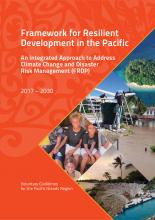
Framework for Resilient Development in the Pacific: An Integrated Approach to Address Climate Change and Disaster Risk Management (FRDP) 2017 - 2030
Climate Change Resilience, Biodiversity Conservation
Available Online
2016
Climate change exacerbates the magnitude and impacts of climate variability and some natural hazards. The existence of some Pacific Island countries (PICs) is threatened by climate change. Pacific Island countries and territories (PICTs) are highly exposed to a range of natural hazards of hydro-meteorological origin (such as cyclones, droughts, landslides and floods) and geological origin (including volcanic eruptions, earthquakes and tsunamis). These hazards often lead to disasters, which affect thousands of people and exacerbate existing development challenges in the region. Climate change predictions identify changes for the Pacific including an increase in extreme hot days and warm nights, extreme rainfall events, intensity of tropical cyclones in the South Pacific, sea level rise and ocean acidification. Climate change is increasing the risks from weather related disasters and posing new impacts to the region. Climate change impacts also cause progressive long-term degradation to the natural environment, to critical ecosystems (e.g. coral reefs), and to social and economic systems, resulting in loss and damage to the system upon which Pacific Island communities depend for their subsistence and livelihoods.