Search the SPREP Catalogue

Refine Search Results

Tags / Keywords

Available Online

Tags / Keywords

Available Online

25 result(s) found.

Sort by

You searched for

  • Tags / Keywords sea turtles
    X
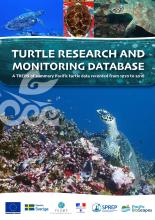
Turtle research and monitoring database: a TREDS of summary Pacific turtle data recorded from 1970 to 2018
SPREP Publications, Biodiversity Conservation
Available Online
2024
The Turtle Research and monitoring Database System (TREDS) was developed in 1993, to allow members of the Secretariat of the Pacific Regional Environment Programme (SPREP) to store, collate, and organise their data for research, monitoring and reporting. This tool is intended to assist members in making informed decisions regarding turtle conservation in the region. The dataset extracted from TREDS is from 1970 to 2018 and has been manipulated for the chapters covered in this report. The difference in dates for the establishment of TREDS in 1993 and the beginning of the date of the dataset of 1970 is simply due to users submitting their existing turtle data from 1970 once the database was launched in 1993, since many users saw the importance of TREDS as a lepository for storing their historical turtle data that was probably stored in paper format or on computers that would be susceptible to corruption or crashes. The purpose of this report is to provide an overview of the data contained within TREDS since its development up until its upgrade to a web-based online database platform. The last TREDS Annual Report was published in 2009 with subsequent Country reports published until 2015.
Freedivers harvest thousands of sea turtles a year in the Solomon Islands
Biodiversity Conservation
Available Online

Hamilton, Richard

2023
1. Sea turtles are harvested in many small-scale fisheries (SSFs), but few nations have quantified the impacts that SSFs are having on their sea turtle stocks. This study provides the first assessment on the catch composition, national harvest rates,and long-term trends in sea turtle catches in the Solomon Islands SSFs. 2. Between October 2016 and May 2018, 10 community monitors located in eight of the nine provinces of the Solomon Islands were trained and employed to work alongside fishers in their respective communities to document, photograph, and geo-reference the reefs where sea turtles were harvested. Local ecological knowledge (LEK) surveys were then conducted with 32 experienced fishers to infer whether the harvest rates of sea turtles had changed in recent decades. 3. Community monitors recorded information on 1,132 sea turtles that were harvested on 529 fishing trips:1,119 sea turtles were identified to species level, with harvests consisting of 73.3% (n=818) green sea turtles (Chelonia mydas), 25.7% hawksbill sea turtles (n=291) (Eretmochelys imbricata), and 0.9% (n=10) olive ridley sea turtles (Lepidochelys olivacea). 4. The great majority (92.6%) of sea turtles were captured by night-time and daytime freedivers who use masks, snorkels, fins, hooks, spears, and underwater flashlights to target a wide range of fauna that inhabit coral reefs.