Search the SPREP Catalogue

Refine Search Results

Tags / Keywords

Language

Available Online

Tags / Keywords

Available Online

17 result(s) found.

Sort by

You searched for

  • Tags / Keywords norway rats
    X
The Isles of Scilly seabird restoration project: the eradication of brown rats (Rattus norvegicus) from the inhabited islands of St Agnes and Gugh, Isles of Scilly
Biodiversity Conservation, BRB
Available Online

Bell, E.

,

Boyle, D.

,

Buckley, P.

,

Floyd, K.

,

Garratt, W.

,

Lock, L.

,

Mason, S.

,

McCarthy, R.

,

Pearce, J.

,

Pearson, J.

,

St Pierre, P.

,

Sugar, K.

2019
As part of the Isles of Scilly Seabird Recovery Project, and directed by Wildlife Management International Ltd, the eradication of brown rats (Rattus norvegicus) from the inhabited islands of St Agnes & Gugh, Isles of Scilly was completed between October 2013 and April 2014 with the assistance of volunteers, and staff from the Royal Society for the Protection of Birds, Isles of Scilly Wildlife Trust and Natural England. Bait stations with cereal-based wax blocks containing bromadiolone at 0.005% w/w were established on a 40–50 metre grid over the island. With the presence of 85 residents on the 142 ha islands, this is the largest community-based brown rat eradication globally to date. Given the fact that a community is based on these islands, community engagement and advocacy was a vital and fundamental part of the eradication. Consultation for eradication began three years prior to the operation to explain the requirements for the proposed project and to assess support, but this built on many years of wider community engagement with seabird conservation. All of the residents supported the eradication of rats and vision of the project. The consultation and inclusion of the community in decision-making and management of the Isles of Scilly Seabird Recovery Project was a critical part of the operation and key to the success of the eradication. The community took ownership of the project and has committed to the on-going biosecurity requirements following the eradication of rats. The removal of brown rats from St Agnes and Gugh was a major achievement and provided the opportunity to restore the islands' communities of seabirds and other native species. This project provided an example of the effectiveness of ground-based rodent eradication techniques on an inhabited island and the lessons learnt during this operation can be used to help proposed eradications on other islands with communities and with terrain suitable for ground-based techniques.
Simultaneous rat, mouse and rabbit eradication on Bense and Little Bense Islands, Falkland Islands
Biodiversity Conservation, BRB
Available Online

Carey, P.W.

2019
Bense and Little Bense Islands (144 ha total area) have, for over a century, supported populations of three introduced pest mammals: Norway rat (Rattus norvegicus), house mouse (Mus musculus), and European rabbit (Oryctolagus cuniculus). An operation to eradicate these mammals simultaneously was undertaken in winter 2016. Cereal pellets laced with brodifacoum (25 ppm) were hand-broadcast on both islands in two applications with 3,900 kg of bait applied in total. Baiting transects were spaced at 20 m intervals and bait-throwing positions located every 20 m along each transect. The coastline was also baited at 20 m intervals. Precision bait coverage was aided by programming GPS units to give off an audible alarm when staff reached each correct bait-throwing position. Application 1 resulted in an average bait density of 15.3 kg/ha. Application 2 commenced 10 days later and resulted in an average baiting density of 11.7 kg/ha. Reduced availability of fi eld staff resulted in coverage in Application 2 being less complete than in Application 1 and only the most important mammal habitats were baited a second time. These were: all tussock areas, all coastlines, and some inland heath areas. Areas with no vegetation (e.g. burned zone on Bense) and some inland heath communities were not treated, although all of these retained unconsumed bait from Application 1. Some non-target mortality was recorded, with dolphin gulls (Larus scoresbii) being the most common victims. This was also the only species observed to consume bait pellets. Consumption of poisoned mammals or gulls may have killed three turkey vultures (Cathartes aura jota), one striated caracara (Phalcoboenus australis), and one short-eared owl (Asio flammeus). The removal of invasive species is part of a broader ecological restoration plan for these islands and will hopefully lead to an increase in native biodiversity, including the re-establishment of the endemic passerines Cobb’s wren (Troglodytes cobbi) and blackish cinclodes (Cinclodes antarcticus).
Long term rodent control in Rdum tal-Madonna yelkouan shearwater colony
Biodiversity Conservation, BRB
Available Online

Cabello, J.S. Santiago

,

Lago, P.

,

Varnham, K.

2019
Rodent predation on eggs and chicks is one of the main threats to procellariiform species in the Mediterranean, where the black rat (Rattus rattus) and brown rat (R. norvegicus) have been present on many islands for centuries. The yelkouan shearwater (Puffinus yelkouan) is an endemic Mediterranean seabird species classified as vulnerable. Malta holds up to 10% of the global population; the largest colony, Rdum tal-Madonna (RM), protected as a Natura 2000 site, hosts around 500 breeding pairs. This colony has been monitored since its discovery in 1969. A very low reproductive success due to rat predation was noticed in the late 1990s to early 2000s. In 2007 a seasonal rodent control programme was established during the breeding season of yelkouan shearwater to reduce rat predation on eggs and chicks. Rodent control took place between 2007 and 2010 and was reviewed and continued from 2012 to 2017. Breeding success since 2007 has been higher than 80%. In two other colonies with rat presence and where rodent control did not take place, the breeding success in 2016 and 2017 was substantially lower than in the colony with the rodent control programme. The European storm-petrel (Hydrobates pelagicus melitensis) only breeds in rat-free areas like remote sea caves or islets around the Maltese islands. In 2014, the first breeding attempt by European storm-petrel was recorded on the Maltese mainland at RM with a chick fledging successfully for the first time in 2016. The ongoing LIFE Arcipelagu Garnija project is assessing rat predation in all Maltese yelkouan shearwater colonies in order to establish predator control in the most important yelkouan shearwater breeding sites in 2018.
The effect of Norway rats on coastal waterbirds of the Falkland Islands: a preliminary analysis
Biodiversity Conservation, BRB
Available Online

Kuepfer, A.

,

Passfi eld, K.

,

Poncet, S.

,

Tabak, M.A.

2019
The Falkland Islands have been affected by anthropogenic-induced habitat modifi cation including introduction of invasive species and grazing by livestock. Introduced Norway rats are known to have a large effect on native Falklands passerines but their effect on other native birds has not been explored. We investigated the effects of several environmental variables, including the presence of Norway rats and chronic grazing by livestock, on an assemblage of 22 species of coastal waterbirds by comparing species richness and relative abundance of birds among 65 rat-infested islands, 29 rat eradicated islands and 76 historically rat-free islands. Bird count data from 299 km of coastline were used to estimate relative bird abundance, expressed as the number of individuals per kilometre of coastline for each species. Our study provided three key results. First, coastal waterbird abundance on islands historically without rats was twice as high as that on islands where rats were present. Second, bird abundance on rat-eradicated islands was intermediate between that of historically rat-free and rat-infested islands. Third, habitat modification by grazing appeared to reduce bird abundance in both rat-free and rat-infested habitats. From a conservation perspective, this study suggests that rat eradication programmes in the Falkland Islands are effective at restoring coastal waterbird abundance and would be even more so if carried out in conjunction with restoration of native coastal plant communities.
Potential public health benefits from eradicating rts in New Zealand cities and a tentative research agenda.
BRB
Available Online

Baker, Michael G.

,

Blaschke, Paul.

,

Mansoor, Osman D.

,

McIntyre, Mary.

,

Muellner, Petra.

,

Wilson, Nick. ? Mary McIntyre ? Paul Blaschke ? Petra Muellner ? Osman D Mansoor ? Michael G Baker

2017
The eradication of some introduced pests such as rats, stoats and possums in New Zealand seems increasingly feasible with successful action to date in various cities (e.g. Wellington City) and with the government’s national 2050 predator-free goal. Here we specifically detail the potential benefits of urban rat eradication and find these cover a wide range of topics including a potentially reduced risk of infection from at least seven zoonotic diseases (e.g. leptospirosis, toxoplasmosis, trichinellosis, murine typhus; and three enteric diseases). Other potential benefits include: psychological benefits from increased native bird life in cities; reduced damage to food supplies; reduced rat damage to building insulation and to building walls and roofing; and reduced fires in buildings associated with rat damage. However, there is considerable uncertainty on the size of such impacts and so we outline a tentative research agenda as a first step towards quantification of the likely key public health benefits of rat eradication.
Invasive rats on tropical islands: their population biology and impacts on native species
BRB
Available Online

Bunbury, Nancy

,

Harper, Grant. A,

2015
The three most invasive rat species, black or ship rat Rattus rattus, brown or Norway rats, R. norvegicus and Pacific rat, R. exulans have been incrementally introduced to islands as humans have explored the world’s oceans. They have caused serious deleterious effects through predation and competition, and extinction of many species on tropical islands, many of which are biodiversity hotspots. All three rat species are found in virtually all habitat types, including mangrove and arid shrub land. Black rats tend to dominate the literature but despite this the population biology of invasive rats, particularly Norway rats, is poorly researched on tropical islands. Pacific rats can often exceed population densities of well over 100 rats ha?1 and black rats can attain densities of 119 rats ha?1, which is much higher than recorded on most temperate islands. High densities are possibly due to high recruitment of young although the data to support this are limited. The generally aseasonally warm climate can lead to year-round breeding but can be restricted by either density-dependent effects interacting with resource constraints often due to aridity. Apparent adverse impacts on birds have been well recorded and almost all tropical seabirds and land birds can be affected by rats. On the Pacific islands, black rats have added to declines and extinctions of land birds caused initially by Pacific rats. Rats have likely caused unrecorded extinctions of native species on tropical islands. Further research required on invasive rats on tropical islands includes the drivers of population growth and carrying capacities that result in high densities and how these differ to temperate islands, habitat use of rats in tropical vegetation types and interactions with other tropical species, particularly the reptiles and invertebrates, including crustaceans.
Special Issue Article: Tropical rat eradication. Seabird recovery and vegetation dynamics after Norway rat eradication at Tromelin Island, western Indian Ocean. Biological Conservation. Volume 185, May 2015
Biodiversity Conservation, BRB
Available Online

Bastien. M

,

Danckwerts. D.K

,

M. Le Corre. M

,

Micol. T

,

Morey Rubio.C

,

Orlowski. S

,

Pinaud. D

,

Ringler. D

2015
Seabirds are notoriously sensitive to introduced mammalian predators and eradication programs have benefitted seabird populations and their habitats on numerous islands throughout the world. However, less evidence is available from the tropics as to the benefits of rat eradication. Here, we report the seabird recovery and vegetation dynamics on a small coralline island of the tropical western Indian Ocean, eight years after Norway rat (Rattus norvegicus) eradication. Two species of seabirds were breeding before rat eradication (red-footed and masked boobies, Sula sula and Sula, dactylatra) and, in both species, the number of breeding pairs had an apparent increase of 22?23% per year after rat eradication. Such a high annual growth rate cannot be achieved by auto-recruitment only and our data suggest that immigration from other source populations never occurred in at least one of these species. We suggest that it is rather due to a rapid increase in breeding success, which rapidly increased the observed number of breeders since birds remained in the available-for-counting-as-breeders group for much longer. Two other species, the white tern (Gygis alba) and the brown booby (Sula leucogaster) were recorded breeding in 2014. The former species has not bred on the island since 1856 and the latter has never bred on the island. Plant cover (monospecific formation of the ruderal herb Boerhavia diffusa) dramatically increased from less than 30% of surface coverage to more than 70%. Although the initial restoration project was to eradicate all introduced mammals of the island simultaneously, house mouse (Mus musculus) eradication failed. Mouse density was high 8 years after rat eradication (32 mice/ha in dry season and 52 mice/ha in rainy season) but not higher than at a comparable tropical island of the region (Juan de Nova) where mice coexist with introduced black rats (Rattus rattus) and feral cats (Felis catus). These results are discussed in terms of the direct positive effects of rat eradication on seabirds and plants and the indirect positive effects of post-eradication seabird increase on soil manuring and vegetation recovery. Overall, our results show that on tropical islands, seabird and habitat recovery can be very rapid after rat eradication and should be implemented as a restoration tool wherever possible.
Encyclopedia of biological invasions.
Biodiversity Conservation, BRB

Rejmanek, Marcel

,

Simberloff, Dadniel

2011
This encyclopedia illuminates a topic at the forefront of global ecology - biological invasions, or organisms that come to live in the wrong place. Written by leading scientists from around the world, the book addresses all aspects of this subject at a global level - including invasions by animals, plants, fungi, and bacteria - in succinct, alphabetically arranged articles. Scientifically uncompromising, yet clearly written and free of jargon, the volume encompasses fields of study including biology, demography, geography, ecology, evolution, sociology, and natural history and features many cross-references, suggestions for further reading, illustrations, an appendix of the world's worst 100 invasive species, a glossary, and more. The book features articles on well-known invasive species such the zebra mussel, chestnut blight, cheatgrass, gypsy moth, Nile perch, giant African snail, and Norway rat and details regions with especially large numbers of introduced species including the Great Lakes, Mediterranean Sea, Hawaiian Islands, Australia and New Zealand. This work will be of great value in ecology and conservation science. Invasive species are a severe and exponentially growing problem of the environment, and one difficult even to characterize, much less contain.-Edward O. Wilson, author and scientist "Second only to habitat loss mixed with climate disruption, invasive species represent the next most serious threat to biodiversity. The Encyclopedia of Biological Invasions, written by an impressive group of experts, now makes available to conservation biologists, managers, decision makers, and concerned citizens a comprehensive single source of this key topic."-Paul R. Ehrlich, co-author of The Dominant Animal
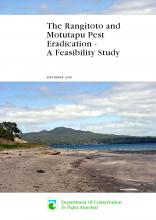
The Rangitoto and Motutapu pest eradication - a feasibility study.
BRB
Available Online

Griffiths, Richard.

,

Towns, David.

2008
The eradication of the seven remaining animal pest species remaining on Rangitoto and Motutapu was announced by the Prime Minister and Minister of Conservation in June 2006. With stoats, cats, hedgehogs, rabbits, mice and two species of rats spread across an area of 3842ha, the proposed project is the most challenging and complex island pest eradication the Department of Conservation (DOC) has ever attempted. To better understand the scale and complexity of the project, a feasibility study was undertaken. This study considered the ecological, economic and social context of the project to allow an informed decision to be made on whether or not to commit resources to further eradication planning. This document outlines the findings of the feasibility study and concludes that while a number of contingencies exist within the project, the proposed eradication is not only feasible, but has many significant benefits. No single precedent exists on which this project can be modelled and information from a wide range of sources has been required. Previous eradication and control programmes have been reviewed in conjunction with what is known about the behaviour and biology of the target species. In some cases, where information has not been available and could not be inferred, trials have been undertaken. The document has been reviewed by a number of experts both within New Zealand and overseas including DOC’s Island Eradication Advisory Group. Consultation has also been undertaken with all of the islands’ key stakeholders and communities of interest. Comments from all of these parties have been reflected in the report. Rangitoto is an iconic Scenic Reserve located just 9km from downtown Auckland City. The island is internationally significant both for its ecology and geology and is an extremely popular visitor destination served by regular ferry services. Motutapu, a Recreation Reserve, is connected to and positioned immediately to the east of Rangitoto. The island, currently managed as a pastoral farm, is noted for its extensive archaeological record but retains a diverse range of habitat types and is the focus of a community-led restoration programme. In addressing the question, ‘can it be done?’ particular attention has been paid to mice, ship rats, hedgehogs and rabbits as eradication of these species on the scale of Rangitoto and Motutapu has never been attempted. Preventing reinvasion on such highly accessible and intensively visited islands is also an enormous undertaking. It is accepted, that of all the target species, mice present the greatest risk of failure. However, while a number of mouse eradications around the world have failed, all ten attempts on islands beyond the swimming range of mice that have followed current Departmental best practice have been successful, providing confidence in the method. Rangitoto and Motutapu are a significant step up from previous operations in terms of scale but are also the logical next step to apply current techniques. Despite the unprecedented elements within the project, it is considered that the key dependencies on which eradication success relies can be met for the species targeted. Preventing reinvasion is perhaps the most important consideration of the feasibility study and the one that will ultimately determine the fate of the project. Achieving an adequate level of protection for the islands hinges heavily on changing the behaviour of all 100,000 visitors that arrive on an annual basis. Without this any investments made in removing pests will be wasted. Bringing these changes about appears possible but is contingent on a number of commitments and actions that must be put in place by both DOC and its key partners. The feasibility study also addresses what the project will take to complete and attempts to identify as many of the planning issues as possible to enable the project to be properly sized. It explores the techniques that must be used, the resources that will be required and the timeframe over which they need to be deployed. While this eradication project is the most challenging and complex to be undertaken by DOC, it also presents a significant opportunity to improve our current understanding of eradication theory and practice. If successful, the project offers outstanding benefits for conservation. The recovery of locally and nationally endangered species, the creation of a stepping stone for wildlife movement between the Hauraki Gulf and the Auckland isthmus, the potential for advocacy and education, and increased recreation and economic opportunities are just some of the likely gains. The study has shown that this project is feasible, but also that there are many significant reasons why it should proceed.