Search the SPREP Catalogue

Refine Search Results

Tags / Keywords

Available Online

Tags / Keywords

Available Online

459 result(s) found.

Sort by

You searched for

  • Tags / Keywords new zealand
    X
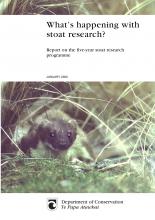
What's happening with stoat research? Report on the five-year stoat research programme
BRB
Available Online
2000
In the May 1999 budget, the New Zealand Government announced that an extra $6.6 million over five years would be given to the Department of Conservation to fund an integrated stoat control research programme. Stoats, ferrets and weasels were introduced to New Zealand in the 1880s in an attempt to control rabbits. Although stoats were implicated in the decline of some native bird species soon after their introduction, the extent to which they are still contributing to the decline of native species is only now becoming clear. Their impacts on threatened and endangered birds are of particular concern. Stoat control in New Zealand will have to be ongoing if some endemic species are to survive on the mainland. Currently, stoat control relies largely on labour-intensive trapping and the use of poisoned hen eggs. New, more cost-effective and sustainable approaches to controlling stoats are urgently needed. The extra funding means that there is now a real opportunity for finding cost-effective solutions for managing stoats. A Stoat Technical Advisory Group (composed of experts from the Department of Conservation, Lincoln University and Auckland University) has been established to develop and oversee this new research programme. Funding for the first year is $338,000 with funding increasing in 2000/01 to $1.406 million and for the subsequent three years, $1.631 million, each year.
Autopsy report for seabirds killed and returned from New Zeland fisheries 1 January 1998 to 30 September - Birds returned by Ministry of Fisheries observers to the Museum of New Zealand Te Papa Tongarewa
Available Online

Robertson, C.J.R.

2000
There were 195 specimens returned from 19 separate fishing trips with onboard observers, between 1 January and 30 September 1998, where birds were killed as a bycatch to various forms of fishing practice. Four of these trips contributed 82% of the birds returned. These autopsies were undertaken for the Department of Conservation as CSL Contract 98/3091. All costs of labelling and packaging, importation under the Biosecurity Act, transportation from Port of Landing to Wellington by refrigerated truck, cold storage, and autopsy facilities were met by the Conservation Services Levy. In 1998 these birds were received from trawlers, domestic tuna longliners, joint venture tuna longliners, and domestic bottom longliners (Tables 1-4). The number of specimens returned for autopsy does not in any way indicate probable catch rates for differing classes of vessel or fishing method, as the observer coverage was not equally distributed throughout the fishing effort. Specific catch locations for the specimens returned are not provided here on the grounds of commercial sensitivity as required by the Ministry of Fisheries and some parts of the fishing industry. However, the maps (Figures 1-5) provide the general location of catches and species returned for the period covered by this report. The distribution shown does not imply any relationship with fishing effort or method as indicated above.