Search the SPREP Catalogue

Refine Search Results

Tags / Keywords

Available Online

Tags / Keywords

Available Online

139 result(s) found.

Sort by

You searched for

  • Tags / Keywords rattus sp
    X
Valuing the impact of selected invasive species in the Polynesia-Micronesia hotspot, final report
BRB
Available Online

Aalbersberg, Bill

,

Boudjelas, Souad

,

Brown, Pike

,

Daigneault, Adam

,

Greenhalgh, Suzie

,

Mather, John

,

Nagle, William

2013
Invasive species pose an enormous threat in the Pacific: not only do they strongly affect biodiversity, but they also potentially affect the economic, social, and cultural wellbeing of Pacific peoples. Invasive species can potentially be managed and that their impacts can potentially be avoided, eliminated, or reduced. However, neither the costs nor the numerous benefits of management are well understood in the Pacific. Thus, the goals of this project were: A) to account for both the costs and benefits of managing invasive species; B) to prepare empirically grounded advocacy materials to help increase investment in the management of invasive species; C) to help governments prioritise investment in managing these species; and D) to build capability for undertaking economic assessments in the future. To accomplish these goals, we undertook cost-benefit analyses (CBAs) of managing five species that are well established on Viti Levu, Fiji: spathodea campanulata (African tulip tree), herpestus javanicus (small Asian mongoose), papuana uninodis (taro beetle), pycnonotus cafer (red-vented bulbul), and merremia peltata (merremia vine). Next, we conducted a comprehensive training programme on the CBA for invasive species management for professionals from the Pacific. Third, we collaborated with Pacific organisations to develop a uniform guide to conducting CBAs with numerous examples from the region. We also designed a flexible Microsoft Excel-based tool for conducting CBAs, enabling professionals who did not attend the training course to nevertheless undertake rigorous CBAs on invasive spsecies management. Finally, we developed advocacy material and publicised findings from this project to promote investment in invasive species management. This report details these activities in turn. It also includes numerous appendices that include the tools, guidance documents, and advocacy materials developed under this project.
Comprehensive Desk-top Review of Biodiversity, Conservation and Invasive Species Information for the Kingdom of Tonga
Biodiversity Conservation, BRB
Available Online

Pagad. Shyama

2013
Situated between Fiji to the west and Samoa to the northeast, the Kingdom of Tonga (referred to as Tonga) is comprised of 171 scattered islands of which less than 50 are inhabited. The islands are mainly composed of limestone formed from uplifted coral. Current critical environmental concerns have arisen due to deforestation; damage to coral reefs and the introduction and spread of invasive alien species. Anthropogenic pressure has resulted in extensive modification of all ecosystems on the limestone islands of this group. Only uninhabited and steep volcanic islands still support large tracts of forest.
Archipelago-wide island restoration in the Galapagos Islands: Reducing costs of invaisve mammal eradication programs and reinvasion risk

BRB
Available Online

Campbell, Karl J.

,

Carrion, Victor

,

Cruz, Felipe

,

Donian, C. Josh

,

Lavoie, Christian

2011
Invasive alien mammals are the major driver of biodiversity loss and ecosystem degradation on islands. Over the past three decades, invasive mammal eradication from islands has become one of society's most powerful tools for preventing extinction of insular endemics and restoring insular ecosystems. As practitioners tackle larger islands for restoration, three factors will heavily influence success and outcomes: the degree of local support, the ability to mitigate for non-target impacts, and the ability to eradicate non-native species more cost-effectively. Investments in removing invasive species, however, must be weighed against the risk of reintroduction. One way to reduce reintroduction risks is to eradicate the target invasive species from an entire archipelago, and thus eliminate readily available sources. We illustrate the costs and benefits of this approach with the efforts to remove invasive goats from the Galápagos Islands. Project Isabela, the world's largest island restoration effort to date, removed > 140,000 goats from > 500,000 ha for a cost of US$10.5 million. Leveraging the capacity built during Project Isabela, and given that goat reintroductions have been common over the past decade, we implemented an archipelago-wide goat eradication strategy. Feral goats remain on three islands in the archipelago, and removal efforts are underway. Efforts on the Galápagos Islands demonstrate that for some species, island size is no longer the limiting factor with respect to eradication. Rather, bureaucratic processes, financing, political will, and stakeholder approval appear to be the new challenges. Eradication efforts have delivered a suite of biodiversity benefits that are in the process of revealing themselves. The costs of rectifying intentional reintroductions are high in terms of financial and human resources. Reducing the archipelago-wide goat density to low levels is a technical approach to reducing reintroduction risk in the short-term, and is being complemented with a longer-term social approach focused on education and governance.
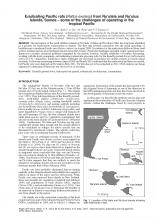
Eradicating Pacific rats (Rattus exulans) from Nu'utele and Nu'ulua Islands, Samoa - some of the challenges of operating in the tropcial Pacific
BRB
Available Online

Butler, D.J.

,

Tipamaa, F.T.

,

Tye, A.

,

Wylie, M.

2011
The restoration of the small offshore islands of Nu’utele (108ha) and Nu’ulua (25ha) has long been identified as a priority for biodiversity conservation in Samoa. The first step towards restoration was the aerial spreading of brodifacoum to eradicate Pacific rats (Rattus exulans) in August 2009. Procedures for the eradication followed those used in New Zealand and involved technical experts from that country. Particular challenges included a tight operational time-frame (two months), technical problems magnified by the remote location, variable reliability of weather forecasting,working with the local community, and mitigating rodenticide exposure risks for the friendly ground-dove (Gallicolumba stairi) (IUCN: vulnerable). Solutions to these challenges are discussed as guidance for similar projects in remote island locations. Follow-up monitoring between August 2009 and March 2010 indicated that the eradication had been successful, but Pacific rats were detected on Nu’utele in May 2011. Nu’ulua has yet to be rechecked in 2011. DNA analyses are being organised to determine if these rats are survivors or re-invaders.