Search the SPREP Catalogue

Refine Search Results

Tags / Keywords

Language

Available Online

Tags / Keywords

Available Online

30 result(s) found.

Sort by

You searched for

  • Tags / Keywords cats
    X
Comprehensive Desk-top Review of Biodiversity, Conservation and Invasive Species Information for the Kingdom of Tonga
Biodiversity Conservation, BRB
Available Online

Pagad. Shyama

2013
Situated between Fiji to the west and Samoa to the northeast, the Kingdom of Tonga (referred to as Tonga) is comprised of 171 scattered islands of which less than 50 are inhabited. The islands are mainly composed of limestone formed from uplifted coral. Current critical environmental concerns have arisen due to deforestation; damage to coral reefs and the introduction and spread of invasive alien species. Anthropogenic pressure has resulted in extensive modification of all ecosystems on the limestone islands of this group. Only uninhabited and steep volcanic islands still support large tracts of forest.
Archipelago-wide island restoration in the Galapagos Islands: Reducing costs of invaisve mammal eradication programs and reinvasion risk
BRB
Available Online

Campbell, Karl J.

,

Carrion, Victor

,

Cruz, Felipe

,

Donian, C. Josh

,

Lavoie, Christian

2011
Invasive alien mammals are the major driver of biodiversity loss and ecosystem degradation on islands. Over the past three decades, invasive mammal eradication from islands has become one of society's most powerful tools for preventing extinction of insular endemics and restoring insular ecosystems. As practitioners tackle larger islands for restoration, three factors will heavily influence success and outcomes: the degree of local support, the ability to mitigate for non-target impacts, and the ability to eradicate non-native species more cost-effectively. Investments in removing invasive species, however, must be weighed against the risk of reintroduction. One way to reduce reintroduction risks is to eradicate the target invasive species from an entire archipelago, and thus eliminate readily available sources. We illustrate the costs and benefits of this approach with the efforts to remove invasive goats from the Galápagos Islands. Project Isabela, the world's largest island restoration effort to date, removed > 140,000 goats from > 500,000 ha for a cost of US$10.5 million. Leveraging the capacity built during Project Isabela, and given that goat reintroductions have been common over the past decade, we implemented an archipelago-wide goat eradication strategy. Feral goats remain on three islands in the archipelago, and removal efforts are underway. Efforts on the Galápagos Islands demonstrate that for some species, island size is no longer the limiting factor with respect to eradication. Rather, bureaucratic processes, financing, political will, and stakeholder approval appear to be the new challenges. Eradication efforts have delivered a suite of biodiversity benefits that are in the process of revealing themselves. The costs of rectifying intentional reintroductions are high in terms of financial and human resources. Reducing the archipelago-wide goat density to low levels is a technical approach to reducing reintroduction risk in the short-term, and is being complemented with a longer-term social approach focused on education and governance.
The catastrophic impact of invasive mammalian predators on birds of the UK overseas territories: a review and synthesis
BRB
Available Online

Cuthbert, Richard J.

,

Hilton, Geoff M

2010
The UK has sovereignty over 16 Overseas Territories, which hold some of the world's great seabird colonies and collectively support more endemic and globally threatened bird species than the whole of mainland Europe. Invasive alien mammalian predators have spread throughout most of the Territories, primarily since European expansion in the 16th century. Here we review and synthesize the scale of their impacts, historical and current, actions to reduce and reverse these impacts, and priorities for conservation. Mammalian predators have caused a catastrophic wave of extinctions and reductions in seabird colony size that mark the UKOTs as a major centre of global extinction. Mammal-induced declines of threatened endemics and seabird colonies continue, with four Critically Endangered endemics on Gough Island (Tristan da Cunha), St Helena and Montserrat directly threatened by invasive alien House Mice Mus musculus, Feral Cats Felis catus and rats Rattus spp. Action to reduce these threats and restore islands has been modest in comparison with other developed countries, although some notable successes have occurred and a large number of ambitious eradication and conservation plans are in preparation. Priority islands for cosnervation action against mammalian predators include Gough (which according to one published prioritization scheme is the highest-ranked island in the world for mammal eradication), St Helena and Montserrat, but also on Tristan da Cunha, Pitcairn and the Falkland Island. Technical, financial and political will is required to push forward and fund the eradication of invasive mammalian predators on these islands, which would significantly reduce extinction risk for a number of globally threatened species.
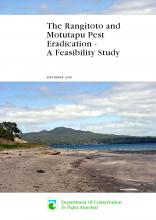
The Rangitoto and Motutapu pest eradication - a feasibility study.

BRB
Available Online

Griffiths, Richard.

,

Towns, David.

2008
The eradication of the seven remaining animal pest species remaining on Rangitoto and Motutapu was announced by the Prime Minister and Minister of Conservation in June 2006. With stoats, cats, hedgehogs, rabbits, mice and two species of rats spread across an area of 3842ha, the proposed project is the most challenging and complex island pest eradication the Department of Conservation (DOC) has ever attempted. To better understand the scale and complexity of the project, a feasibility study was undertaken. This study considered the ecological, economic and social context of the project to allow an informed decision to be made on whether or not to commit resources to further eradication planning. This document outlines the findings of the feasibility study and concludes that while a number of contingencies exist within the project, the proposed eradication is not only feasible, but has many significant benefits. No single precedent exists on which this project can be modelled and information from a wide range of sources has been required. Previous eradication and control programmes have been reviewed in conjunction with what is known about the behaviour and biology of the target species. In some cases, where information has not been available and could not be inferred, trials have been undertaken. The document has been reviewed by a number of experts both within New Zealand and overseas including DOC’s Island Eradication Advisory Group. Consultation has also been undertaken with all of the islands’ key stakeholders and communities of interest. Comments from all of these parties have been reflected in the report. Rangitoto is an iconic Scenic Reserve located just 9km from downtown Auckland City. The island is internationally significant both for its ecology and geology and is an extremely popular visitor destination served by regular ferry services. Motutapu, a Recreation Reserve, is connected to and positioned immediately to the east of Rangitoto. The island, currently managed as a pastoral farm, is noted for its extensive archaeological record but retains a diverse range of habitat types and is the focus of a community-led restoration programme. In addressing the question, ‘can it be done?’ particular attention has been paid to mice, ship rats, hedgehogs and rabbits as eradication of these species on the scale of Rangitoto and Motutapu has never been attempted. Preventing reinvasion on such highly accessible and intensively visited islands is also an enormous undertaking. It is accepted, that of all the target species, mice present the greatest risk of failure. However, while a number of mouse eradications around the world have failed, all ten attempts on islands beyond the swimming range of mice that have followed current Departmental best practice have been successful, providing confidence in the method. Rangitoto and Motutapu are a significant step up from previous operations in terms of scale but are also the logical next step to apply current techniques. Despite the unprecedented elements within the project, it is considered that the key dependencies on which eradication success relies can be met for the species targeted. Preventing reinvasion is perhaps the most important consideration of the feasibility study and the one that will ultimately determine the fate of the project. Achieving an adequate level of protection for the islands hinges heavily on changing the behaviour of all 100,000 visitors that arrive on an annual basis. Without this any investments made in removing pests will be wasted. Bringing these changes about appears possible but is contingent on a number of commitments and actions that must be put in place by both DOC and its key partners. The feasibility study also addresses what the project will take to complete and attempts to identify as many of the planning issues as possible to enable the project to be properly sized. It explores the techniques that must be used, the resources that will be required and the timeframe over which they need to be deployed. While this eradication project is the most challenging and complex to be undertaken by DOC, it also presents a significant opportunity to improve our current understanding of eradication theory and practice. If successful, the project offers outstanding benefits for conservation. The recovery of locally and nationally endangered species, the creation of a stepping stone for wildlife movement between the Hauraki Gulf and the Auckland isthmus, the potential for advocacy and education, and increased recreation and economic opportunities are just some of the likely gains. The study has shown that this project is feasible, but also that there are many significant reasons why it should proceed.