Search the SPREP Catalogue

Refine Search Results

Tags / Keywords

Available Online

Tags / Keywords

Available Online

1853 result(s) found.

Sort by

You searched for

  • Tags / Keywords fiji
    X
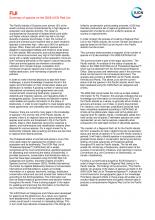
The Pacific Islands: an analysis of the status of species as listed on the 2008 IUCN Red List of Threatened Species: American Samoa, Cook Islands, Fiji, French Polynesia, Guam, Kiribati, Marshall Islands, Federated States of Micronesia, Nauru, New Caledonia, Niue, Norfolk Island, Northern Mariana Islands, Palau, Papua New Guinea, Pitcairn Island, Samoa, Solomon Islands, Tokelau, Tonga, Tuvalu, US Minor outlying islands, Vanuatu, Wallis and Futuna
Climate Change Resilience, Biodiversity Conservation, BRB
Available Online

Pippard, Helen

2009
The Pacific islands of Oceania cover almost 15% of the world’s surface and are characterised by a high degree of ecosystem and species diversity. The region is characterised by thousands of isolated small coral atolls and higher volcanic islands, which has led to the high diversity of species found today. In fact, the number of plants and animals found nowhere else on earth (endemic species) is extremely high - often up to 90% for particular groups. Often, these rare and endemic species are adapted to specialised habitats and limited to small areas of a few islands. With economic and cultural dependence on the natural environment very high in the Pacific islands, along with a rapidly expanding human population, there are everincreasing demands on the region’s natural resources. Plant and animal species are therefore very vulnerable to extinction from climate change, competition from introduced (invasive) species and human impacts such as habitat destruction, over-harvesting of species and pollution.
Evaluating the role of science in community based adaptive management of coastal resources in Fiji
Available Online

Seidel Henrike

2009
Community-based adaptive management (CBAM) has generally been accepted as an effective means to sustainably manage coastal ecosystems and small scale fishing activities. This particularly applies to areas where indigenous communities have significant control over their resources through customary marine tenure (CMT) such as the South Pacific. In Fiji CBAM is employed as a national strategy for coastal area management with over 300 communities involved. Activities are coordinated by the Fiji Locally-Managed Marine Area (FLMMA) Network which aims to integrate modern scientific knowledge with traditional management and governance systems for improved coastal area management. The use and degree of natural science required to support CBAM, however, is not well defined and viewpoints vary greatly between stakeholders and managers. This thesis highlights the actual and the potential use of natural science to be integrated into CBAM and support sustainable management at various levels of governance. Particularly, existing approaches such as participatory community-based biological monitoring are discussed. Statistical analysis of generated data was used to review the quality of this key scientific input to CBAM. Interviews were conducted with managers, scientists, government personnel, and community members to determine different stakeholder priorities and information needs for the CBAM approach. This allowed to examine how current efforts are addressing these priorities and needs at various governance levels and where potential use for future science interventions lie. Existing biophysical data from Fiji were compiled to propose suitable methods for predictive coordinative planning such as modelling approaches. In addition, alternative monitoring and evaluation methods are discussed. The study suggests that the supporting function of natural science to CBAM has not been fully exploited to date. Current procedures to generate site based scientific knowledge tend to be limited in their scope, and appear to be having limited direct impact on management of coastal resources. The main issues that prevent effective use of existing scientific knowledge are a lack of clearly defined objectives, a lack of capacity, deficient communication of scientific outputs, and a need for increased community education and training. These limitations combined with the degree and capacity to which communities can effectively benefit from the collection and interpretation of data based on scientific methodologies without continuous external input, need to be revised. At mid and national level and for improved project facilitation, there is potential to use novel approaches. This however, will require the amelioration of capacity and support functions.