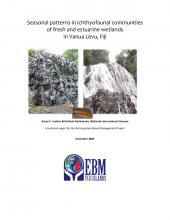
Seasonal patterns in ichthyofaunal communities of fresh and estuarine wetlands in Vanua Levu, Fiji : a technical report for the Fiji Ecosystem based management project

Biodiversity Conservation
Available Online
Jenkins, Aaron P.
,
Mailautoka, Kinikoto
2009
As a component of the Fiji Ecosystem Based management project, this study examined seasonal patterns of variation in the ichthyofaunal communities in seven river systems in Macuata and Kubulau districts, Vanua Levu, Fiji. The study was designed to determine the abundance, diversity and biomass of fishes within different reaches of the systems during the wet and dry seasons. Catchment characteristics clearly distinguish the districts in terms of potential impacts on ecological integrity. Macuata catchments, on average, are much larger (25789 vs 3306 ha), possess much less natural forest cover (49.6 vs 76 %), have greater density of roads (1.7 vs 0.51/km2 ) and river crossings (1.4 vs 0/km2 ), and are heavily invaded by exotic species Oreochromis spp and Gambusia affinis. Rainfall patterns are similar during the wet season for the districts but Kubulau has on average twice the rainfall during the dry season. 1616 individual fishes were collected or observed from 32 families, 19 genera and 87 species both seasons. 12% more species were seen during the wet season (68 vs 58), however the two districts show conflicting patterns with higher numbers of species in the wet in Kubulau District and higher numbers of species in the dry in Macuata District. Over half of species were observed in only one season (55%), 19 (21%) species only in the dry, 29 (33%) only in the wet. Proportions of life history patterns remain relatively consistent across both seasons although there are 6 % more estuarine migrant species (particularly mud dwelling species) and 1 % more amphidromous species in the wet while there is a 4% increase in freshwater straggler species in the dry mainly driven by additional pipefish species. It is clear that Kubulau, despite its smaller average catchment sizes is significantly (p = 0.035) more diverse than Macuata. Examination of community structure across reach and season suggest that position in river reach is a greater determinant of what species are in a community than season. A conflicting pattern between the districts with regard to seasonal influence on species richness, diversity, abundance and biomass of fishes if taken in conjunction with the water quality information, suggests the wet season is having a net positive effect on habitable space for fishes in Kubulau District and having a net negative effect in Macuata District. This result suggests degraded catchments are losing ecological resilience and natural responses to cycles of seasonal change. Comparison of mean abundance and biomass in Vanua Levu to the pristine rivers of Tetepare Island, Solomon Islands suggest that the rivers of Vanua Levu are already severely ecologically compromised and in most cases adequate biomass for food utilization is only energetically worthwhile in lower reaches.