Search the SPREP Catalogue

Refine Search Results

Tags / Keywords

Available Online

Tags / Keywords

Available Online

1853 result(s) found.

Sort by

You searched for

  • Tags / Keywords fiji
    X
Elasmobranch captures in the Fijian pelagic longline fishery
Biodiversity Conservation

Gilman, Eric

,

Piovano, Susanna

2016
1. Pelagic longline fisheries for relatively fecund tuna and tuna-like species can have large adverse effects on incidentally caught species with low-fecundity, including elasmobranchs. 2. Analyses of observer programme data from the Fiji longline fishery from 2011 to 2014 were conducted to characterize the shark and ray catch composition and identify factors that significantly explained standardized catch rates. Catch data were fitted to generalized linear models to identify potentially significant explanatory variables. 3. With a nominal catch rate of 0.610 elasmobranchs per 1000 hooks, a total of 27 species of elasmobranchs were captured, 48% of which are categorized as Threatened under the IUCN Red List. Sharks and rays made up 2.4% and 1.4%, respectively, of total fish catch. Blue sharks and pelagic stingrays accounted for 51% and 99% of caught sharks and rays, respectively. 4. There was near elimination of ‘shark lines’, branchlines set at or near the sea surface via attachment directly to floats, after 2011. 5. Of caught elasmobranchs, 35% were finned, 11% had the entire carcass retained, and the remainder was released alive or discarded dead. Finning of elasmobranchs listed in CITES Appendix II was not observed in 2014. 6. There were significantly higher standardized shark and ray catch rates on narrower J-shaped hooks than on wider circle hooks. Based on findings from previous studies on single factor effects of hook width and shape, the smaller minimum width of the J-shaped hooks may have caused the higher shark and ray catch rates. For sharks, the effect of hook width may have exceeded the effect of hook shape, where small increases in shark catch rates have been observed on circle vs J-shaped hooks. 7. Shark and ray standardized catch rates were lowest in the latter half of the year. Focusing effort during the second half of the year could reduce elasmobranch catch rates.
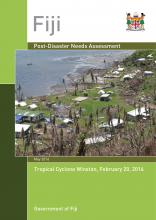
Fiji Post-Disaster Needs Assessment : Tropical Cyclone Winston, February 20, 2016
Biodiversity Conservation
Available Online

Ester, Simone

2016
On Saturday February 20, 2016, Tropical Cyclone (TC) Winston, an extremely destructive Category 5 cyclone, struck Fiji. TC Winston was the first Category 5 cyclone to directly impact Fiji and the most intense cyclone on record to affect the country.1 Fiji’s Eastern Division was the first to be struck, with Koro, Ovalau and Taveuni Islands sustaining severe damage. The cyclone swept across Fiji’s islands, reaching its peak strength shortly before making landfall on the country’s largest island, Viti Levu. Maximum average wind speeds reached 233km/hour and wind gusts peaked at around 306km/hour, making Winston one of the most powerful cyclones ever recorded in the Southern Hemisphere.2 In addition to the extreme wind speeds, many islands were flooded by storm surges, including Koro Island and the southern coast of Fiji’s secondlargest island, Vanua Levu, which was inundated almost 200 meters inland in some areas. Following TC Winston’s passage from Fiji, reports emerged of widespread damage and destruction, with the cyclone impacting approximately 540,400 people, equivalent to 62 percent of the country’s total population.3 The storm brought down the power and communications systems linking the islands, with approximately 80 percent of the nation’s population losing power, including the entire island of Vanua Levu, and 44 fatalities were subsequently confirmed. Entire communities were destroyed and approximately 40,000 people required immediate assistance following the cyclone.4 30,369 houses, 495 schools and 88 health clinics and medical facilities were damaged or destroyed. In addition, the cyclone destroyed crops on a large scale and compromised the livelihoods of almost 60 percent of Fiji’s population.
Cetacean diversity, common occurrence and community importance in Fijian waters

Batibasaga, Aisake

,

Chand, Prerna

,

Dulunaqio, Sirilo

,

Fox, Margaret

,

Jupiter, Stacy

,

Miller, Cara E.

,

Naisilisili, Waisea

,

Nand, Yashika

,

Sharma-Gounder, Saras

,

Smith, Brian

2016
Fiji has demonstrated a strong commitment to cetacean conservation via national, regional and international plans and agreements. To provide baseline information in support of these efforts, this paper provides an updated listing of cetacean species found in Fijian waters and identifies locations where cetaceans have been noted on a consistent basis. Information for this review was sourced from peer-reviewed publications, field reports, historical whaling records, national consultations, anecdotal and opportunistic sources, as well as a national database held by the Fiji Government's Department of Fisheries. Reliable and recent records were confirmed for 10 cetacean species in Fijian waters. In addition, less reliable records and regional species' information provides support for the occurrence of at least 14 additional species or groups of similar-looking species that could not be identified more specifically. Thirteen hotspot areas within the Fiji Economic Exclusive Zone were preliminarily identified as being particularly important for cetaceans, including numerous sites within the Vatu-i-Ra and Lomaiviti passages and surrounding waters. Issues with the available data include uneven coverage, inherent biases within available sources, and difficulties with species identification and verification in some cases. Nevertheless, it is hoped that this review will provide a reference point from which to move forward with cetacean management and conservation efforts in Fiji.
Systematic conservation planning within a Fijian customary governance context

Aalbersberg, W.

,

Comley, J.

,

Weeks, R.

,

Wendt, H. K.

2016
Although conservation planning research has influenced conservation actions globally in the last two decades, successful implementation of systematic conservation plans in regions where customary marine tenure exists has been minimal. In such regions, local community knowledge and understanding of socioeconomic realities may offer the best spatially explicit information for analysis, since required socioeconomic data are not available at scales relevant to conservation planning. Here we describe the process undertaken by the Kadavu Yaubula Management Support Team, a team of researchers from The University of the South Pacific and the local communities to assess whether systematic conservation planning tools can be effectively applied and useful in a customary governance context, using a case study from Fiji. Through a participatory approach and with the aim of meeting local-scale conservation and fisheries needs, a spatial conservation planning tool, Marxan with Zones, was used to reconfigure a collection of locally designed marine protected areas in the province of Kadavu in order to achieve broader objectives. At the local scale, the real value of such tools has been in the process of identifying and conceptualising management issues, working with communities to collate data through participatory techniques, and in engaging communities in management decision making. The output and use of the tool has been of secondary value. The outcome was invaluable for developing marine protected area network design approaches that combine traditional knowledge with ecological features in a manner appropriate to a Melanesian context.