Search the SPREP Catalogue

Refine Search Results

Tags / Keywords

Available Online

Tags / Keywords

Available Online

1025 result(s) found.

Sort by

You searched for

  • Tags / Keywords cook islands
    X
Source information for the inventory of dioxins and furan releases in the Cook Islands, September 2010
Biodiversity Conservation

Hilyard, Maureen

2010
Dioxins are organic compounds that are not produced intentionally but only as a product of other chemical procedures such as incineration, wood and fuel burning, combustion,and others. When dioxins enter the food chain,they are retained in the fatty tissue of living organisms. General hospital waste, including used bandages, are put into yellow bins to indicate that they will be burned in the incinerator. Syringes from the outer islands are delivered to the incinerator in special boxes. Needles are disposed of in a special electric burner. The incinerator area has become a dumping ground for a variety of waste not just for burning. The hospital does not have a sustainable environment policy. Quarantine wastes are incinerated at the Rarotonga airport. Two incinerators were purchased in 1973. One has only one of its two chambers operational. The other has not worked for years and has supplied parts for the other as parts are no longer available. The Airport Authority and AirNZ have had discussions about the efficiency of the incineration process, especially when food waste from LSG is included with wet waste from daily aircraft. A new incinerator for the airport is warranted if aircraft waste continues to be required to be burned at its destination.. A general survey of domestic fuel and waste burning revealed that 89% of households use gas cookers although 33%also use an umu for cooking food at least once a month. 68% burn green waste with only 2 of those who were surveyed having compost bins. 17.6 tonnes of wood and 2794 kg of LPG are burned by householders each month. Recycling is used with varying degrees of efficiency within our schools. Green waste is burned in all schools. Some attempt at composting is used in one of the primary schools. None of the schools had an environmental sustainability policy, and it was noted that students had seen already separated material combined together during the weekly collection by the waste contractors. There is not enough information about who accepts material for recycling or other more appropriate methods of disposal of school waste. In 2008,the statistics department recorded 17 million litres of gasoline and other mineral fuels imported to the Cook Islands for general use by the public for cars,boats,etc,and also by Te Aponga Uiraandthe Airport Authority. In 2010, 21% of the 9214 registered vehicles are older than 6 years with implications as to their effectiveness regarding exhaust emissions. 336,000 litres of fuel is consumed annually by the inter island shipping service and local charter and recreational craft. There is no policy about the disposal of waste oil. 11 tonnes of tobacco products including 8.5 million cigarettes were imported into the Cook Islands in 2008. 52 tonnes of plastic and polymers were imported in 2008, mainly for use by food vendors.
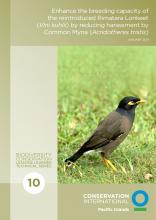
The Distribution and Abundance of Myna Birds (Acridotheres tristis) and Rimatara Lorikeets (Vini kuhlii) on Atiu, Cook Islands.
Biodiversity Conservation, BRB
Available Online

Heptonstall. R.E.A

2010
The Common Myna Acridotheres tristis was originally introduced to the island of Atiu, Cook Islands, in 1915 to control the Coconut stick insect Graeffea crouanii but it has since become a pest itself. The Rimatara lorikeet Vini Kuhlii or ‘Kura’ was reintroduced, after disappearing from the Southern Cook Islands almost 200 years ago, to Atiu on 24th April 2007 from Rimatara, French Polynesia to create a reserve population due to there being only approximately 1000 birds left on Rimatara. Due to observations of mynas reportedly harassing and attacking adult and juvenile Kura at the nest, an eradication programme was introduced by Gerald McCormack, Director of the Cook Island Natural Heritage Trust (CINHT), in May 2009 to reduce the population size of myna birds to give the Kura a couple of peaceful nesting seasons to help establish a stable population on Atiu. A study by J. Mitchell of the University of Leeds in May/June 2009 estimated a starting count of approximately 6000 myna birds prior to the eradication programme. That survey was followed up in May 2010 using two strategies, the transect method and roost counts. Analysis of transect method counts, using the Distance software, estimate there are approximately 3128 mynas on Atiu. Roost counts were at variance with that figure and estimated only 1280 myna birds. The roost counts estimate of 1280 may be the most accurate because all mynas would be in the winter roosts for heat conservation from May to July alleviating the concern that females and young would be nesting away from the roosts during counts, whereas transect counts may involve recounting the same birds numerous times; a problem minimized by repeating transect counts twice daily and using different transects to cover as much of the expected habitat as possible. Only a limited survey of the population of Kura was possible during this visit to Atiu since almost all available time and logistics were focused on myna surveys. An estimate of the Kura population suggests there are approximately 100 birds, which suggests that since the 2007 introduction the Kura population is thriving on Atiu. However, comparisons with the exponential growth rate model of 184 birds suggest this difference could be due to myna bird harassment despite culling. A more comprehensive survey is recommended perhaps using similar strategies to determine whether the myna has any deleterious effect on the Kura. In July 2010 a new myna bounty was introduced and is proving successful as a further 383 myna birds were culled by the end of July. The Atiu Island Council may decide on complete eradication of the myna to give the Kura full advantage of living on Atiu in the absence of the competitive myna bird.