Search the SPREP Catalogue

Refine Search Results

Tags / Keywords

Language

Available Online

Tags / Keywords

Available Online

74 result(s) found.

Sort by

You searched for

  • Tags / Keywords rodents
    X
Improving the efficiency of aerial rodent eradications by means of the numerical estimation of rodenticide density
Biodiversity Conservation, BRB
Available Online

Aguirre-Muñoz, A.

,

Méndez-Sánchez, F.A.

,

Rojas-Mayoral, B.

,

Rojas-Mayoral, E.

2019
Invasive rodents are present on approximately 80% of the world’s islands and constitute one of the most serious threats to island biodiversity and ecosystem functioning. The eradication of rodents is central to island conservation eff orts and the aerial broadcast of rodenticide bait is the preferred dispersal method. To improve the efficiency of rodent eradication campaigns, the generation of accurate and real-time bait density maps is required. Creating maps to estimate the spatial dispersion of bait on the ground has been carried out using traditional GIS methodologies, which are based on limiting assumptions and are time intensive. To improve accuracy and expedite the evaluation of aerial operations, we developed an algorithm for the numerical estimation of rodenticide density (NERD). The NERD algorithm performs calculations with increased accuracy, displaying results almost in real-time. NERD describes the relationship between bait density, the mass fl ow rate of rodenticide through the bait bucket, and helicopter speed and produces maps of bait density on the ground. NERD also facilitates the planning of helicopter fl ight paths and allows for the instant identification of areas with low or high bait density. During the recent and successful rodent eradication campaign on Banco Chinchorro in Mexico, carried out during 2015, NERD results were used to enable dynamic decision-making in the fi eld and to ensure the efficient use of resources.
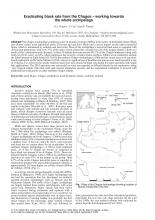
Eradicating black rats from the Chagos - working towards the whole archipelago
Biodiversity Conservation, BRB
Available Online

Carr, P.

,

Harper,G.A.

,

Pitman, H.

2019
The Chagos Archipelago comprises some 58 islands covering 5,000 ha in the centre of the Indian Ocean. Black rats (Rattus rattus) were introduced about 230 years ago and have likely had a severe impact on the native terrestrial fauna, which is dominated by seabirds and land crabs. Most of the archipelago’s terrestrial land mass is vegetated with old coconut plantations, with over 75% of the native forest cleared for coconut from 26 of the largest islands. Likely as a result of this colonisation and clearance, at least 30 islands have rats present (95.3% of the Chagos landmass) along with feral cats (Felis catus) on 62%, which suppresses the recovery of native fauna and fl ora. Efforts at rat eradication include the failed attempt on Eagle Island (252 ha) in the northern Chagos Archipelago in 2006 and the recent success of a ground-based eradication on Île Vache Marine in 2014, where two applications of brodifacoum poison were hand-spread at a rate of 18 kg/ha. Two islets on the nearby Salomon atoll were also cleared of black rats during the same operation with single bait applications. The 2014 operation was successful on what are regarded as difficult islands for rat eradication, being ‘wet’ tropical islands with land crabs and coconut plantations present, and has engendered confidence to proceed with additional rat eradications on other northern Chagos islands.
Bridging the research-management gap: using knowledge exchange and stakeholder engagement to aid decision-making in invasive rat management
Biodiversity Conservation, BRB
Available Online

Ewen, J.G.

,

Ferrière, C.

,

Jones, C.G.

,

Maggs, G.

,

Murrell, D.J.

,

Nicoll, M.A.C.

,

Norris, K.

,

Tatayah, V.

,

Zuël, N.

2019
The world is facing a biodiversity crisis. Nowhere is that more apparent than on oceanic islands where invasive species are a major threat for island biodiversity. Rats are one of the most detrimental of these and have been the target of numerous eradication programmes; a well-established conservation tool for island systems. For at-risk native species inhabiting large, populated islands, where rat eradication is not an option, control of rat populations has been conducted but this requires continuous management and therefore its long-term viability (and that of the at-risk native species which the project aims to protect) can be uncertain. Large-scale rat management areas or ‘mainland islands’ have been successfully developed in New Zealand. However, large-scale management is a long-term investment with huge financial implications and committing to such an investment can be met with reluctance. This reluctance, and its subsequent hindrance to decision-making, can be caused by uncertainty relating to species conservation outcomes, and the multiple objectives of stakeholders. We address the issue of uncertainty and the importance of communication between all stakeholder parties in relation to the Mauritius olive white-eye (Zosterops chloronothos), a critically endangered passerine endemic to Mauritius and highly threatened by invasive rats. Specifically, we illustrate how the combination of scientific research and communication, knowledge exchange, and stakeholder workshops, can address some of the barriers of decision-making, helping to bridge the research-management gap, and enable the timely expansion of existing rat management for the benefit of this highly threatened bird.
Timing aerial baiting for rodent eradications on cool temperate islands: mice on Marion Island
Biodiversity Conservation, BRB
Available Online

Parkes, J.P.

2019
Aerial baiting from helicopters with a bait-sowing bucket and GPS to ensure coverage with anticoagulant toxins in cereal-based baits can reliably eradicate rodents on islands. Current best practice for temperate islands is to bait in winter when the rodents are not breeding, rodent numbers are lowest so competition for toxic baits is lowest, natural food is likely to be scarce, and many non-target species are absent from the island. However, short winter day lengths at high latitudes restrict the time helicopters can fly and poor weather in winter may increase risks of failure. This paper notes precedents from cool temperate islands where baiting was not conducted in winter and then uses the extensive data on mice on Marion Island to explore whether current recommendations for winter baiting based on breeding and natural food availability are important risk factors in determining time of year to bait. Marion Island mice do not breed between early May and late September, mouse densities reach a maximum in May and minimum in November, but the biomass of main natural food (invertebrates) does not fluctuate greatly over the year. This means the per capita food availability is least in autumn and increases through winter to most in spring and summer. The weight of the stomach contents of mice is also highest in winter. Based on this per capita food parameter, mice are likely to be most hungry between about March and May suggesting baiting would be more effective in this period (perhaps towards the end of it when breeding stops) than in the more traditional winter season.
A potential new tool for the toolbox: assessing gene drives for eradicating invasive rodent populations
Biodiversity Conservation, BRB
Available Online

Brown, P.R.

,

Campbell, K.J.

,

Delborne, J.

,

Godwin, J.

,

Gould, F.

,

Howald, G.R.

,

Kanavy, D.M.

,

Kuiken, T.

,

Packard, H.

,

Piaggio, A.

,

Saah, J.R.

,

Serr, M.

,

Shiels, A.

,

Thomas, P.

,

Threadgill, D.

,

Tompkins, D.M.

2019
Invasive rodents have significant negative impacts on island biodiversity. All but the smallest of rodent eradications currently rely on island-wide rodenticide applications. Although significant advances have been made in mitigating unintended impacts, rodent eradication on inhabited islands remains extremely challenging. Current tools restrict eradication efforts to fewer than 15% of islands with critically endangered or endangered species threatened by invasive rodents. The Genetic Biocontrol of Invasive Rodents partnership is an interdisciplinary collaboration to develop and evaluate gene drive technology for eradicating invasive rodent populations on islands. Technological approaches currently being investigated include the production of multiple strains of Mus musculus with a modified form of the native t-complex, or a CRISPR gene drive, carrying genes or mechanisms that determine sex. These systems have the potential to skew the sex ratio of off spring to approach 100% single-sex, which could result in population collapse. One goal proposed is to test the ability of constructs to spread and increase in frequency in M. musculus populations in biosecure, captive settings and undertake modelling to inform development and potential deployment of these systems. Structured ecologically-based risk assessments are proposed, along with social and cultural engagement to assess the acceptability of releasing a gene drive system. Work will be guided by an external ethics advisory board. Partners are from three countries with significant regulatory capacity (USA, Australia, New Zealand). Thus, we will seek data sharing agreements so that results from experiments may be used within all three countries and treat regulatory requirements as a minimum. Species-specific, scalable, and socially acceptable new eradication tools could produce substantial biodiversity benefits not possible with current technologies. Gene drive innovation may provide such a tool for invasive species management and be potentially transformative and worthy of exploring in an inclusive, responsible, and ethical manner.
The impacts of introduced house mice on the breeding success of nesting seabirds on Gough Island
BRB
Available Online

Bond, Alexander L.

,

Caravaggi, Anthony

,

Cooper, John

,

Cuthber, Richard J.

,

Ryan, Peter G.

2018
Invasive species are the main threat to island biodiversity; seabirds are particularly vulnerable and are one of the most threatened groups of birds. Gough Island, a UNESCO World Heritage Site in the South Atlantic Ocean, is an Important Bird and Biodiversity Area, and one of the most important seabird colonies globally. Invasive House Mice Mus musculus depredate eggs and chicks of most seabird species on the island, but the extent of their impact has not been quantified. We used field data and bootstrapped normal distributions to estimate breeding success and the number of surviving chicks for 10 seabird species on Gough Island, and compared estimates with those of analogous species from predator-free islands. We examined the effects of season and nest-site location on the breeding success of populations on Gough Island, predicting that the breeding success of Gough birds would be lower than that of analogues, particularly among small burrownesting species. We also predicted that winter-breeding species would exhibit lower breeding success than summer-breeding species, because mice have fewer alternative food sources in winter; and below-ground nesters would have lower breeding success than surface nesters, as below-ground species are smaller so their chicks are easier prey for mice. We did indeed find that seabirds on Gough Island had low breeding success compared with analogues, losing an estimated 1 739 000 (1 467 000–2 116 000) eggs/ chicks annually. Seven of the 10 focal species on Gough Island had particularly high chick mortality and may have been subject to intense mouse predation. Below-ground and winter breeders had lower breeding success than surface- and summer-breeders. MacGillivray’s Prion Pachyptila macgillivrayi, Atlantic Petrel Pterodroma incerta and Tristan Albatross Diomedea dabbenena are endemic or near-endemic to Gough Island and are likely to be driven to extinction if invasive mice are not removed.
Estimating burdens of neglected tropical zoonotic diseases on islands with introduced mammals

BRB
Available Online

Croll, Donald A.

,

Holmes, Nick D.

,

Kilpatrick, A. Marm.

,

Newton, Kelly M.

,

Spatz, Dena R.

,

Tershy, Bernie.

,

de Wit, Luz A.

2017
Many neglected tropical zoonotic pathogens are maintained by introduced mammals, and on islands the most common introduced species are rodents, cats, and dogs. Management of introduced mammals, including control or eradication of feral populations, which is frequently done for ecological restoration, could also reduce or eliminate the pathogens these animals carry. Understanding the burden of these zoonotic diseases is crucial for quantifying the potential public health benefits of introduced mammal management. However, epidemiological data are only available from a small subset of islands where these introduced mammals co-occur with people. We examined socioeconomic and climatic variables as predictors for disease burdens of angiostrongyliasis, leptospirosis, toxoplasmosis, toxocariasis, and rabies from 57 islands or island countries. We found strong correlates of disease burden for leptospirosis, Toxoplasma gondii infection, angiostrongyliasis, and toxocariasis with more than 50% of the variance explained, and an average of 57% (range = 32–95%) predictive accuracy on out-of-sample data. We used these relationships to provide estimates of leptospirosis incidence and T. gondii seroprevalence infection on islands where nonnative rodents and cats are present. These predicted estimates of disease burden could be used in an initial assessment of whether the costs of managing introduced mammal reservoirs might be less than the costs of perpetual treatment of these diseases on islands.