Search the SPREP Catalogue

Refine Search Results

Tags / Keywords

Available Online

Tags / Keywords

Available Online

27 result(s) found.

Sort by

You searched for

  • Tags / Keywords Problem definition, Prioritisation, Decision-making
    X
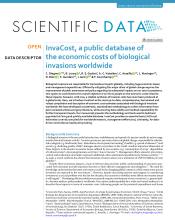
InvaCost, a Public Database of the Economic Costs of Biological Invasions Worldwide
Biodiversity Conservation, BRB
Available Online

Assailly, C.

,

Courchamp, F.

,

Diagne, C.

,

Gozlan, R. E.

,

Jarić, I.

,

Jourdain, F.

,

Leroy, B.

,

Nuninger, L.

,

Roiz, D.

,

Vaissière, A.-C.

2020
Biological invasions are responsible for tremendous impacts globally, including huge economic losses and management expenditures. Efficiently mitigating this major driver of global change requires the improvement of public awareness and policy regarding its substantial impacts on our socio-ecosystems. One option to contribute to this overall objective is to inform people on the economic costs linked to these impacts; however, until now, a reliable synthesis of invasion costs has never been produced at a global scale. Here, we introduce InvaCost as the most up-to-date, comprehensive, harmonised and robust compilation and description of economic cost estimates associated with biological invasions worldwide. We have developed a systematic, standardised methodology to collect information from peer-reviewed articles and grey literature, while ensuring data validity and method repeatability for further transparent inputs. Our manuscript presents the methodology and tools used to build and populate this living and publicly available database. InvaCost provides an essential basis (2419 cost estimates currently compiled) for worldwide research, management efforts and, ultimately, for datadriven and evidence-based policymaking.
Abundance and Home ranges of Feral Cats in an Urban Conservancy where there is Supplemental Feeding: a case study from South Africa
Biodiversity Conservation, BRB
Available Online

Downs, C.T.

,

Tennent, J.

2008
There is much debate surrounding the impact of feral cats (Felis catus) on wildlife. Conservancies areusually areas where indigenous flora and fauna are protected and aliens excluded or managed. The University of KwaZulu-Natal’s Howard College campus (HCC) is an urban conservancy containing feral cats that are presently not managed, and little is known about their ecology and behaviour. Consequently a feral cat population census was conducted, and their home range investigated. Estimates of the overall campus feral cat population numbers ranged between 23.4–40.0 cats/km2 with a minimum of 55 identified as resident. They were not randomly distributed in the study area, with spacing patterns being related to resource availability. Home range area and core distribution of eight radio-collared cats were determined over 13 months. Total home range areas were relatively small, with considerable overlap between them. Home ranges were clustered in areas with permanent feeding stations and these were also within the cats’ core ranges. Supplemental food resources appear to have a major influence on numbers, home and core range area, and behavior of cats. It is clear that cat densities grow to high levels with reliable and abundant food supply and only ad hoc sterilization. This has implications for their management in the HCC urban conservancy.