Search the SPREP Catalogue

Refine Search Results

Tags / Keywords

Available Online

Tags / Keywords

Available Online

5433 result(s) found.

Sort by

You searched for

  • Organisation Secretariat of the Pacific Regional Environment Programme (SPREP)
    X
Strategies and on the ground options for climate change adaptation and disaster risk management in the Pacific
Climate Change Resilience
Available Online

Faletau, Taniela

,

Leavai, Peniamina

,

McFadzien, Diane

,

Ronneberg, Espen

2012
Small Island developing states (SIDS) have ongoing projects and projects in the pipeline which are targeted at implementing adaptation measures. In the Pacific alone there have been a range of such initiatives starting with the PICCAP project in the late 90s to the ongoing PACC project, the latter building on the lessons learnt from its predecessors to help increase resilience to the impacts of climate change. On a global, regional and national level these projects have stringently involved strengthening of institutions, policy and regulations, but more importantly evolved to implement on the ground-level tasks, many of which follow on from, or are acting in synergy with other projects for the mainstreaming of climate change adaptation (CCA) and disaster risk reduction (DRR) initiatives in communities. A key challenge in this context for decision makers, policy makers, and development partners is to understand and adopt strategies that are effective in mobilizing people and resources in response to CCA and DRR. All efforts in this context must be made to learn from past lessons and concerted action taken to refine, augment and deploy these initiatives appropriately and urgently.
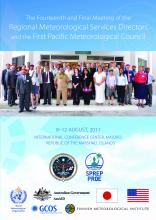
Report of the Fourteenth (14th) and final meeting of the Regional Meteorological Services Directors (RMSD) and the First (1st) Pacific Meteorological Council (PMC-1), 8–12 August 2011, Majuro, Marshall Islands
Available Online

Secretariat of the Pacific Regional Environment Programme (SPREP)

2012
The Regional Meteorological Services Directors (RMSD) Meeting convened for its 14th session at the International Conference Centre in Majuro, Republic of the Marshall Islands from 9–12th August 2011. It was preceded by a Pacific Regional Meteorological Services Directors Workshop in Support of Climate Adaptation Planning in the Pacific Islands on 8th August. The objectives of the meeting were for participants to formulate and establish a clear understanding of the Pacific Meteorological Council (PMC), the Pacific Desk Partnership concept (since renamed as the Pacific Meteorological Desk Partnership, PMDP), and the Pacific Meteorological Strategic Plan (PMSP) (2012– 2015). A total of 54 participants attended the meeting. Primarily the participants were Meteorological Service Directors and representatives from American Samoa, Australia, Cook Islands, Federated States of Micronesia, Fiji, French Polynesia, Guam, Kiribati, New Caledonia, New Zealand, Palau, Papua New Guinea, Marshall Islands, Samoa, Solomon Islands, Tonga, Tuvalu, United States of America and Vanuatu. Representatives of the Finnish Meteorological Institute, SPREP, SPC, WMO, UNESCO-IOC, Institute for Global Environmental Strategies, University of Oklahoma, Pacific ENSO Applications Climate (PEAC) Centre (co-located at the University of Hawaii and the University of Guam) were also present
Pacific Island States capacity development needs for climate change adaptation and disaster risk reduction
Climate Change Resilience, Biodiversity Conservation
Available Online

Faletau, Taniela

,

Leavai, Peniamina

,

McFadzien, Diane

,

Ronneberg, Espen

2012
This paper provides a brief examination of capacity development needs for climate change adaptation (CCA) and disaster risk reduction (DRR) in small island developing states (SIDS). It is noted that this is a critical time for SIDS which must contend with ongoing developmental pressures in addition to growing pressures from risks associated with global environmental change and economic liberalisation that threaten their physical and economic security. Much depends in this context on the orientation of SIDS in global economic and political systems. Getting the policies right is proving to be very difficult as SIDS continue to be deficient in a critical mass of intellectual capital, policy coherence, financial resources and qualified personnel that are needed to develop and implement sustainable development policies and projects. In turn, this critically hampers the emergence of adequate systemic capacity. SIDS however have a history of changes at the global and regional levels which not only created constraints but can be seen as a source of new opportunities for building resilience to natural disasters. How effective this process transpires in the end will depend on how well lessons learnt from preceding years are taken on board and effectively acted upon.