Search the SPREP Catalogue

Refine Search Results

Tags / Keywords

Available Online

Tags / Keywords

Available Online

5433 result(s) found.

Sort by

You searched for

  • Organisation Secretariat of the Pacific Regional Environment Programme (SPREP)
    X
The Republic of the Marshall Islands: State of the Environment (SOE) Report 2016
Available Online
2016
The 2016 State of Environment (SOE) Report for the Republic of Marshall Islands (RMI) updates the 1992 SOE report. It uses the DPSIR model (Drivers, Pressures, State, Impact and Response) and aims to:| Document the key drivers and pressures behind the changing environment.| Assess the RMI environment since 1992, using the best available information on the state of RMI’s environment in seven key themes: Atmosphere and Climate, Land, Marine, Biodiversity, Culture and Heritage, Built Environment and Nuclear Legacy.| Document the impacts of environmental changes on the society, economy and environment from changes in the state of the environment.| Document current responses to protect and better manage RMI’s natural resources.| Provide recommendations for RMI to address key challenges and link them to actions in the National Environmental Management Strategy (NEMS) and other key policy documents. This report is comprised of three discussions: 1. Drivers and Pressures in Marshall Islands: A summary of the main points discussed in the Pressures and Drivers section of the report. 2.The State of RMI’s Environment and Impacts on the Society, Economy and Environment: Key findings for each of the seven themes. 3. Responses and Recommendations – Challenges in Moving from Policy to Action: This presents key responses, opportunities, challenges and recommendations.
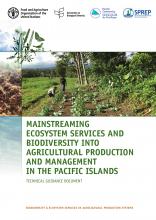
Mainstreaming Ecosystem Services and Biodiversity into Agricultural Production and Management in the Pacific Islands - Technical guidance document
Biodiversity Conservation
Available Online

FAO

2016
The international community is increasingly aware of the link between biodiversity and sustainable development and its direct impact on wealth, health and well-being. Biodiversity is the origin of all crops and domesticated livestock. It is also the source of vital ecosystem services and functions, including soil conservation, water cycling, pollination, pest and disease regulation, carbon sequestration and nitrogen fixation. Biodiversity and the ecosystem services it supports are thus key to nutritional diversity and to agricultural productivity and resilience. The Convention on Biological Diversity (CBD) Strategic Plan for Biodiversity 2011–2020 and its 20 Aichi Biodiversity Targets provide a framework for countries to develop national targets and policies for sustaining biodiversity for a healthy planet. To meet rising global food demands, agricultural systems need to produce greater quantities of more diverse and nutritious food in a sustainable way. This progress can and must be achieved without driving biodiversity loss. It must come through gains in the efficiency of resource use, through sustainable intensification and a landscape perspective in agricultural production. By contributing to the conservation and sustainable use of biodiversity, agriculture will be a key driver for eliminating poverty, improving human health and providing energy, food and clean water for all while maintaining natural ecosystems.