Search the SPREP Catalogue

Refine Search Results

Language

Available Online

Available Online

58 result(s) found.

Sort by

You searched for

Dugong surveys of Manus and Bougainville Islands, Papua New Guinea
Available Online

Bass Deborah

2009
Dugong dugon are the last extant species in the Family Dugongidae and are listed as Vulnerable to extinction by the IUCN Red List. The dugong population is believed to be in decline globally. Throughout its range, relic populations remain and are separated by large areas where populations have disappeared (Marsh & Lefebvre 1994). The degree of the decline of numbers or fragmentation of its range is not known for any country. For many countries the only information available is from incidental sightings, drownings and anecdotal information. The Pacific region supports the world's largest remaining population of dugongs (Marsh et al. 2002). Dugong occur in most of Melanesia, Papua New Guinea (PNG), the northeast and east coasts of Australia and as far east as Vanuatu.. The current status of dugongs is unknown throughout the region (Marsh et al. 2002) and information on dugong distribution and abundance is outdated or non-existent. It is likely that dugongs are widely distributed in small numbers in much of PNG. the Solomon Islands and Vanuatu and that larger numbers occur in the Papua New Guinea waters of Torres Strait. Marsh et al. (2002) states that their reliance on relatively shallow water seagrass beds for food, limits the ability of dugongs to travel between islands and continents that are separated by extensive areas of deep water. For this reason, many island populations become essentially isolated, making these populations especially vulnerable to extinction.
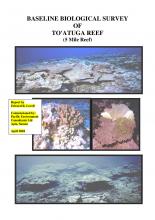
Baseline biological survey of To'atuga reef : Samoa
Available Online

Lovell, Edward R.

2004
To’atuga Reef is located between 6.5-7.4 km (3.5-4.0 nautical miles) north or seaward of Apia Harbour (middle) on the north coast of Upolo Island, Samoa. It is an elongate ridge of reef extending in a NW–SE axis, with a broad reef top which ranges between 15-22m descending on a slope of 300 450 with vertical sections to a sand and rubble bottom at 35-40m. The reef top is characterised by a low topographic relief with the undulating contours of small ridges and depressions. This report provides a baseline description of the major habitat types and dominant fauna present on the reef. A basic inventory and description of the To’atuga marine environment is undertaken. Transects were used to detail the occurrence primarily of fish, coral, algae, mobile invertebrates and physical substrate types. Preliminary species inventories were compiled for hard coral and fish, with records of other benthos. General features of the habitat such as the surge environment, current, depth, bathymetric profile, community type and dynamics are described. Bathymetric assessment was aided by the profiling of the reef by South Pacific Applied Geoscience Commission (SOPAC) which provided a framework for site position and general reef assessment. Impacts of storms, coral bleaching, disease and the human impacts of recreational diving, fishing and anchoring are discussed and management recommendations made.