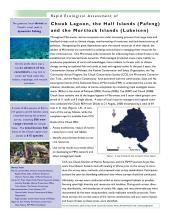
Rapid ecological assessment of Chuuk lagoon, the Hall islands (Pafeng) and the Mortlock Islands (Lukeisen)

Climate Change Resilience
Available Online
Conservation Society of Pohnpei
Throughout Micronesia, marine ecosystems are under increasing pressure from large-scale and localized threats such as climate change, overharvesting of resources, and land-based sources of pollution. Recognizing the great dependence upon the natural resources of their islands, the leaders of Micronesia are committed to assisting communities in managing these resources for their continued use. One Micronesia-wide movement for addressing these critical threats is the establishment of protected areas networks. Well-managed protected areas create healthy reproductive populations of coral reef assemblages, more resilient to threats such as climate change, serving to replenish fish and corals at local and regional scales. In the past 3 years, the Conservation Society of Pohnpei, the Kosrae Conservation and Safety Organization, the Yap Community Action Program, the Chuuk Conservation Society (CCS), the Micronesia Conservation Trust, and the Nature Conservancy have partnered with the communities, State and National governments of the Federated States of Micronesia (FSM) to understand the current distribution, abundances, and status of marine ecosystems by conducting rapid ecological assessments (REAs) in the states of Pohnpei (2005), Kosrae (2006), Yap (2007) and Chuuk (2008). Chuuk State contains one of the largest lagoons in Micronesia, and 3 outer island groups comprised of 11 atolls and 3 single islands. A team of local resource managers and regional scientists conducted the Chuuk REA from 28 July to 21 August, 2008, encompassing a total of 69 sites in 21 days. A summary of the survey follows, while the complete report is available from CCS.