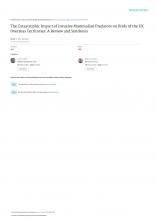
The catastrophic impact of invasive mammalian predators on birds of the UK overseas territories: a review and synthesis

BRB
Available Online
Cuthbert, Richard J.
,
Hilton, Geoff M
2010
The UK has sovereignty over 16 Overseas Territories, which hold some of the world's great seabird colonies and collectively support more endemic and globally threatened bird species than the whole of mainland Europe. Invasive alien mammalian predators have spread throughout most of the Territories, primarily since European expansion in the 16th century. Here we review and synthesize the scale of their impacts, historical and current, actions to reduce and reverse these impacts, and priorities for conservation. Mammalian predators have caused a catastrophic wave of extinctions and reductions in seabird colony size that mark the UKOTs as a major centre of global extinction. Mammal-induced declines of threatened endemics and seabird colonies continue, with four Critically Endangered endemics on Gough Island (Tristan da Cunha), St Helena and Montserrat directly threatened by invasive alien House Mice Mus musculus, Feral Cats Felis catus and rats Rattus spp. Action to reduce these threats and restore islands has been modest in comparison with other developed countries, although some notable successes have occurred and a large number of ambitious eradication and conservation plans are in preparation. Priority islands for cosnervation action against mammalian predators include Gough (which according to one published prioritization scheme is the highest-ranked island in the world for mammal eradication), St Helena and Montserrat, but also on Tristan da Cunha, Pitcairn and the Falkland Island. Technical, financial and political will is required to push forward and fund the eradication of invasive mammalian predators on these islands, which would significantly reduce extinction risk for a number of globally threatened species.