Search the SPREP Catalogue

Refine Search Results

Tags / Keywords

Available Online

Tags / Keywords

Available Online

534 result(s) found.

Sort by

You searched for

  • Tags / Keywords problem definition
    X
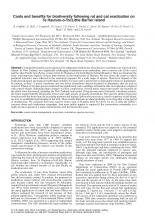
Costs and bene? ts for biodiversity following rat and cat eradication on Te Hauturu-o-Toi/Little Barrier Island
Biodiversity Conservation, BRB
Available Online

Bell, E.

,

Campbell, J.

,

Cassey, P.

,

Ewen, J.G.

,

Green, C.

,

Gri?ths, R.

,

Joyce, L.

,

Rayner, M.

,

Towns, D.

,

Toy, R.

,

Veitch, C.R.

,

Wade, L.

,

Walle, R.

2019
Considerable bene?ts can be achieved for indigenous biodiversity when invasive vertebrates are removed from islands. In New Zealand, two logistically challenging eradications were undertaken, one to remove cats (Felis catus) and the other Paci?c rats (Rattus exulans) from Te Hauturu-o-Toi/Little Barrier Island (Hauturu). Here we document the short- and long-term impacts of these interventions on the biodiversity of Hauturu. We also assess the extent to which predicted outcomes were re?ected in the measured responses for a wide range of species. Short-term impacts of the eradication program encompassed individual mortality for some native species but no measurable impact to populations. In contrast, at least 11 native vertebrates and one native invertebrate species increased in abundance after rat and cat removal. Fifteen of 34 plant species monitored had signi?cantly more seedlings on Hauturu after rat eradication compared with control islands, indicating future changes in forest composition. Several native species previously not recorded on the island were discovered, including the New Zealand storm petrel (Fregetta maoriana) (formerly considered extinct), the forest ringlet butter?y (Dodonidia helmsi) and eight species of aquatic invertebrate. The chevron skink (Oligosoma homalonotum) has been found in increasing numbers and tuatara (Sphenodon punctatus), raised in captivity on the island, are now re-established and breeding in the wild. These results illustrate an island gradually recovering after a long period of modi?cation. We conclude that more success stories such as Hauturu must be told if we are to allay the public’s concerns about such eradication campaigns. And more public support is required if the conservation community is to tackle invasive species at a scale commensurate with the threats they pose.
Island invasives: scaling up to meet the challenge. Proceedings of the international conference on island invasives 2017
Biodiversity Conservation, BRB
Available Online

Godwin, J.

,

Heard, N.

,

Serr, M.

2019
House mice are significant invasive pests, particularly on islands without native mammalian predators. As part of a multi-institutional project aimed at suppressing invasive mouse populations on islands, we aim to create heavily male-biased sex ratios with the goal of causing the populations to crash. Effective implementation of this approach will depend on engineered F1 wild-lab males being effective secondary invaders that can mate successfully. As a first step in assessing this possibility, we are characterising genetic and behavioural differences between Mus musculus strains in terms of mating and fecundity using wild house mice derived from an invasive population on the Farallon Islands (MmF), a laboratory strain C57BL/6/129 (tw2), and F1 wild-lab off spring. Mice with the ‘t allele’ (tw2) have a naturally occurring gene drive system. To assess fertility in F1 wild-lab crosses, tw2 males were paired with wild-derived females from the Farallon Islands (MmF). Results of these matings indicate litter sizes are comparable but that weaned pup and adult wild-lab mice are heavier in mass. Next, we initiated tests of male competitiveness using larger (3 m2) enclosures with enrichment. We introduced both an MmF and a tw2-bearing male to two MmF females to assess mating outcomes. Preliminary results of these experiments show none of the off spring carried the t-allele. However, performing the same experiment with F1 wild-lab males instead of a full lab background resulted in 70% of off spring carrying the tw2 allele. This indicates that F1 wild-lab males may be able to successfully compete and secondarily invade. It will be important in subsequent experiments to determine what characteristics contribute to secondary invasion success. More generally, a better understanding of characteristics contributing to overall success in increasingly complex and naturalistic environments will be critical in determining the potential of a gene drive-based eradication approach for invasive mice on islands.