Search the SPREP Catalogue

Refine Search Results

Tags / Keywords

Language

Available Online

Tags / Keywords

Available Online

22 result(s) found.

Sort by

You searched for

  • Collection BRB
    X
  • Tags / Keywords eba
    X
Climate change vulnerability assessment of species
Climate Change Resilience, BRB
Available Online

Akçakaya, H. Resit

,

Bickford, David

,

Carr, Jamie A.

,

Foden, Wendy B.

,

Garcia, Raquel A.

,

Hoffmann, Ary A.

,

Hole, David G.

,

Huntley, Brian

,

Martin, Tara G.

,

Pacifici, Michela

,

Pearce‐Higgins, James W.

,

Platts, Philip J.

,

Stein, Bruce A.

,

Thomas, Chris D.

,

Visconti, Piero

,

Watson, James E. M.

,

Wheatley, Christopher J.

,

Young, Bruce E.

2018
Assessing species' vulnerability to climate change is a prerequisite for developing effective strategies to conserve them. The last three decades have seen exponential growth in the number of studies evaluating how, how much, why, when, and where species will be impacted by climate change. We provide an overview of the rapidly developing field of climate change vulnerability assessment (CCVA) and describe key concepts, terms, steps and considerations. We stress the importance of identifying the full range of pressures, impacts and their associated mechanisms that species face and using this as a basis for selecting the appropriate assessment approaches for quantifying vulnerability. We outline four CCVA assessment approaches, namely trait?based, correlative, mechanistic and combined approaches and discuss their use. Since any assessment can deliver unreliable or even misleading results when incorrect data and parameters are applied, we discuss finding, selecting, and applying input data and provide examples of open?access resources. Because rare, small?range, and declining?range species are often of particular conservation concern while also posing significant challenges for CCVA, we describe alternative ways to assess them. We also describe how CCVAs can be used to inform IUCN Red List assessments of extinction risk. Finally, we suggest future directions in this field and propose areas where research efforts may be particularly valuable.
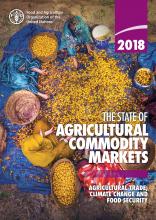
The state of agricultural dommodity markets 2018. agricultural trade, climate change and food security
Environmental Governance, Climate Change Resilience, BRB
Available Online
2018
This edition of The State of Agricultural Commodity Markets focuses on the complex and underexplored intersection between agricultural trade, climate change and food security. It is clear that we cannot tackle hunger without finding adaptation and mitigation solutions to climate change in agriculture and food systems. It is also clear that the uneven impact of climate change across regions and countries, and the corresponding changes in food availability and access will affect international trade patterns and trade routes. This report supports these discussions by providing an in-depth analysis of the Paris Agreement and the WTO agreements to enhance clarity and provide guidance on policy options that could strengthen the mutually supportive role of these accords in tackling climate change and hunger. Wide-ranging policy actions are necessary to ensure that trade will contribute to the efforts aimed at ensuring food security and promoting adaptation and mitigation to climate change. The uneven impact of climate change across the world and its implications for agricultural trade, especially for developing countries, underlines the need for a balanced approach to policies, which should enhance the adaptive role of trade, while supporting the most vulnerable.
Natural resources management and the environment in small island developing states.
BRB
Available Online
2014
The First United Nations Conference on Environment and Development held in Rio de Janeiro in 1992 (also known as the Earth Summit) acknowledged that SIDS are a special case for sustainable development (given their unique and particular vulnerabilities).This gave rise to the First International Conference on SIDS in 1994 and the Barbados Program of Action (BPOA) which is the main policy framework addressing the economic, social and environmental vulnerabilities facing SIDS. The sustainable development of SIDS was also at the heart of the Second International Conference on SIDS held in Mauritius in 2005, and the “Mauritius Strategy for the further implementation of the Programme of Action for the Sustainable Development of Small Island Developing States” was adopted and subsequently endorsed by the United Nations General Assembly. The United Nations Conference on Environment and Sustainable Development held in Rio de Janeiro in June 2012 (Rio+20) agreed to convene the Third International Conference on SIDS in 2014. This was later endorsed by the UN General Assembly (UNGA). “The Sustainable Development of Small Island Developing States (SIDS) through Genuine and Durable Partnerships” will be held in Samoa in September 2014. FAO has been involved in supporting SIDS in addressing sustainable development issues and has contributed to the regional preparatory process (i.e. Caribbean, Pacific and AIMS regions) as well as the inter-regional and global consultation process held at the UN Headquarters in New York in February 2014. The outcome documents of these preparatory meetings specifically mention topics that are relevant to FAO’s core areas such as coastal zone management and ecosystem based approaches, institutional capacity to deter illegal, unreported and unregulated fisheries and increased attention to small-scale fisheries. Climate change is also highlighted as a threat to food security, natural resources (land, water, forest and biodiversity) and marine and coastal resources. This paper focuses on the environmental challenges of sustainable development issues with particular attention to natural resource management, environment and climate change in the food and agriculture sector (including crops, livestock, fisheries and forestry). FAO’s agriculture, fisheries, forestry and technical assistance programmes provide considerable resources to assist member countries promote conservation, sustainable use and management of natural resources and to reduce the risks associated with climate extremes as well as resilience building.