Search the SPREP Catalogue

Refine Search Results

Tags / Keywords

Available Online

Tags / Keywords

Available Online

279 result(s) found.

Sort by

You searched for

  • Collection BRB
    X
  • Material Type Report
    X
Rodent baits and delivery systems for island protection / Cheryl E. O'Connor and Charles T. Eason
BRB
Available Online

Eason, Charles T.

,

O'Connor, Cheryl E.

2000
There are five toxicants (brodifacoum, bromadialone, coumatetralyl, diphacinone, and flocoumafen) registered for rodent control in New Zealand. They are all anticoagulants and are available in water-resistant bait formulations (i.e. wax coating, wax block, or egg). Several new rodenticide products, which are currently in the process of being developed or registered, including a new anticoagulant difethialone, have also been identified. There are no published data on the relative effectiveness, palatability, or durability of the existing rodenticides for field use under New Zealand conditions. However, relevant published information on laboratory and wild rodents is reviewed. It is concluded that the highest priority should be to assess the four weather resistant, second-generation anticoagulant products (Pestoff® Rodent block, Talon® 50WB, Contrac®, and Baraki®) for palatability, durability, and effectiveness for an island protection situation. Improvements could then be made to the existing products if required with additives to improve palatability or durability, lures to attract rodents, and repellents for non-target insect, lizard and bird species. Trials of an alternative (e.g. cholecalciferol) to the persistent anticoagulants should also be considered for island protection. The most rodent-attractive bait station which also eliminates bird access needs to be determined for the complete island protection system.
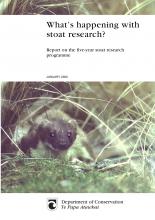
What's happening with stoat research? Report on the five-year stoat research programme
BRB
Available Online
2000
In the May 1999 budget, the New Zealand Government announced that an extra $6.6 million over five years would be given to the Department of Conservation to fund an integrated stoat control research programme. Stoats, ferrets and weasels were introduced to New Zealand in the 1880s in an attempt to control rabbits. Although stoats were implicated in the decline of some native bird species soon after their introduction, the extent to which they are still contributing to the decline of native species is only now becoming clear. Their impacts on threatened and endangered birds are of particular concern. Stoat control in New Zealand will have to be ongoing if some endemic species are to survive on the mainland. Currently, stoat control relies largely on labour-intensive trapping and the use of poisoned hen eggs. New, more cost-effective and sustainable approaches to controlling stoats are urgently needed. The extra funding means that there is now a real opportunity for finding cost-effective solutions for managing stoats. A Stoat Technical Advisory Group (composed of experts from the Department of Conservation, Lincoln University and Auckland University) has been established to develop and oversee this new research programme. Funding for the first year is $338,000 with funding increasing in 2000/01 to $1.406 million and for the subsequent three years, $1.631 million, each year.
Border control for potential aquatic weeds, stage 1 : weed risk model / P.D. Champion and J.S. Clayton
BRB
Available Online

Champion, P.D.

,

Clayton, J.S.

2000
This report is the first stage in a three-stage development of a Border Control Programme for aquatic plants that have the potential to become ecological weeds in New Zealand. A large number of freshwater aquatic plants have already been introduced and are naturalised in New Zealand, impacting on most waterbodies within this country. There are many additional potential weed species reported as present in New Zealand, but not naturalised, and an even greater number not recorded as introduced here. Some of these species could pose an even greater threat to our aquatic environment than those weeds currently naturalised. A range of tables is presented to illustrate the array of new aquatic species that are already believed to be in New Zealand or that could enter and become established. Possible entry pathways identified in this report include natural spread from wind- and bird-dispersed seed, introduction of ornamental, culinary and medicinal herbs, contaminants in other plants and produce, mislabelled plants, and various types of illegal imports. Existing weed risk assessment models fail to adequately separate aquatic plants with different levels of impact. A new model is presented, tailored to the impacts of aquatic species. Tables are presented to demonstrate the improved system of ranking risks for aquatic plant species. A combination of assessments for weediness and the risk of entry into New Zealand will determine the potential threat of each species, allowing a comparison with existing weed species and other species not yet naturalised or introduced here. The greatest risk is perceived to be posed by some species reported to be present, but not yet naturalised in New Zealand, followed by species not reported here, but traded overseas with the potential to be brought here illegally.
Atolls as settlement landscapes: Ujae, Marshall Islands
Biodiversity Conservation, BRB
Available Online

Weisler Marshall I

1999
Williamson and Sabath (1982) have demonstrated a significant relationship between modern population size and environment by examining atoll area and rainfall in the Marshall Islands. The present work seeks to extend that argument into prehistory by examining the relationship of ancient habitation sites and size of aroid pit agricultural systems to atoll land area and rainfall regime along the 1,500-3,500 mm precipitation gradient in the Marshall Islands. Four atolls were selected for study: Ebon at the wettest extent in the extreme south; Ujae and Maloelap near the center of the archipelago; and Utrok at the dry north. The first phase of this long-term archaeological program is reported. During the survey of Ujae Atoll (90 05' N, 165° 40' E), three habitation sites, an aroid pit agricultural zone, one early historic burial, and seven fish traps, weirs, and enclosures were recorded. Along with excavations at two habitation sites (8 m2 total area), 35 traditional artifacts were recovered (shell adzes, ornaments, and manufacturing tools). Seven radiocarbon age determinations document land use beginning as early as the third century A.D. A beachrock sample dated to 2450 ± 70 BP relates to atoll development. Some 4,748 bones of fish, birds, turtles, Pacific rats, lizards, humans, and possible cetaceans, along with nearly 13 kg of shellfish, provide the basis for understanding prehistoric subsistence, human adaptations to the atoll setting, and land use patterns.
The non-native vascular plants of Henderson Island, South Central Ocean
Biodiversity Conservation, BRB
Available Online

Waldren Steve at al.

1999
Henderson island, a World Heritage Site in the Pitcairn group, south-central Pacific Ocean, has often been thought to have a pristine vegetation. Our archaeological investigations and field observations in 1991-1992, supported by recent observations in 1997, suggest the occurrence of former areas of Polynesian cultivation near to the North and East Beaches, and indicate that about 17 non-native vascular plant taxa have occurred. The majority of these were deliberate Polynesian introductions, some taxa are known only as sub-fossils from Polynesian occupation sites; some of this sub-fossil material may represent imported plant parts such as timber or food wraps, rather than indicating in situ cultivation. These Polynesian introductions show little spread from their probable site of introduction and are mostly restricted to the vicinity of the northern beaches; some have become extinct on Henderson. The Pitcairn islanders have also introduced a small number of vascular plants, and one of these (Passiflora maliformis) is potentially invasive. Other taxa have been accidentally introduced, at least one by a recent scientific expedition in 1991. The intact nature of much of the native vegetation may have restricted the opportunities for more widespread colonization; care is needed to ensure that this situation persists.
Impacts of aerial 1080 possum control operations on North Island robins and moreporks in Pureora 1997 and 1998
BRB
Available Online

Knegtmans, Jaap W.

,

Powlesland, Ralph G.

,

Styche, Andrew

1999
This is the final report describing the results from the second and third years of a three-year programme to determine the costs and benefits of aerial 1080 possum control operations to North Island robins (Petroica australis longipes) and moreporks (Ninox novaeseelandiae) in Pureora Forest Park, North Island, New Zealand. During this study robins were individually colour-banded, and moreporks radio-tagged in both treatment and non-treatment study areas. A poison operation using carrot baits in August 1997 covered 8577 ha and incorporated the 300 ha Waimanoa study area. A poison operation using cereal baits in August 1998 covered just the 200 ha Long Ridge study area. After the 1997 operation, very few possums remained alive and rat foot-print tracking indices remained very low during the robin nesting season (September 1997 February 1998). Similarly, possum and rat population indices were much reduced after the 1998 operation, but rats and possums were found in a small portion of the study area, presumably because it did not receive baits. Following both the 1997 and 1998 poison operations, there was no significant difference in the proportion of banded robins that disappeared from the non-treatment and treatment study areas. During the 1997/98 nesting season, the nesting success of robins was significantly better in the treatment area than in the non-treatment area. One year after the poison operation (spring 1998), the robin population in the treatment area had increased by 37% on the number present just prior to the poison operation, compared with 16.3% in the non-treatment area. No radio-tagged moreporks were available in the treatment area during the 1997 poison operation, and all three radio-tagged in each of treatment and non-treatment areas were still alive two months after the poison operation in 1998.