Search the SPREP Catalogue

Refine Search Results

Tags / Keywords

Available Online

Tags / Keywords

Available Online

501 result(s) found.

Sort by

You searched for

  • Collection Biodiversity Conservation
    X
  • Material Type Environmental Impact Assessment
    X
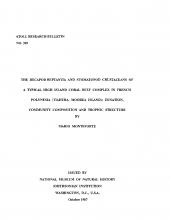
The decapod reptantia and stomatopod crustaceans of a typical high island coral reef complex in French Polynesia (Tiahura, Moorea Island): Zonation, community composition and trophic structure
Biodiversity Conservation
Available Online

Monteforte, Mario

1987
In a typical High Island coral reef complex of French Polynesia (transect of Tiahura, Hoorea Island, Society Archipelago!, 73 species of decapod Reptantia and stomatopod crustaceans were collected. Over 9 stations localised along the transect, 3 different units of hard coral substrate of simi1ar volume (about 17 litres each), were sampled at each station. The results are discussed from two aspects : the first shows that at least 50 carcinologic species occur within the cavitary biotopes ; 16 species (mainly Xanthid crabs), represent more than 90% of all collected individuals. Most of the dominant species are widely distributed along the transect (Chlorodiella barbata, Pilodius pugil, Lipcarpilodes integerrimus, Galathea aculeata), and locally, some others are numerically important (Chlorodiella Laevissima, Globopilumnus globosus, Daira perlata,Phymodius ungulatus, etc.). The second aspect concerns the repartition of species in the different biotopes in relation to their feeding habits. Based on the functional morphology of chelipeds, mouth-parts and gastric sill, and on gut content analysis, the species were placed into 5 MORPHO- LOGIC GROUPS : filter-suspension feeders, omnivores/herbivores, omnivores/carnivores, generalised omnivores and predators. The feeding habits and the distribution pattern of abundant species suggest that trophic and habitat partitioning say exist. The predominant species show either different nutritional modes, or inhabit different areas and/or biotopes. Distribution patterns of the morphologic groups ip the different substrates are proposed, and schemes of interspecific relation; are analysed.
Initial recolonization of Funafuti atoll coral reefs devasted by hurricane "Bebe"
Biodiversity Conservation
Available Online

Mergner Hans

1985
On the 21st of October, 1972, hurricane "Bebe" devas- tated a large part of Funafuti atoll, Ellice Islands. Among the most spectacular geomorphological alterations caused by the hurricane was a storm beach 19 km long, 4 m high and 37 m wide. The amount of coral debris washed up from the offshore coral reefs onto the reef flat was estimated at 2.8 x 10 tons of material (Baines, Beveridge and Maragos, 1974). The oceanside reef communities of the SE and E rim of the atoll had been totally destroyed, and those of the inner reefs of the lagoon side had been heavily damaged. Eight months after the storm a quantitative analysis of the resettlement and recruitment of coral species on 7 reef sections was carried out: the destruction of the biophysiographic zones could be described as increasing from the northern border and also to the W rim of the atoll. Near the centre at Fongafale the lagoon reef flat was covered by thick carpets of the brown alga Dictyota bartaysii, possibly brought about by eutrophication effects. The resettlement of the reef flat by corals began with the recolonization of branching corals as well as regeneration of the very few surviving massive corals: about 80% of the number of new colonies belong to Acropora (mainly A. humilis and A. hyaclnthus), and about 20% to Pocillopora eydouxi, Porltes lutea (?) and some Faviidae. The percentage of the area settled by the massive coral species is, however, greater than that settled by the branching species. Nevertheless, in the long-term, branching corals are expected to have a decisive influence on the future structural and biophysiographic zonation of the reef edge and reef flat, due to their more numerous young colonies, which are evenly scattered over the reef area, and due to their rapid growth rate. Consequently, an Acropora humilis - hyacinthus-community or an Acropora - Pocillopora eydouxi-assemblage can be predicted as the future biophysiographic zone.