Search the SPREP Catalogue

Refine Search Results

Tags / Keywords

Available Online

Tags / Keywords

Available Online

501 result(s) found.

Sort by

You searched for

  • Collection Biodiversity Conservation
    X
  • Material Type Environmental Impact Assessment
    X
Checklist of the shorefishes of Ouvea atoll, New Caledonia
Biodiversity Conservation
Available Online

Kulbickland Michel

,

Williams Jeffrey T

1997
The shorefishes of Ouvea, an isolated atoll in the Loyalty Islands group of New Caledonia, had not been surveyed prior to 1990. An extensive survey was conducted by ORSTOM between 1991 and 1992 to obtain baseline information on the shorefishes. A total of 653 taxa among 72 families are now documented from this area. The most diverse families are the Labridae (69 species), Pomacentridae (58 species), Gobiidae (54 spccies),Serranidae (39 species), Chaetodontidae (31 species) and Apogonidae (28 species). The absence or very low diversity of some families (Clupeidae, Nemipteridae, Siganidae) or genera (Abudefduf, Neopomacentrus) is similar to findings for other isolated islands of the Coral Sea. Of the 653 species recorded from Ouvea, 51 species have not been reported from New Caledonia, a large high island to the South. Only one endemic species, Luzonichthys williamsi, has been recognized among the shorefishes at Ouvea. A number of Pacific Plate endemic species were recorded at Ouvea. which is positioned on the Australasian Plate to the south of the edge of the Pacific Plate. Antennarius duescus, previously known from three specimens taken at the Hawaiian Islands, is recorded from a single specimen taken at Ouvea. Another antitropical distribution pattern is exhibited by Dinemalichthys riukiuensis, which is known to occur at Fiji, Ouvea and Queensland in the South and from Okinawa.

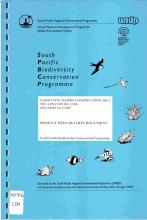
Community marine conservation area, the Arnavon islands, Solomon islands : project preparation document (PPD)
Biodiversity Conservation
Available Online

Secretariat of the Pacific Regional Environment Programme (SPREP)

,

South Pacific Biodiversity Conservation Programme (SPBCP)

1995
In 1981, the Isabel provincial government first recognized the importance of the Arnavon Islands as a nesting ground for Hawksbill turtles, and designated the islands as a Wildlife Sanctuary. At that time, however, the government did not adequately recognize the local communities' rights and the project failed. In 1989, the South Pacific Regional Environment Programme (SPREP) collaborated with the Solomon Islands government and the Ministry of Natural Resources (now the Ministry of Forestry, Environment and Conservation or MFEC) to survey the Hawksbill turtle nesting beaches and populations in the northern Solomon Islands including the Amavons. The surveys documented the severe depletion of the Hawksbill turtle population due to the turtle shell (bekko) export trade which has flourished in recent years. As a result of the surveys interest was renewed for conservation in the area and local communities were approached for their support in establishing a conservation area. Through its close association with SPREP and MFEC, The Nature Conservancy (TNC) was invited by the government to take a leading role in developing and implementing a marine conservation area project to protect turtle nesting beaches and other important marine and island species on the Arnavon Islands.