Search the SPREP Catalogue

Refine Search Results

Tags / Keywords

Available Online

Tags / Keywords

Available Online

501 result(s) found.

Sort by

You searched for

  • Collection Biodiversity Conservation
    X
  • Material Type Environmental Impact Assessment
    X
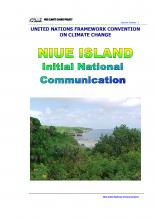
United Nations Framework Convention on Climate Change: Niue Island Initial National Communication
Climate Change Resilience, Biodiversity Conservation
Available Online

Government of Niue

2000
Niue consists of a single uplifted coral atoll with a unique rugged coastline. It is situated in the Southwest Pacific Ocean within the Polynesian cultural zone. The population of Niue was 2.088 at the 1977 population census, and is a declining population due to outward migration. Niue lies on the edge of the southern tropical cyclone belt, and has two distinct seasons, a hot wet season from November to March and a cool dry season from April to November. The economy is largely dependent on overseas aid. with no realistic prospect of economic self-reliance. However, there is a modest export production mainly comprising of taro and coconuts to New Zealand. Agriculture, fisheries and forestry are at subsistence levels with current government policy focusing on tourisim and private sector development. The predominant energy source is electricity and is provided by diesel powered generators. Although alternative energy sources have been investigated they are all currently under-utilised mainly due to the initial capital expense involved. Trade and tourism to Niue is hampered by transport. Currently there is a weekly flight to Auckland via Tonga serviced by Royal Tongan Airlines. There is a small concrete wharf at Alofi. the capital of Niue. however the channel is too small to be navigated by the larger ships. The larger container ship's cargo is transferred by 'lighters' on a monthly basis. Internal transport is mainly comprised of privately owned ships.
Atolls as settlement landscapes: Ujae, Marshall Islands
Biodiversity Conservation, BRB
Available Online

Weisler Marshall I

1999
Williamson and Sabath (1982) have demonstrated a significant relationship between modern population size and environment by examining atoll area and rainfall in the Marshall Islands. The present work seeks to extend that argument into prehistory by examining the relationship of ancient habitation sites and size of aroid pit agricultural systems to atoll land area and rainfall regime along the 1,500-3,500 mm precipitation gradient in the Marshall Islands. Four atolls were selected for study: Ebon at the wettest extent in the extreme south; Ujae and Maloelap near the center of the archipelago; and Utrok at the dry north. The first phase of this long-term archaeological program is reported. During the survey of Ujae Atoll (90 05' N, 165° 40' E), three habitation sites, an aroid pit agricultural zone, one early historic burial, and seven fish traps, weirs, and enclosures were recorded. Along with excavations at two habitation sites (8 m2 total area), 35 traditional artifacts were recovered (shell adzes, ornaments, and manufacturing tools). Seven radiocarbon age determinations document land use beginning as early as the third century A.D. A beachrock sample dated to 2450 ± 70 BP relates to atoll development. Some 4,748 bones of fish, birds, turtles, Pacific rats, lizards, humans, and possible cetaceans, along with nearly 13 kg of shellfish, provide the basis for understanding prehistoric subsistence, human adaptations to the atoll setting, and land use patterns.