Search the SPREP Catalogue

Refine Search Results

Tags / Keywords

Language

Available Online

Tags / Keywords

Available Online

47 result(s) found.

Sort by

You searched for

  • Collection Climate Change Resilience
    X
  • Tags / Keywords problem definition
    X
Climate change vulnerability assessment of species
Climate Change Resilience, BRB
Available Online

Akçakaya, H. Resit

,

Bickford, David

,

Carr, Jamie A.

,

Foden, Wendy B.

,

Garcia, Raquel A.

,

Hoffmann, Ary A.

,

Hole, David G.

,

Huntley, Brian

,

Martin, Tara G.

,

Pacifici, Michela

,

Pearce‐Higgins, James W.

,

Platts, Philip J.

,

Stein, Bruce A.

,

Thomas, Chris D.

,

Visconti, Piero

,

Watson, James E. M.

,

Wheatley, Christopher J.

,

Young, Bruce E.

2018
Assessing species' vulnerability to climate change is a prerequisite for developing effective strategies to conserve them. The last three decades have seen exponential growth in the number of studies evaluating how, how much, why, when, and where species will be impacted by climate change. We provide an overview of the rapidly developing field of climate change vulnerability assessment (CCVA) and describe key concepts, terms, steps and considerations. We stress the importance of identifying the full range of pressures, impacts and their associated mechanisms that species face and using this as a basis for selecting the appropriate assessment approaches for quantifying vulnerability. We outline four CCVA assessment approaches, namely trait?based, correlative, mechanistic and combined approaches and discuss their use. Since any assessment can deliver unreliable or even misleading results when incorrect data and parameters are applied, we discuss finding, selecting, and applying input data and provide examples of open?access resources. Because rare, small?range, and declining?range species are often of particular conservation concern while also posing significant challenges for CCVA, we describe alternative ways to assess them. We also describe how CCVAs can be used to inform IUCN Red List assessments of extinction risk. Finally, we suggest future directions in this field and propose areas where research efforts may be particularly valuable.
The state of agricultural dommodity markets 2018. agricultural trade, climate change and food security
Environmental Governance, Climate Change Resilience, BRB
Available Online
2018
This edition of The State of Agricultural Commodity Markets focuses on the complex and underexplored intersection between agricultural trade, climate change and food security. It is clear that we cannot tackle hunger without finding adaptation and mitigation solutions to climate change in agriculture and food systems. It is also clear that the uneven impact of climate change across regions and countries, and the corresponding changes in food availability and access will affect international trade patterns and trade routes. This report supports these discussions by providing an in-depth analysis of the Paris Agreement and the WTO agreements to enhance clarity and provide guidance on policy options that could strengthen the mutually supportive role of these accords in tackling climate change and hunger. Wide-ranging policy actions are necessary to ensure that trade will contribute to the efforts aimed at ensuring food security and promoting adaptation and mitigation to climate change. The uneven impact of climate change across the world and its implications for agricultural trade, especially for developing countries, underlines the need for a balanced approach to policies, which should enhance the adaptive role of trade, while supporting the most vulnerable.
Global threats from invasive alien species in the twenty-first century and national response capacities
Climate Change Resilience, BRB
Available Online

Blumenthal, Dana M.

,

Bradley, Bethany A.

,

Dukes, Jeffrey S.

,

Early, Regan

,

Gonzalez, Patrick

,

Grosholz, Edwin D.

,

Ibañez, Ines

,

Lawler, Joshua J.

,

Miller, Luke P.

,

Olden, Julian D.

,

Sorte, Cascade J.B.

,

Tatem, Andrew J.

2016
Invasive alien species (IAS) threaten human livelihoods and biodiversity globally. Increasing globalization facilitates IAS arrival, and environmental changes, including climate change, facilitate IAS establishment. Here we provide the first global, spatial analysis of the terrestrial threat from IAS in light of twenty-first century globalization and environmental change, and evaluate national capacities to prevent and manage species invasions. We find that one-sixth of the global land surface is highly vulnerable to invasion, including substantial areas in developing economies and biodiversity hotspots. The dominant invasion vectors differ between high-income countries (imports, particularly of plants and pets) and low-income countries (air travel). Uniting data on the causes of introduction and establishment can improve early-warning and eradication schemes. Most countries have limited capacity to act against invasions. In particular, we reveal a clear need for proactive invasion strategies in areas with high poverty levels, high biodiversity and low historical levels of invasion.
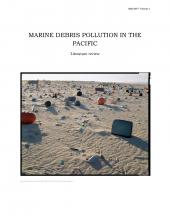
Marine Debris Pollution in the Pacific : Literature review
Climate Change Resilience, Biodiversity Conservation, Waste Management and Pollution Control, BRB
Available Online

Secretariat of the Pacific Regional Environment Programme (SPREP)

2014
Rapidly expanding human populations and associated economic growth and overconsumption is resulting in serious degradation of the natural environment human survival depends on (Vitousek et al., 1997; Sanderson et al., 2002; Orr, 2004; Alroy, 2010; Branch et al., 2013). Almost half of the global human population currently lives within 150km of the coast (UN Atlas of the Oceans, 2014). This results in severe pressures being placed on marine and coastal environments. Anthropogenic impacts on oceans include physical alterations of the coasts and seafloor, as well as chemical and biological contamination through sewage, industrial wastes and agricultural discharges, dredging, desalination, shipping, and fossil fuel and ore extraction. These pressures, together with overfishing, by-catch, destructive fishing methods (e.g. blast fishing), introduction of invasive species, boat strikes, acoustic pollution, climate-related changes (i.e. ocean acidification, sea level rise, freshwater inundations, cyclones) can cause structural changes in marine communities and the loss of genetic variability and other side-effects of human interference with exceptionally complex ocean ecosystems (Gray et al., 1979; Goldberg, 1995; Vitousek et al. 1997; Islam and Tanaka, 2004; Pauly et al., 2005; Panigada et al., 2006; Crain et al., 2008; Halpern et al., 2008; Ramirez-Llodra et al., 2011)