Search the SPREP Catalogue

Refine Search Results

Language

Available Online

Available Online

23 result(s) found.

Sort by

You searched for

  • Collection Climate Change Resilience
    X
  • Publication Year 2017
    X
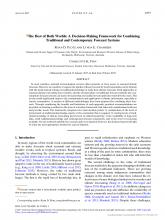
The Best of Both Worlds: A decision-making framework for combining traditional and contemporary forecast systems
Climate Change Resilience
Available Online

Chambers, Lynda D.

,

Finn, Charlotte K.

,

Plotz, Roan D.

2017
In most countries, national meteorological services either generate or have access to seasonal climate forecasts.However,inanumberofregions,theuptakeoftheseforecastsbylocalcommunitiescanbelimited, with the locals instead relying on traditional knowledgeto make their climate forecasts.Both approachesto seasonal climate forecasting have bene ts, and the incorporation of traditional forecast methods into contemporaryforecastsystemscanleadtoforecaststhatarelocallyrelevantandbettertrustedbytheusers.This in turn could signi cantly improve the communication and application of climate information, especially to remote communities. A number of different methodologies have been proposed for combining these forecasts. Through considering the bene ts and limitations of each approach, practical recommendations are providedonselectingamethod,intheformofadecisionframework,thattakesintoconsiderationbothuser and provider needs. The framework comprises four main decision points: 1) consideration of the level of involvement of traditional-knowledge experts or the community that is required, 2) existing levels of traditional knowledge of climate forecasting and its level of cultural sensitivity, 3) the availability of long-term data—both traditional-knowledge and contemporary-forecast components, and 4) the level of resourcing available.Noonemethodissuitableforeveryoneandeverysituation;however,thedecisionframeworkhelps to select the most appropriate method for a given situation.
A region at risk - The human dimensions of climate change in Asia and the Pacific
Climate Change Resilience, Biodiversity Conservation
Available Online

Asian Development Bank

2017
The Asia and Pacific region is extremely vulnerable to the impacts of climate change. Unabated warming could significantly undo previous achievements of economic development and improvements of living standards. At the same time, the region has both the economic capacity and weight of influence to change the present fossil-fuel based development pathway and curb global emissions. This report sheds light on the regional implications of the latest projections of changes in climate conditions over Asia and the Pacific. The assessment concludes that, even under the Paris consensus scenario in which global warming is limited to 1.5°C to 2°C above preindustrial levels, some of the land area, ecosystems, and socioeconomic sectors will be significantly affected by climate change impacts, to which policy makers and the investment community need to adapt to. However, under a Business-As-Usual (BAU) scenario, which will cause a global mean temperature rise of over 4°C by the end of this century, the possibilities for adaptation are drastically reduced. Among others, climate change impacts such as the deterioration of the Asian “water towers”, prolonged heat waves, coastal sea-level rise and changes in rainfall patterns could disrupt ecosystem services and lead to severe effects on livelihoods which in turn would affect human health, migration dynamics and the potential for conflicts. This assessment also underlines that, for many areas vital to the region’s economy, research on the effects of climate change is still lacking.