Search the SPREP Catalogue

Refine Search Results

Language

Available Online

Available Online

40 result(s) found.

Sort by

You searched for

  • Author Secretariat of the Pacific Regional Environment Programme (SPREP) (SPREP)
    X
  • Material Type Environmental Impact Assessment
    X
Geographic information systems in wildlife management: a case study using yellow-eyed penguin nest site data
Biodiversity Conservation
Available Online

Clark Ryan D

,

Mathieu Renaun

,

Seddon Philip J

2008
This report provides a comprehensive yet simple guide to the construction and use of a Geographic Information System (GIS) for collating, analysing, updating and managing data in wildlife management or research projects. The spatial analysis of yellow-eyed penguin (hoiho, Megadyptes antipodes) nest site data from Boulder Beach. Otago Peninsula, is used as an example. The report describes the key components used in the construction of the GIS, which included aerial photography, a digital elevation model and habitat map of the study area, and nest site data collected at Boulder Beach between 1982 and 1996. The procedures for estimating the geographic locations of nest sites using historical hand-drawn sketch maps are also described, demonstrating the potential for incorporating and analysing historical datasets in this type of GIS. The resulting GIS was used to conduct simple spatial analyses of some of the characteristics of yellow-eyed penguin nesting habitat selection, as well as the densities of nest sites in each type of nesting habitat at Boulder Beach. The sources of error, uncertainty and other limitations of this and other GIS arc described, along with procedures and steps to minimise and avoid them. The yellow-eyed penguin GIS described in this report provides an example of the potential utility of GIS in ecological research and management of both yellow-eyed penguins and many other species.
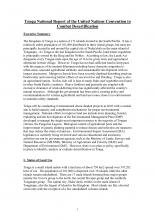
Tonga national report of the United Nations Convention to Combat Desertification (UNCCD)
Available Online

Secretariat of the Pacific Regional Environment Programme (SPREP) (SPREP)

2003
The Kingdom of Tonga is a nation of 171 islands located in the South Pacific. It has a relatively stable population of 101,000 distributed in three island groups, but most are principally located in and around the capital city of Nukualofa on the main island of Tongatapu. As Tonga is the last Kingdom in the South Pacific, land tenure regulation is principally owned by the King and his Nobles. According to law, the Lands Act designates every Tongan male upon the age of 16 to be given town and agricultural allotments in their village. However, Tonga has not had sufficient land to keep pace with the nuances of its modern dilemmas including heavy domestic migration to urban areas, unsound agricultural methods, and unsustainable development with no impact assessment. Mangrove forests have been severely depleted disturbing precious biodiversity and removing barrier effects of sea level rise and flooding. Tonga is also an agricultural nation. Its flat, rich soil is host to many fruits and vegetables not found in other South Pacific countries. Heavy fertilizer and pesticide use coupled with excessive clearance of wind-sheltering trees has significantly affected the country's natural resources. Although the government has been active creating policy and recommendations for various agricultural and land use issues, there is no enforcement to maintain safety standards.
Pacific Islands Renewable Energy Project (PIREP) : a climate change-mitigating partnership of GEF, UNDP, SPREP and the Pacific Islands : project document
Climate Change Resilience, Biodiversity Conservation
Available Online

Pacific Islands Renewable Energy Project (PIREP)

,

Secretariat of the Pacific Regional Environment Programme (SPREP) (SPREP)

2002
The Pacific Island Countries (PICs) are currently heavily dependent on fossil fuels. Renewable energy (RE), mostly hydro, is estimated to contribute less than 10 percent of each PICs commercial energy use and the region is characterized by scattered and fragmented efforts to promote RE technologies that are based on unreliable and unsubstantiated data on RE resource potentials. The Pacific Islands Renewable Energy Project (PIREP) will facilitate the promotion within the PICs of the widespread implementation and ultimately, commercialisation of RE technologies (RETs) through the establishment of a suitable enabling environment. The establishment of an environment conducive to the region-wide adoption and commercialisation of RETs would involve the design, development and implementation of appropriate policies, strategies and interventions addressing the fiscal, financial, regulatory, market, technical and information barriers to RE development and utilization. It will also involve the development of interventions for strengthening of the relevant institutional structures and national capacity for the coordination and the sustainable management (design, implementation, monitoring, maintenance, evaluation and the marketing) of RE initiatives in each PIC. This Project Document has been revised to reflect minor changes suggested by SPREP at a meeting Friday the 6th of September 2002 between SPREP and UNDP to improve clarity concerning internal communications in SPREP between the CTA and the management level and external communications between SPREP and UNDP management levels. Refer to Part IV - Management Arrangements and the Terms of Reference in Appendix B. C.and D.