Search the SPREP Catalogue

Refine Search Results

Language

Available Online

Available Online

18 result(s) found.

Sort by

You searched for

  • Author Secretariat of the Pacific Regional Environment Programme (SPREP)
    X
  • Publication Year 2024
    X
  • Publication Year 2014
    X
COP28 PRISMSS Side Event (Summary) - Restoring Island Restoring Island Resilience
Biodiversity Conservation, BRB
Available Online

Secretariat of the Pacific Regional Environment Programme (SPREP)

2024
The Pacific Island nations of Niue and Tonga are leading global efforts to expand the management of invasive species at a large-landscape scale and increase the resilience of their ecosystems and communities to the impacts of climate change. Niue’s Environment Minister, Hon. Mona Ainuu, recently made an ambitious pledge for the country to control four priority invasive species by 2030, including Taro Vine, rats, feral pigs, and the coral eating Drupella snail. This work will help to enhance Niue’s premium ecotourism brand and directly support the provision of green jobs. Tonga has also pledged to expand the management of priority invasive species at a large-landscape scale following the successful eradication of rats from Late Island, the largest eradication ever undertaken in the Pacific Islands region. Studies have shown that, once rats are removed, the nutrients from returning seabird populations restore the climate resilience of coral reefs and increase the productivity of fish stocks by up to 50%. Tonga’s plans to scale-up the management of priority invasive species will help expand its national park system, provide refugia for 95% of the country’s biodiversity, and directly increase the climate resilience of its ecosystems and communities.
COP28 PRISMSS Side Event -Restoring Island Resilience
Biodiversity Conservation, BRB
Available Online

Secretariat of the Pacific Regional Environment Programme (SPREP)

2024
The Pacific Island nations of Niue and Tonga are leading global efforts to expand the management of invasive species at a large-landscape scale and increase the resilience of their ecosystems and communities to the impacts of climate change. Niue’s Environment Minister, Hon. Mona Ainuu, recently made an ambitious pledge for the country to control four priority invasive species by 2030, including Taro Vine, rats, feral pigs, and the coral eating Drupella snail. This work will help to enhance Niue’s premium ecotourism brand and directly support the provision of green jobs. Tonga has also pledged to expand the management of priority invasive species at a large-landscape scale following the successful eradication of rats from Late Island, the largest eradication ever undertaken in the Pacific Islands region. Studies have shown that, once rats are removed, the nutrients from returning seabird populations restore the climate resilience of coral reefs and increase the productivity of fish stocks by up to 50%. Tonga’s plans to scale-up the management of priority invasive species will help expand its national park system, provide refugia for 95% of the country’s biodiversity, and directly increase the climate resilience of its ecosystems and communities.
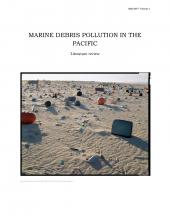
Marine Debris Pollution in the Pacific : Literature review
Climate Change Resilience, Biodiversity Conservation, Waste Management and Pollution Control, BRB
Available Online

Secretariat of the Pacific Regional Environment Programme (SPREP)

2014
Rapidly expanding human populations and associated economic growth and overconsumption is resulting in serious degradation of the natural environment human survival depends on (Vitousek et al., 1997; Sanderson et al., 2002; Orr, 2004; Alroy, 2010; Branch et al., 2013). Almost half of the global human population currently lives within 150km of the coast (UN Atlas of the Oceans, 2014). This results in severe pressures being placed on marine and coastal environments. Anthropogenic impacts on oceans include physical alterations of the coasts and seafloor, as well as chemical and biological contamination through sewage, industrial wastes and agricultural discharges, dredging, desalination, shipping, and fossil fuel and ore extraction. These pressures, together with overfishing, by-catch, destructive fishing methods (e.g. blast fishing), introduction of invasive species, boat strikes, acoustic pollution, climate-related changes (i.e. ocean acidification, sea level rise, freshwater inundations, cyclones) can cause structural changes in marine communities and the loss of genetic variability and other side-effects of human interference with exceptionally complex ocean ecosystems (Gray et al., 1979; Goldberg, 1995; Vitousek et al. 1997; Islam and Tanaka, 2004; Pauly et al., 2005; Panigada et al., 2006; Crain et al., 2008; Halpern et al., 2008; Ramirez-Llodra et al., 2011)
Gender and the Pacific Adaptation to Climate Change (PACC) programme: Assessment and Action Plan. Technical Report 3
Climate Change Resilience
Available Online

Pacific Adaptation to Climate Change Programme (PACC)

,

Secretariat of the Pacific Regional Environment Programme (SPREP)

2014
The Pacific Adaptation to Climate Change (PACC) programme is the largest climate change adaptation initiative in the Pacific region, with activities in 14 countries and territories. PACC has three main areas of activity: practical demonstrations of adaptation measures; driving the mainstreaming of climate risks into national development planning and activities; and sharing knowledge in order to build adaptive capacity. The programme focuses on three key climate-sensitive development sectors: coastal zone management, food security and food production, and water resources management. The PACC programme began in 2009 and is scheduled to end in December 2014. As the first major climate change adaptation programme in the Pacific, PACC has led the way in developing and designing adaptation projects, using a ‘learning by doing’ approach. Many lessons have been learned and better practices developed as the programme has progressed. One of these is the importance of integrating gender into climate change adaptation activities. Gender was mostly overlooked during the initial stages of the programme, but significant efforts have since been made to address this shortcoming and integrate gender across programme activities. This report summarises two key documents produced by PACC as part of the drive to address gender. The first, a Gender Assessment of the programme, was carried out in 2012 to assess the level and degree that the programme addressed gender. The Gender Action Plan, which covers 2013–2014, was developed soon afterwards to address the recommendations arising from the Assessment. Activities in the Plan are currently underway, and will be reported in further PACC publications.