Skip to main content
SPREP on Facebook
SPREP on Twitter
SPREP on YouTube
SPREP on LinkedIn
Home
About us
Projects
Search
General Search
Advanced Search
Collections
Anamua: Treasures of the Pacific Environment
Ecosystem Based Adaptation
Gender
Live & Learn Environmental Education
Marine Species
Oceans
Research4Life (Peer-reviewed articles)
Samoa Conservation Society
Seabirds
Traditional Knowledge
Threatened and Migratory Species (TAMS)
Submit Publication
Log in
Search the SPREP Catalogue
Advanced Search
Refine Search Results
Collection
Climate Change Resilience
(91)
Biodiversity Conservation
(6)
BRB
(1)
Related Countries
Worldwide
(1)
Tags / Keywords
fiji
(33)
nauru
(11)
climate change
(8)
climatic changes
(6)
disaster risks
(6)
vulnerability
(6)
federated states of micronesia
(5)
oceania
(5)
pacific
(5)
samoa
(5)
cook islands
(4)
niue
(4)
pacc
(4)
palau
(4)
tonga
(4)
tuvalu
(4)
vanuatu
(4)
papua new guinea
(3)
solomon islands
(3)
tokelau
(3)
republic of the marshall islands
(2)
crown of thorns starfish
(1)
gender
(1)
management action
(1)
management action-management
(1)
marine invasive species
(1)
Author
(-)
PACC
(90)
SPREP
(433)
Secretariat of the Pacific Regional Environment Programme (SPREP)
(413)
UNEP
(321)
International programme on chemical safety
(201)
Secretariat of the Pacific Regional Environment Programme (SPREP) (SPREP)
(197)
United Nations Environment Programme
(168)
IUCN
(121)
Secretariat of the Pacific Regional Environment Programme
(111)
John Schenk
(99)
Forum Secretariat
(98)
United Nations Environment Programme (UNEP)
(97)
Secretariat of the Pacific Community
(96)
United Nations
(88)
Asian Development Bank
(85)
Global Environment Facility
(79)
International Maritime Organization
(78)
South Pacific Commission
(68)
et al
(61)
Organisation
Secretariat of the Pacific Regional Environment Programme (SPREP)
(88)
Pacific Adaptation to Climate Change Programme (PACC)
(85)
UNDP/GEF
(2)
United Nations Development Programme (UNDP)
(2)
GEF/UNDP
(1)
Government of Cook Islands/ UNDP/GEF/AusAID
(1)
NIWA
(1)
NIWA/GEF/UNDP/SPC
(1)
Swensea University
(1)
UNDP/GEF/AusAID
(1)
UNDP/GEF/AusAID/NIWA/SPC/National Environment Services/Government of Cook Islands
(1)
UNDP/GEF/Government of Cook Islands
(1)
Language
English
(93)
Publication Year
2015
(2)
2014
(2)
2012
(23)
2011
(23)
2010
(19)
2009
(10)
2008
(8)
2007
(3)
2006
(2)
Material Type
Report
(90)
DVD
(3)
Article
(1)
Available Online
Yes
(88)
No
(5)
Collection
Climate Change Resilience
(91)
Biodiversity Conservation
(6)
BRB
(1)
Related Countries
Worldwide
(1)
Tags / Keywords
fiji
(33)
nauru
(11)
climate change
(8)
climatic changes
(6)
disaster risks
(6)
vulnerability
(6)
federated states of micronesia
(5)
oceania
(5)
pacific
(5)
samoa
(5)
cook islands
(4)
niue
(4)
pacc
(4)
palau
(4)
tonga
(4)
tuvalu
(4)
vanuatu
(4)
papua new guinea
(3)
solomon islands
(3)
tokelau
(3)
republic of the marshall islands
(2)
crown of thorns starfish
(1)
gender
(1)
management action
(1)
management action-management
(1)
marine invasive species
(1)
Author
(-)
PACC
(90)
SPREP
(433)
Secretariat of the Pacific Regional Environment Programme (SPREP)
(413)
UNEP
(321)
International programme on chemical safety
(201)
Secretariat of the Pacific Regional Environment Programme (SPREP) (SPREP)
(197)
United Nations Environment Programme
(168)
IUCN
(121)
Secretariat of the Pacific Regional Environment Programme
(111)
John Schenk
(99)
Forum Secretariat
(98)
United Nations Environment Programme (UNEP)
(97)
Secretariat of the Pacific Community
(96)
United Nations
(88)
Asian Development Bank
(85)
Global Environment Facility
(79)
International Maritime Organization
(78)
South Pacific Commission
(68)
et al
(61)
Organisation
Secretariat of the Pacific Regional Environment Programme (SPREP)
(88)
Pacific Adaptation to Climate Change Programme (PACC)
(85)
UNDP/GEF
(2)
United Nations Development Programme (UNDP)
(2)
GEF/UNDP
(1)
Government of Cook Islands/ UNDP/GEF/AusAID
(1)
NIWA
(1)
NIWA/GEF/UNDP/SPC
(1)
Swensea University
(1)
UNDP/GEF/AusAID
(1)
UNDP/GEF/AusAID/NIWA/SPC/National Environment Services/Government of Cook Islands
(1)
UNDP/GEF/Government of Cook Islands
(1)
Publication Year
2015
(2)
2014
(2)
2012
(23)
2011
(23)
2010
(19)
2009
(10)
2008
(8)
2007
(3)
2006
(2)
Material Type
Report
(90)
DVD
(3)
Article
(1)
Available Online
Yes
(88)
No
(5)
93 result(s) found.
Sort by
Publication Year
Sort results by
Created
Sort results by
Updated
Sort results by
You searched for
Author
PACC
X
clear
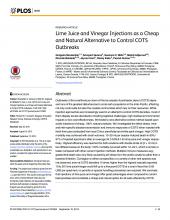
Lime juice and vinegar injections as a cheap and natural alternative to control COTS outbreaks
BRB
Available Online
Moutardler, Gregoire ... et al.
2015
Outbreaks of the corallivorous crown-of-thorns seastar Acanthaster planci (COTS) represent one of the greatest disturbances to coral reef ecosystems in the Indo-Pacific, affecting not only coral reefs but also the coastal communities which rely on their resources. While injection approaches are increasingly used in an attempt to control COTS densities, most of them display severe drawbacks including logistical challenges, high residual environmental impacts or low cost-effectiveness. We tested a new alternative control method based upon acidic injections of cheap, 100% natural products. We investigated the lethal doses, intraand inter-specific disease transmission and immune responses of COTS when injected with fresh lime juice (extracted from local Citrus arantifolia) and white spirit vinegar. High COTS mortality was achieved with small volumes: 1020 ml per seastar induced death in 89%/ 97% of injected specimens after an average 34.3 h/29.8 h for lime juice and vinegar respectively. Highest efficiency was reached for both solutions with double shots of (2 × 10 ml) in two different areas on the body: 100% mortality occurred within 1224 h, which is similar or faster compared with other current injection methods. Multiple immune measures suggested that death was very likely caused by pH stress from the acidic solutions rather than a bacterial infection. Contagion to either conspecifics or a variety of other reef species was not observed, even at COTS densities 15 times higher than the highest naturally reported. 10 to 20 l lime juice/vinegar could kill up to a thousand COTS at a cost of less than 0.05 USD per specimen; no permits or special handling procedures are required. We conclude that injections of lime juice and vinegar offer great advantages when compared to current best practises and constitute a cheap and natural option for all reefs affected by COTS
management action
management action-management
marine invasive species
crown of thorns starfish
Vital Access (PACC Video) Federated States of Micronesia
Climate Change Resilience, Biodiversity Conservation
PACC
,
SPREP
2015
federated states of micronesia
Vital Health (PACC) Tokelau
Climate Change Resilience, Biodiversity Conservation
PACC
,
SPREP
2014
tokelau
Vital Coast (PACC) Samoa
Biodiversity Conservation
PACC
,
SPREP
2014
samoa
Pacific Adaptation to Climate Change (PACC) Project 3rd Multipartite Review Meeting 2012; UNDP, SPREP, AusAID, Cook Islands, Federated States of Micronesia (FSM), Republic of the Marshall Islands (RMI), Nauru, Niue, Fiji, Palau, Papua New Guinea (PNG), Samoa, Solomon Islands, Tonga, Tokelau, Tuvalu, Vanuatu, Gender Assessment, Mid Term Review
Climate Change Resilience
Available Online
PACC
2012
PACC reports
samoa
pacific
oceania
climate change
solomon islands
tonga
vanuatu
palau
federated states of micronesia
cook islands
fiji
nauru
niue
papua new guinea
tokelau
tuvalu
pacc
republic of the marshall islands
vulnerability
gender
climatic changes
disaster risks
2011 PACC Cook Mangaia Harbour Design Brief Report
Climate Change Resilience
PACC
2011
Pacific Adaptation to Climate Change (PACC) Project 2nd Multipartite Review Meeting 2011; SPREP, UNDP, AusAID, GIZ, PSE, IUCN, Cook Islands, Federated States of Micronesia (FSM), Fiji, Republic of the Marshall Islands (RMI), Nauru, Niue, Palau, Papua New Guinea (PNG), Solomon Islands, Samoa, Tonga, Tokelau, Tuvalu, Vanuatu, NIWA, Prof Robert Mendelsohn
Climate Change Resilience
Available Online
PACC
2011
Reports from the PACC project
samoa
pacific
oceania
climate change
solomon islands
tonga
vanuatu
palau
federated states of micronesia
cook islands
fiji
nauru
niue
papua new guinea
tokelau
tuvalu
pacc
republic of the marshall islands
vulnerability
climatic changes
disaster risks
Pacific Adaptation to Climate Change (PACC) Project 1st Multipartite Review Meeting 2010 Presentations; UNDP, SPREP, SOPAC, Cook Islands, Fiji, Federated States of Micronesia, Nauru, Niue, Palau, Samoa, Solomon Islands, Tonga, Tuvalu, Vanuatu.
Climate Change Resilience
Available Online
PACC
2010
Technical report
samoa
pacific
oceania
climate change
solomon islands
tonga
vanuatu
palau
federated states of micronesia
cook islands
fiji
nauru
niue
tuvalu
pacc
vulnerability
climatic changes
disaster risks
Quantification and magnitude of losses and damages resulting from the impacts of climate change: modelling the transformational impacts and costs of sea level rise in the Caribbean
Climate Change Resilience
Available Online
Simpson, M.C...[et al.]
2010
The inextricable links between climate change and sustainable development have been increasingly recognised over the past decade. In 2007, the Intergovernmental Panel on Climate Change (IPCC)1 concluded with very high confidence that climate change would impede the ability of many nations to achieve sustainable development by mid-century and become a security risk that would steadily intensify, particularly under greater warming scenarios. Article 4.8 of the United Nations Framework Convention on Climate Change (UNFCCC) lists several groups of countries that merit particular consideration for assistance to adapt to climate change especially: (a) small island countries, (b) countries with low-lying coastal areas, c) countries with areas prone to natural disasters. Small Island Developing States (SIDS) have characteristics which make them particularly vulnerable to the effects of climate change, sea level rise (SLR) and extreme events, including: relative isolation, small land masses, concentrations of population and infrastructure in coastal areas, limited economic base and dependency on natural resources, combined with limited financial, technical and institutional capacity for adaptation.2
climate change
vulnerability
climatic changes
disaster risks
2009 PACC Cook Mangaia Visit Report
Climate Change Resilience
PACC
2009
Pagination
Current page
1
Page
2
Page
3
Page
4
Page
5
Page
6
Page
7
Page
8
Page
9
…
Next page
››
Last page
Last »
Login