Search the SPREP Catalogue

Refine Search Results

Related Countries

Language

Available Online

Related Countries

Available Online

14 result(s) found.

Sort by

You searched for

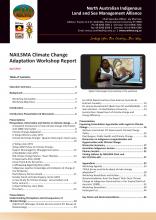
Northern Australian Indigenous Land and Sea Management Alliance (NAILSMA) climate change adaptation workshop report
Climate Change Resilience
Available Online

NAILSMA

2010
It was made clear from all of the presentations that climate change is occurring and its consequences, or changes attributed to climate change, are manifestly being observed and noted by Traditional owners on country in ways that richly complement the much more publicised knowledge emerging from the “western” scientific paradigm. The impacts are both direct and indirect, obvious and variously disguised, environmental and social. The way to mitigate impacts and adapt to changes varies across natural and human landscapes. One of the key features in north Australia is the relatively large proportion of Indigenous people who are particularly vulnerable, not only to obvious physical impacts of climate change effects like more frequent severe cyclones; but to background conditions such as economic underinvestment, poverty, health issues and the vicissitudes of policy making. Such conditions in over-governed, under-resourced communities (remote and urban) exacerbate problems with adaptation to change and capacity to respond. Climate change in north Australia cannot be treated in isolation from existing conditions of life and is increasingly affecting Indigenous lives everywhere, becoming a key stimulus for driving Indigenous capacity, response and adaptation to short and long term changes in their physical and social environment.
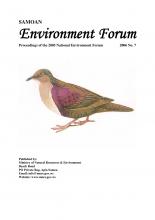
Samoan Environment Forum: proceedings of the 2005 National Environment Forum|The fact-or-myth of Samoan cultural heritage: personal reflections on family oral history / Tu'u'u Ieti Taule'alo|Samoan and Japan: concerns over mangroves development / Juliet Boon-Nanai|Status of hawksbill turtle nesting in Samoa, 2003/2004 / Mauigoa Lui Bell, Malama S. Momoemausu, Juney Ward & Malaki Iakopo|Participatory approaches for environmental initiatives - community consultation in Samoa / Natalie Mitchell|Emotional intelligence, management concept: a contributing factor for effective service delivery / Mulipola Ausetalia Titimaea|Tropical cyclone forecasting: theory and practical application - case study of tropical cyclone Olaf 2005 / Sala Sagato Tuiafiso|Samoa and the World Heritage Convention - is Samoa ready for world heritage listing / Tuiolo Schuster|Exploring the status of tsunami early warning systems in Samoa / Shaun P. Williams & Aliimalemanu F.M. Leavasa|Determination of a mean daily discharge values for Faleaseela River: implications for population water demand / Masina Nagau Chun, Iosefatu Eti & Mulipola A. Titimaea
Available Online

MNRE

2006
The community based conservation (CBC)paradigm predicts that sustainable biodiversity can only be achieved if local people perceive benefits from conservation. Through interviews, the situation in Samoa portrays that the CBC of mangroves was received with apprehension because the mangrove biodiversity was more significant than sustaining the livelihood of the local communities. In contrast, Iriomote Island residents were able to achieve maximum socio-economic benefits but to the extent that they were over commercializing the mangrove ecosystem. More research is imperative to find out how biodiversity conservation can be married with sustainable development objectives to sustain the local communities' livelihood.