Search the SPREP Catalogue

Refine Search Results

Related Countries

Language

Available Online

14 result(s) found.

Sort by

You searched for

Understanding the Bigger Energy Picture
Available Online

Michael Düren

2017
Since thousands of years, the human race has been developing cultural skills and technological capabilities that support its struggle for survival and lead to dominance over all other species. Since about a century, the exponential growth of knowledge, technology, industry and population (see Fig. 1.1) has reached a scale where man modifies biosphere to an extent, that living conditions on the whole planet earth start to change significantly. Resources that had been abundant are becoming scarce within decades. We have arrived in the Anthropocene [1] where man has a significant impact on the basic living conditions of the biosphere of the whole planet. A continuation of this growth rate will unavoidably reach its natural limits where resources vanish; the biosphere will change more rapidly than the ability of organisms and ecosystems to accommodate, and contaminations will endanger living. When such a condition is reached, it is likely that our human civilization will collapse and human population will diminish rapidly. Historic examples demonstrated that drought, hunger, wars and epidemics were typical endpoints of drastic environmental changes and overpopulation. While historic examples mostly affected only individual towns, islands, countries or indigenous nations, the limits of growth this time affect the whole planet and there is no “new world” to which our civilization can migrate. Recent research has proven that the era of a new biological mass extinction has already started [2] and it can be assumed that finally also our species will be affected.
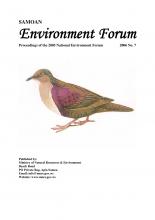
Samoan Environment Forum: proceedings of the 2005 National Environment Forum|The fact-or-myth of Samoan cultural heritage: personal reflections on family oral history / Tu'u'u Ieti Taule'alo|Samoan and Japan: concerns over mangroves development / Juliet Boon-Nanai|Status of hawksbill turtle nesting in Samoa, 2003/2004 / Mauigoa Lui Bell, Malama S. Momoemausu, Juney Ward & Malaki Iakopo|Participatory approaches for environmental initiatives - community consultation in Samoa / Natalie Mitchell|Emotional intelligence, management concept: a contributing factor for effective service delivery / Mulipola Ausetalia Titimaea|Tropical cyclone forecasting: theory and practical application - case study of tropical cyclone Olaf 2005 / Sala Sagato Tuiafiso|Samoa and the World Heritage Convention - is Samoa ready for world heritage listing / Tuiolo Schuster|Exploring the status of tsunami early warning systems in Samoa / Shaun P. Williams & Aliimalemanu F.M. Leavasa|Determination of a mean daily discharge values for Faleaseela River: implications for population water demand / Masina Nagau Chun, Iosefatu Eti & Mulipola A. Titimaea
Available Online

MNRE

2006
The community based conservation (CBC)paradigm predicts that sustainable biodiversity can only be achieved if local people perceive benefits from conservation. Through interviews, the situation in Samoa portrays that the CBC of mangroves was received with apprehension because the mangrove biodiversity was more significant than sustaining the livelihood of the local communities. In contrast, Iriomote Island residents were able to achieve maximum socio-economic benefits but to the extent that they were over commercializing the mangrove ecosystem. More research is imperative to find out how biodiversity conservation can be married with sustainable development objectives to sustain the local communities' livelihood.