Search the SPREP Catalogue

Refine Search Results

Language

Available Online

Available Online

15 result(s) found.

Sort by

You searched for

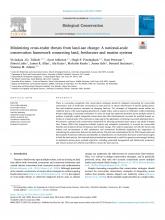
Minimizing cross-relam threats from land-use change: A national-scale conservation framework connecting land, freshwater and marine system
Environmental Governance, Biodiversity Conservation
Available Online

Atkinson, S.

,

Peterson, N

,

Possingham, H P

,

Tulloch, V J D.

,

et al.

2021
There is a growing recognition that conservation strategies should be designed accounting for cross-realm connections, such as freshwater connections to land and sea, to ensure effectiveness of marine spatial protection and minimize perverse outcomes of changing land-use. Yet, examples of integration across realms are relatively scarce, with most targeting priorities in a single realm, such as marine or freshwater, while minimizing threats originating in terrestrial ecosystems. To date, no study has optimized priorities across multiple realms to produce a spatially explicit integrated conservation plan that simultaneously accounts for multiple human activities at a national scale. This represents a major gap in the application of existing cross-realm planning theory. We present a national scale conservation framework for selecting protected areas using a case study of Papua New Guinea (PNG) that integrates multiple systems and ecological connectivity to account for cross-realm benefits and minimize threats of land-use and climate change. The relative importance of both the forests and inshore reef environments to PNG subsistence and commercial livelihoods emphasizes the importance of considering the connections between the land and sea. The plan was commissioned by the PNG Conservation and Environment Protection Authority and identifies a comprehensive set of priorities that meet conservation targets in both the land and sea. Our national-scale prioritization framework is useful for agencies and managers looking to implement actions given multiple objectives, including watershed management and biodiversity protection, and ensures actions are efficient and effective across the land and sea.
A plan for the eradication of invasive alien species from Arctic islands

BRB
Available Online

Howald, G.

,

Reaser, J.

,

Veatch, S.

2019
Invasive alien species represent one of the most significant threats to Arctic ecosystems and their inhabitants. Rapidly changing environmental conditions and a growing interest in resource extraction, settlement and tourism make the Arctic region particularly vulnerable to biological invasion. For this reason, invasive alien species are of substantial concern to the Arctic Council, a multi-national body comprised of Canada, the Kingdom of Denmark (including Greenland and the Faroe Islands), Finland, Iceland, Norway, Russia, Sweden, and the United States, as well as six international organisations that represent Arctic indigenous peoples as Permanent Participants. The Arctic Council’s Arctic Invasive Alien Species (ARIAS) Strategy and Action Plan includes the priority to: “actively facilitate the eradication of invasive alien species from island ecosystems throughout the Arctic, as well as the recovery of native island species and habitats that have been impacted by invasive alien species.” A multi-national team of governmental and non-government partners is collaborating in the development of an action plan (hereafter ‘islands plan’) for the eradication of invasive alien species from Arctic island ecosystems. The intent of the plan is to provide a vision and strategy for a region-wide approach to the eradication of island invasive alien species as a multi-national commitment. The islands plan will set forth a strategy for prioritising island eradications consistent with the growing pressures on ecological and cultural systems. We have a unique opportunity in the Arctic to take decisive action to prevent and mitigate the adverse impacts of invasive alien species that plague much of the rest of the world. The eradication of invasive alien species from islands in other parts of the world provides useful insights into best practices, including approaches to prioritisation and cost-effectiveness.
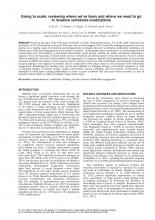
Going to scale: reviewing where we’ve been and where we need to go in invasive vertebrate eradications
Available Online

Hagen, E.

,

Holmes, N.

,

Howald, G.

,

Keitt, B.

,

Poiani, K.

2019
We are on the edge of the sixth mass extinction on Earth. Islands represent ca. 5% of the earth’s land area yet are home to 61% of extinctions in the past 500 years, and currently support 39% of critically endangered species. Invasive species are a leading cause of extinction and endangerment on islands. Invasive vertebrates, particularly mammals, are among some of the most damaging invasive species on islands. Eradicating invasive mammals is an increasingly utilised conservation tool. Nevertheless, conservation intervention needs greatly outstrip the island restoration community’s capacity. There are thousands of islands where invasive vertebrates are driving species toward extinction. So, how can the effort be matched to the scale of the problem? One approach is to improve outreach and communications to increase the resources available for projects. There are great stories; but these need to be told compellingly and repeatedly. Increasing social acceptance and support for invasive species eradications will reduce project costs associated with stakeholder engagement. Broadening the funding base can be accomplished by building stronger cost benefit valuations as well as engaging funders of climate change, marine conservation, human wellbeing, and food security. Furthermore, it is important to build upon existing partnerships to create or grow coalitions that can access these resources as part of broader, holistic efforts to address multiple conservation issues.