Search the SPREP Catalogue

Refine Search Results

Language

Available Online

Available Online

33 result(s) found.

Sort by

You searched for

  • Author Secretariat of the Pacific Regional Environment Programme
    X
  • Collection Biodiversity Conservation
    X
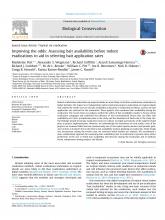
Special Issue Article: Tropical rat eradication. Improving the odds: Assessing bait availability before rodent eradications to aid in selecting bait application rates. Biological Conservation. Volume 185, May 2015
Biodiversity Conservation, BRB
Available Online

Berentsen. A.R

,

Brooke. M.L

,

Cuthbert. R.J

,

Griffiths. R.

,

Holmes. N.D

,

Howald. G.R

,

Pitt. W.C

,

Pott. M

,

Ramos-Rend¢n. G

,

Russell. J.C

,

Samaniego-Herrera. A

,

Wegmann. A.S

2015
Rodent eradications undertaken on tropical islands are more likely to fail than eradications undertaken at higher latitudes. We report on 12 independent rodent eradication projects undertaken on tropical islands that utilized the results of an in situ bait availability study prior to eradication to inform, a priori, the bait application rate selected for the eradication. These projects also monitored bait availability during the eradication. The results from our analysis verified the utility of bait availability studies to future rodent eradication campaigns and confirmed the influence of two environmental factors that can affect bait availability over time: precipitation prior to the study and the abundance of land crabs at the study site. Our findings should encourage eradication teams to conduct in-depth assessments of the targeted island prior to project implementation. However, we acknowledge the limitations of such studies (two of the projects we reviewed failed and one removed only one of two rodent species present) and provide guidance on how to interpret the results from a bait availability study in planning an eradication. Study design was inconsistent among the twelve cases we reviewed which limited our analysis. We recommend a more standardized approach for measuring bait availability prior to eradication to provide more robust predictions of the rate at which bait availability will decrease during the eradication and to facilitate future comparisons among projects and islands.
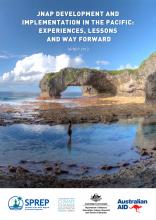
JNAP Development and implementation in the Pacific: Experiences, lessons and way forward.
Climate Change Resilience, Biodiversity Conservation
Available Online

Secretariat of the Pacific Regional Environment Programme

2013
Since 2010, Pacific Island Countries (PICs) have taken steps to develop and implement an integrated action plan, or Joint National Action Plan (JNAP), for climate change (CC) and disaster risk management (DRM). Tonga was the first country to develop its JNAP and to get government approval in July 2010, with several other PICs following suit. The development of a JNAP has been encouraged and facilitated by the Secretariat of the Pacific Regional Environment Programme (SPREP) and the Secretariat of the Pacific Community (SPC) through its Applied Geosciences Division (SOPAC) and multilateral and bilateral development partners such as the United Nations Development Program (UNDP), GIZ and the Government of Australia. Countries have also made efforts to systematically implement their JNAPs by accessing domestic resources and financial resources available through bilateral and multilateral Official Development Assistance (ODA) and climate change finances (CCF). The purpose of this report is to review the JNAP development and implementation process, and assess lessons learnt for future JNAPs in the region. The review focuses on the Cook Islands and Tonga, which have made progress in implementing their JNAP strategies. These countries obtained support from development partners for JNAP implementation. The review also included Tuvalu, which has completed development of its JNAP with Government endorsement, and countries currently in the process of developing their JNAP – Kiribati, Nauru, Niue and the Republic of Marshall Islands. Reference is also made to other countries such as Palau, Solomon Islands and Vanuatu, which chose alternative paths to their integration of CC and DRM.