Effort required to confirm eradication of an Argentine ant invasion: Tiritiri Matangi Island, New Zealand


Biodiversity Conservation, BRB
Available Online
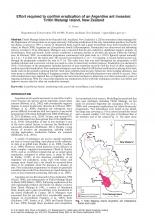
Tiritiri Matangi Island in the Hauraki Gulf, Auckland, New Zealand is a 220 ha restoration island managed by the Department of Conservation as an open sanctuary. Following eradication of the only mammalian predator, the Paci?c rat (Rattus exulans) in 1993, a variety of threatened birds, lizards and a giant invertebrate have been transferred to the island. In March 2000, Argentine ant (Linepithema humile) (Hymenoptera: Formicidae) was discovered and delimiting surveys revealed a 10 ha infestation. Managers were concerned that the ant could have signi?cant negative impacts on invertebrates, birds and lizards. Early surveys con?rmed a dramatic decline in all other ant species within the infested area. In February 2001, an eradication programme commenced with paste baits (a.i. 0.01% ? pronil) spread manually in a 2 m × 3 m grid over the entire area. The second year employed a 1 m × 3 m spacing. A second incursion part way through the programme extended the area to 11 ha. The same toxic bait was used throughout the programme to kill residual colonies and a non-toxic version was used as a lure to intensively monitor progress. Eradication was declared in 2016. Critical parts of the programme included detection of post treatment survivors and the level of e?ort required to con?rm successful eradication. New treatment techniques were developed to kill the last small nests by placing toxic baits inside vials on the ground to prolong bait life. Such nests exhibited non-invasive behaviour, short foraging distances, and were prone to disturbance leading to foraging cessation. Bait densities and ?eld placement were critical to success. Sites with residual nests were deemed free of Argentine ant once there had been no detections over three consecutive years of ongoing monitoring. With few successful Argentine ant eradications in the world the techniques used here can inform and improve success rates for other ant eradication attempts.