Search the SPREP Catalogue

Refine Search Results

Language

Available Online

Available Online

17 result(s) found.

Sort by

You searched for

  • Author Government of Samoa
    X
  • Material Type Report
    X
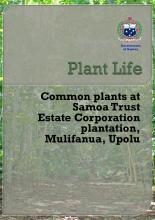
Plant Life : Common plants at Samoa Trust Estate Corporation plantation, Mulifanua, Upolu
Climate Change Resilience
Available Online

Government of Samoa

2017
Samoa is home to abundant plant life including indigenous species and some foreign introduced plant species. A majority of the foreign plants were introduced to Samoa in the pre-independence era through arrival of the early missionaries, Germans and Japanese, for various purposes from medicinal use to construction. These plants can be found across all the four islands; Upolu, Savai’i, Manono and Apolima. As part of the EU-GIZ Adapting to Climate Change and Sustainable Energy (ACSE) programme, a component of the Energy Bill and Sustainable Bioenergy, Samoa project focuses on biomass resource assessments at the Samoa Trust Estates Corporation (STEC) Plantation at Mulifanua, Upolu. Through fieldwork for biomass resource assessments at the non-leased land areas within the STEC Mulifanua plantation, eight common plants were identified and further scientific analysis on each was conducted by the Scientific Research Organisation of Samoa (SROS). SROS laboratory tests took place over a period of 14 days using the Quality Management System implemented by SROS and which also meets the requirements of the International Organization for Standardization (ISO) and the International Electrotechnical Commission (IEC) standards, ISO/IEC 17025 (2005). Thus, this publication provides a brief description of these plants as well as some data on moisture content and energy content under different conditions.
2015 Myna Survey. Report to inform the Samoan Myna Management Plan
Biodiversity Conservation, BRB
Available Online

Serra. G.

,

Young. S

2015
In May 2015, 74 line transects in three different habitat types (plantation, mixed crops, urban) were surveyed on Upolu and Savai’i islands, Samoa, with an aim of estimating the population size, density and distribution of two invasive bird species, Common Myna (Acridotheres tristis) and Jungle Myna (Acridotheres fuscus). Based on the available literature, the surveyed habitats were identified as preferred foraging habitat for the two myna species. The three habitats make up 24.9% of Samoa’s land area. Survey data were analysed using the Distance program. It was estimated that the population of myna birds occurring in the plantation, mixed crops and urban habitats of Samoa is approximately 158,995 (+- 29,588). Approximately 130,030 (+- 19,837) myna were estimated to live on Upolu and 28,968 (+- 9,751) on Savai’i, across the three habitat types. Survey results also revealed that both species show a significant preference for urban habitat. Jungle Myna were estimated to be the most numerous (population estimate: 133,925 +-24,321), occurring on both islands and in all surveyed habitat types. Jungle Myna seem to have saturated the urban habitat available in Upolu and therefore have proceeded to colonise plantations and mixed crops adjacent to urban areas. Common Myna (population estimate: 23,367 +- 7,612), having reached the shores of Samoa ca. 20 years later than Jungle Myna, show highest density in urban environments. They are concentrated in the north-west section of Upolu, with only a few individuals observed on the east coast of Savai’i.