Search the SPREP Catalogue

Refine Search Results

Related Countries

Language

Available Online

Related Countries

Available Online

60 result(s) found.

Sort by

You searched for

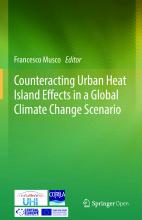
Counteracting Urban Heat Island Effects in a Global Climate Change Scenario
Available Online

Francesco Musco

2016
Reflect on the present, on the dynamics and the conditions that built it, and look forward at the same time, in search of a prospect to improve the future. Since Howard (1850–1928) and Geddes (1854–1932), this has been the dominant logic supporting the work of all those (architects, urban planners, planners, landscape architects, etc.) who grappled with city and territorial management and planning. However, from the 1970s, territorial planning has been confronted with new concepts – such as sustainable development, environmental sustainability and social equity – and more recently, new challenges – such as the ones linked to climate change, which led to the need to redefine territorial planning in disciplinary and operational terms. For some years now, the planner’s new role is under discussion, especially in relation to the challenges posed by climate change. Sustainability, mitigation, adaptation, renewable energy, low-carbon transition, ecosystem approach and post-disaster planning are just some of the new keywords surrounding the discussion on territorial management and planning. This chapter aims to present rationally, what it means to re-organize and re-think the city, in a long-term perspective. It wants to show how it is possible, and above all is a duty to integrate the new concepts mentioned above in urban planning, to deal with the effects of climate change. The Urban Heat Islands contrast enters fully into the feasible experimentation with appropriate innovations in territorial planning. The paper draws attention to the Italian situation, in the light of the European reference framework.
Integrated Climate Change Risks in the Agriculture and Health Sectors in Samoa (ICCRAHSS) - Agriculture Component: Geographical Information Systems Activities

GEF

,

Ministry of Agriculture and Fisheries (Government of Samoa)

,

UNDP

2010
In 1989, the Asian Development Bank provided technical assistance to the then Department of Agriculture and the Survey Department through a NZ Consulting Firm - ANZDEC under an ADB Land Resource Planning Survey Project. The Project provided training on mapping and GIS capability for the survey staff who were involved in the mapping work. Electronic GIS data and equipment were handed over to the Department of Agriculture at the end of the project which were later on damaged by Cyclone Ofa in 1990. A decade later, the Integrated Climate Change Risks in Agriculture and Health Sectors (ICCRAHSS) Project funded by the GEF through UNDP contracted the services of a consultant to provide: -improved GIS maps for soil, crops and rainfall distribution under different climatic projections; -review existing GIS systems and possible areas for collaboration; -consider a program to support capacity building on the use of the system and; -some applications that addresses options for climate change adaptation for the agriculture sector. Based on this report, a GIS system for the Ministry of Agriculture was procured to address the need for such a system to be in place with the expectation that the system will be properly utilized and maintained by relevant people.