Search the SPREP Catalogue

Refine Search Results

Language

Available Online

Available Online

51 result(s) found.

Sort by

You searched for

Sustainable livelihood strategies for conservation of biodiversity in Fiji, including potential crops and value adding opportunities in three FPAM project sites - Marketing of suitable products and recommendations; across three project sites: Greater Tomaniivi Protected Areas on Viti Levu, Greater Delaikoro Protected Areas on Vanua Levu, Taveuni Forest Reserve/Ravilevu Nature Reserve on Taveuni.
Biodiversity Conservation
Available Online

Addinsall, Cherise (Dr.)

,

FAO

,

Glencross, Kevin (Dr.)

,

Hancock, Wayne (Dr.)

,

Kete, Tevita

,

Prasad, Vinesh

2017
Conservation of biodiversity, improving rural livelihoods and supporting sustainable agriculture are key issues globally, but for many Pacific Island Countries (PICs) key biodiversity reserves are under considerable pressure from clearing and degradation. Rural communities are often put in a situation where clearing of forest margins is undertaken to meet demand for arable land to produce food and generate income. Forest reserves are also degraded by logging, where timber royalties are important in the absence of other sources of income for traditional landowners and communities. Therefore, agroforestry and ecologically based agriculture systems in the forest margins can help to offset reliance on forest degradation and can enhance the buffers around key reserves. Sustainable forest management and ecotourism also need to be maximised to help meet these challenges of generating income whilst maintaining or enhancing biodiversity, conserving soil and water resources.
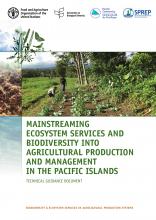
Mainstreaming Ecosystem Services and Biodiversity into Agricultural Production and Management in the Pacific Islands - Technical guidance document
Biodiversity Conservation
Available Online

FAO

2016
The international community is increasingly aware of the link between biodiversity and sustainable development and its direct impact on wealth, health and well-being. Biodiversity is the origin of all crops and domesticated livestock. It is also the source of vital ecosystem services and functions, including soil conservation, water cycling, pollination, pest and disease regulation, carbon sequestration and nitrogen fixation. Biodiversity and the ecosystem services it supports are thus key to nutritional diversity and to agricultural productivity and resilience. The Convention on Biological Diversity (CBD) Strategic Plan for Biodiversity 2011–2020 and its 20 Aichi Biodiversity Targets provide a framework for countries to develop national targets and policies for sustaining biodiversity for a healthy planet. To meet rising global food demands, agricultural systems need to produce greater quantities of more diverse and nutritious food in a sustainable way. This progress can and must be achieved without driving biodiversity loss. It must come through gains in the efficiency of resource use, through sustainable intensification and a landscape perspective in agricultural production. By contributing to the conservation and sustainable use of biodiversity, agriculture will be a key driver for eliminating poverty, improving human health and providing energy, food and clean water for all while maintaining natural ecosystems.
Northern Australian Indigenous Land and Sea Management Alliance (NAILSMA) climate change adaptation workshop report
Climate Change Resilience
Available Online

NAILSMA

2010
It was made clear from all of the presentations that climate change is occurring and its consequences, or changes attributed to climate change, are manifestly being observed and noted by Traditional owners on country in ways that richly complement the much more publicised knowledge emerging from the “western” scientific paradigm. The impacts are both direct and indirect, obvious and variously disguised, environmental and social. The way to mitigate impacts and adapt to changes varies across natural and human landscapes. One of the key features in north Australia is the relatively large proportion of Indigenous people who are particularly vulnerable, not only to obvious physical impacts of climate change effects like more frequent severe cyclones; but to background conditions such as economic underinvestment, poverty, health issues and the vicissitudes of policy making. Such conditions in over-governed, under-resourced communities (remote and urban) exacerbate problems with adaptation to change and capacity to respond. Climate change in north Australia cannot be treated in isolation from existing conditions of life and is increasingly affecting Indigenous lives everywhere, becoming a key stimulus for driving Indigenous capacity, response and adaptation to short and long term changes in their physical and social environment.