Search the SPREP Catalogue

Refine Search Results

Related Countries

Language

Available Online

Related Countries

Available Online

93 result(s) found.

Sort by

You searched for

  • Author PACC
    X
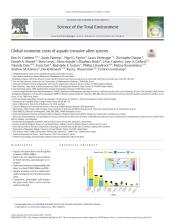
Global Economic Costs of Aquatic Invasive Alien Species
Biodiversity Conservation, BRB
Available Online

Ahmed, Danish A.

,

Angulo, Elena

,

Briski, Elizabeta

,

Capinha, César

,

Catford, Jane A.

,

Cuthbert, Ross N.

,

Dalu, Tatenda

,

Diagne, Christophe

,

Essl, Franz

,

Gozlan, Rodolphe E.

,

Leroy, Boris

,

Pattison, Zarah

,

Taylor, Nigel G.

,

Verbrugge, Laura

2021
Much research effort has been invested in understanding ecological impacts of invasive alien species (IAS) across ecosystems and taxonomic groups, but empirical studies about economic effects lack synthesis. Using a comprehensive global database, we determine patterns and trends in economic costs of aquatic IAS by examining: (i) the distribution of these costs across taxa, geographic regions, and cost types; (ii) the temporal dynamics of global costs; and (iii) knowledge gaps, especially compared to terrestrial IAS. Based on the costs recorded from the existing literature, the global cost of aquatic IAS conservatively summed to US$345 billion, with the majority attributed to invertebrates (62%), followed by vertebrates (28%), then plants (6%). The largest costs were reported in North America (48%) and Asia (13%) and were principally a result of resource damages (74%); only 6% of recorded costs were from management. The magnitude and number of reported costs were highest in the United States of America and for semi-aquatic taxa. Many countries and known aquatic alien species had no reported costs, especially in Africa and Asia. Accordingly, a network analysis revealed limited connectivity among countries, indicating disparate cost reporting. Aquatic IAS costs have increased in recent decades by several orders of magnitude, reaching at least US$23 billion in 2020. Costs are likely considerably underrepresented compared to terrestrial IAS; only 5% of reported costs were from aquatic species, despite 26% of known invaders being aquatic. Additionally, only 1% of aquatic invasion costs were from marine species. Costs of aquatic IAS are thus substantial, but likely underreported. Costs have increased over time and are expected to continue rising with future invasions. We urge increased and improved cost reporting by managers, practitioners and researchers to reduce knowledge gaps. Few costs are proactive investments; increased management spending is urgently needed to prevent and limit current and future aquatic IAS damages.
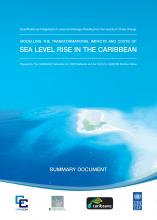
Quantification and magnitude of losses and damages resulting from the impacts of climate change: modelling the transformational impacts and costs of sea level rise in the Caribbean
Climate Change Resilience
Available Online

Simpson, M.C...[et al.]

2010
The inextricable links between climate change and sustainable development have been increasingly recognised over the past decade. In 2007, the Intergovernmental Panel on Climate Change (IPCC)1 concluded with very high confidence that climate change would impede the ability of many nations to achieve sustainable development by mid-century and become a security risk that would steadily intensify, particularly under greater warming scenarios. Article 4.8 of the United Nations Framework Convention on Climate Change (UNFCCC) lists several groups of countries that merit particular consideration for assistance to adapt to climate change “especially: (a) small island countries, (b) countries with low-lying coastal areas, c) countries with areas prone to natural disasters.” Small Island Developing States (SIDS) have characteristics which make them particularly vulnerable to the effects of climate change, sea level rise (SLR) and extreme events, including: relative isolation, small land masses, concentrations of population and infrastructure in coastal areas, limited economic base and dependency on natural resources, combined with limited financial, technical and institutional capacity for adaptation.2