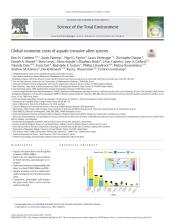
Global Economic Costs of Aquatic Invasive Alien Species


Biodiversity Conservation, BRB
Available Online
Ahmed, Danish A.
,
Angulo, Elena
,
Briski, Elizabeta
,
Capinha, César
,
Catford, Jane A.
,
Cuthbert, Ross N.
,
Dalu, Tatenda
,
Diagne, Christophe
,
Essl, Franz
,
Gozlan, Rodolphe E.
,
Leroy, Boris
,
Pattison, Zarah
,
Taylor, Nigel G.
,
Verbrugge, Laura
2021
Much research effort has been invested in understanding ecological impacts of invasive alien species (IAS) across ecosystems and taxonomic groups, but empirical studies about economic effects lack synthesis. Using a comprehensive global database, we determine patterns and trends in economic costs of aquatic IAS by examining: (i) the distribution of these costs across taxa, geographic regions, and cost types; (ii) the temporal dynamics of global costs; and (iii) knowledge gaps, especially compared to terrestrial IAS. Based on the costs recorded from the existing literature, the global cost of aquatic IAS conservatively summed to US$345 billion, with the majority attributed to invertebrates (62%), followed by vertebrates (28%), then plants (6%). The largest costs were reported in North America (48%) and Asia (13%) and were principally a result of resource damages (74%); only 6% of recorded costs were from management. The magnitude and number of reported costs were highest in the United States of America and for semi-aquatic taxa. Many countries and known aquatic alien species had no reported costs, especially in Africa and Asia. Accordingly, a network analysis revealed limited connectivity among countries, indicating disparate cost reporting. Aquatic IAS costs have increased in recent decades by several orders of magnitude, reaching at least US$23 billion in 2020. Costs are likely considerably underrepresented compared to terrestrial IAS; only 5% of reported costs were from aquatic species, despite 26% of known invaders being aquatic. Additionally, only 1% of aquatic invasion costs were from marine species. Costs of aquatic IAS are thus substantial, but likely underreported. Costs have increased over time and are expected to continue rising with future invasions. We urge increased and improved cost reporting by managers, practitioners and researchers to reduce knowledge gaps. Few costs are proactive investments; increased management spending is urgently needed to prevent and limit current and future aquatic IAS damages.